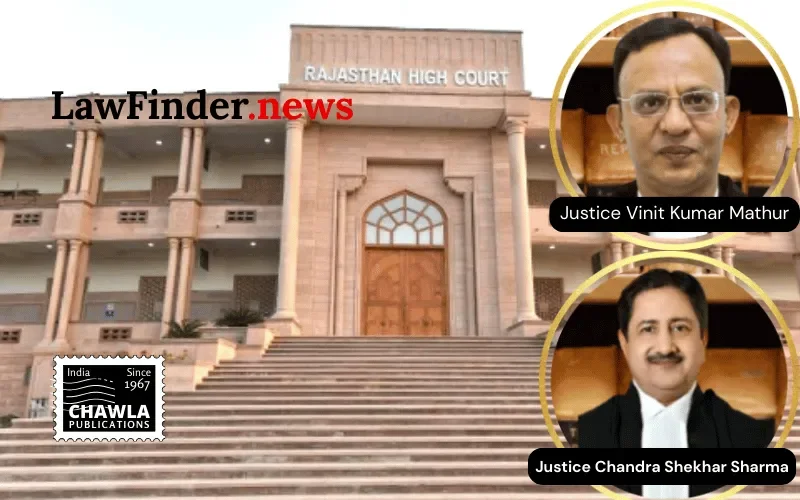
Court Seeks Detailed Affidavit on Steps for Effective Management, Urges Consideration of Petitioner's Suggestions for Educational Reforms and Compliance
In a significant judgment delivered on September 28, 2026, the Rajasthan High Court (Division Bench comprising Justices Vinit Kumar Mathur and Chandra Shekhar Sharma) addressed critical concerns related to the governance and functioning of approximately 3,000 Madarsas operating within the State of Rajasthan. The writ petitions filed by petitioner Pratipal Singh brought to the court's attention the glaring absence of effective control, supervision, and regulatory oversight by the State and competent educational authorities over these religious educational institutions.
The petitioner challenged the adequacy of the Rajasthan Madarsa Board Act, 2020, asserting that it lacks robust provisions to ensure proper management and imparting of education by qualified teachers. The petitioner also highlighted that the existing guidelines for Madarsa operations are insufficient for effective governance and called for the establishment of a comprehensive mechanism to regulate these institutions.
The court acknowledged the gravity of the issue and directed the State Government to file a detailed affidavit outlining the effective steps it proposes to take for the proper management, control, and operation of Madarsas across Rajasthan. The court emphasized that the State's response should incorporate the extensive suggestions put forth by the petitioner aimed at the betterment of children studying in Madarsas.
Key suggestions submitted by the petitioner include:
- Identification and reporting of Madarsas conducting secondary and senior secondary education affiliated with RBSE and CBSE, with a proposal to cancel their registration under the Madarsa Board if they function as secondary schools.
- Re-examination or cancellation of registration/affiliation of recognized schools running Madarsa institutions at the secondary level.
- Cessation of grants and assistance to Madarsas that have secondary/senior secondary education affiliations with other boards, coupled with cancellation of their Madarsa Board registration.
- Development of a state-prepared syllabus for primary and upper primary Madarsas aligned with a common examination system administered by District Institutes of Education and Training (DIETs).
- Creation of a digital portal to maintain student data, assigning unique identification numbers linked to Aadhaar for tracking educational progress.
- Ensuring that only teachers holding qualified diplomas or degrees in education are remunerated and continue in contractual roles, discontinuing unqualified teaching staff.
- Prohibition of State funds being used to pay salaries of religious teachers such as Maulvis, Muftis, and Imaams appointed by private Madarsa bodies.
- Investigation into allegations of illegalities and fraud in Madarsas based on recommendations by district education officers.
- Direction to prevent admission of non-Muslim children in Madarsas for religious education, and ensuring their enrollment in schools governed by the Right to Education Act, 2009.
- Guaranteeing that all Muslim children attending Madarsas receive school education in accordance with the Right to Education Act.
- Identification and closure of unregistered or non-compliant Madarsas involved in educational activities, with reversion of land to district authorities where applicable.
The Additional Advocate General, Mr. B.L. Bhati, was tasked with responding to these issues and suggestions through a comprehensive affidavit, ensuring that the State's regulatory framework for Madarsas meets educational standards and protects the rights and futures of children studying therein.
The court has scheduled the next hearing on October 27, 2026, to review the State's affidavit and determine the appropriate course of action.
This judgment underscores the judiciary's role in safeguarding educational quality and regulatory compliance in minority educational institutions, balancing religious freedom with the State's duty to ensure standardized and quality education for all children.
Bottom Line:
Madarsas - Regulation and governance - Rajasthan High Court sought detailed affidavit from State on effective steps for management, control and operation of approximately 3,000 Madarsas in State - State also directed to consider suggestions made by petitioner regarding affiliation, syllabus, teacher qualification, grants, student data, inspections and compliance with educational norms.
Statutory provision(s):
Rajasthan Madarsa Board Act, 2020; Right to Education Act, 2009; National Education Policy, 2020
Pratipal Singh v. State of Rajasthan, (Rajasthan)(DB) : Law Finder Doc Id # 2990621