Court holds denial of cohabitation and lodging of false criminal case amount to cruelty under Section 13(1)(ia) of Hindu Marriage Act, 1955; marriage dissolved after 14 years of separation
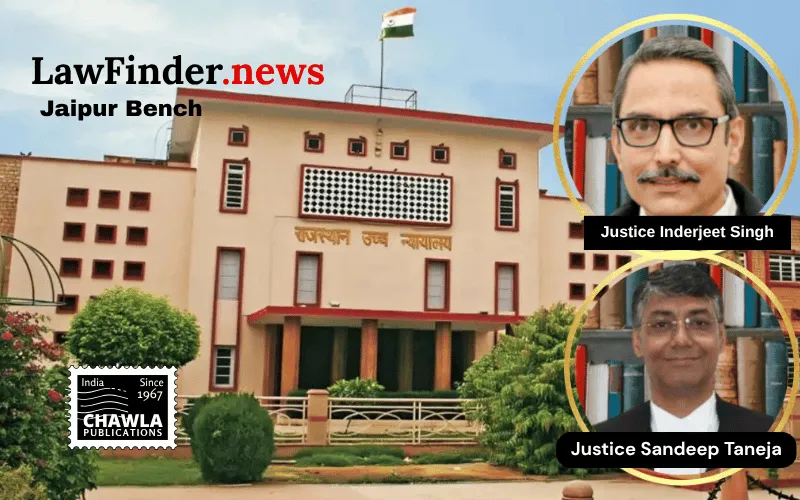
In a significant judgment delivered on September 1, 2026, the Rajasthan High Court (Jaipur Bench) allowed the appeal filed by Manoj Kumar Yadav, dissolving his marriage with Saroj Devi on the grounds of cruelty under Section 13(1)(ia) of the Hindu Marriage Act, 1955. The Division Bench comprising Justices Inderjeet Singh and Sandeep Taneja set aside the earlier decision of the Additional District Judge, Kishangarhbas (Alwar), which had dismissed the husband's petition for divorce.
The couple was married on April 29, 2004, and has one daughter. The husband alleged that the wife denied cohabitation from 2005 onwards and lodged a false criminal complaint against him under Sections 498A (dowry harassment) and 406 (criminal breach of trust) of the Indian Penal Code. The husband was acquitted of all charges by the Judicial Magistrate at Rewari on September 2, 2015. Both parties have been living separately since 2010, with no possibility of reconciliation.
The wife refuted the allegations, claiming the husband was abusive and that the criminal case was warranted due to dowry demands. She also asserted willingness to resume marital life, stating the husband had expelled her from the matrimonial home.
After considering the evidence, including witness testimonies and documentary proof such as the acquittal order, the High Court held that denial of cohabitation and the lodging of false criminal cases constitute cruelty. The Court relied heavily on Supreme Court precedents, notably:
- - Rakesh Raman v. Kavita (2023), which interprets cruelty as conduct causing mental or physical harm, including prolonged refusal of marital relations without valid reason;
- - Narasimha Sastry v. Suneela Rani (2020), which clarifies that acquittal in a false dowry harassment case can be a ground for cruelty;
- - Parveen Mehta v. Inderjit Mehta (2002), which distinguishes cruelty from ordinary matrimonial discord.
The Court observed that the prolonged separation of over a decade, coupled with the absence of cohabitation and mutual bitterness, rendered the marriage a "fiction" and that forcing the parties to remain married would itself amount to cruelty.
Accordingly, the High Court allowed the appeal, dissolved the marriage, and directed the preparation of the divorce decree. The judgment underscores the judiciary's recognition of mental cruelty arising from denial of marital obligations and misuse of criminal law as valid grounds for divorce.
This ruling serves as a precedent emphasizing that in matrimonial disputes, not only physical cruelty but also acts such as false litigation and abandonment can constitute cruelty under the Hindu Marriage Act, thereby justifying divorce.
Bottom Line:
In matrimonial disputes, denial of co-habitation and lodging of false criminal cases by one spouse against the other amounts to cruelty and can be a valid ground for dissolution of marriage under Section 13(1)(ia) of the Hindu Marriage Act, 1955.
Statutory provision(s):
Hindu Marriage Act, 1955 Section 13(1)(ia), Indian Penal Code Sections 498A, 406
Manoj Kumar Yadav v. Saroj Devi, (Rajasthan)(DB)(Jaipur Bench) : Law Finder Doc Id # 2975268