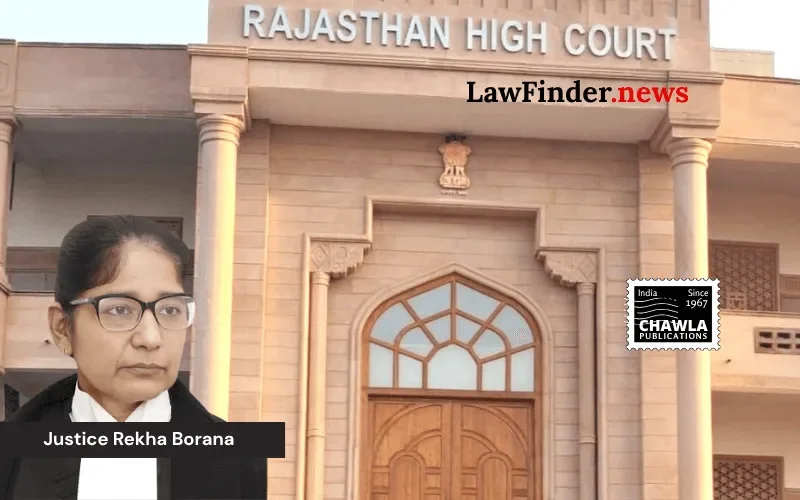
Court holds mere communication role insufficient for framing charges under Prevention of Corruption Act Section 7A and IPC Section 120B; stresses rigorous scrutiny before trial.
In a significant judgment delivered on October 27, 2026, the Rajasthan High Court, presided over by Justice Rekha Borana, quashed charges framed against advocate Balvindra Singh under Section 7A of the Prevention of Corruption (PC) Act, 2018, and Section 120B of the Indian Penal Code (IPC). The charges arose from allegations related to an illegal gratification demand involving public servants.
The petitioner, Balvindra Singh, a practicing lawyer, was accused alongside two others for allegedly mediating in a corrupt transaction. However, the Court found that his role was limited to acting as a communicator within the chain of events, without independently soliciting or accepting any illegal gratification. Crucially, since he was not a public servant, the Court held that Section 7A of the PC Act, which penalizes the acceptance of undue advantage to influence public servants, was inapplicable to him.
Senior Advocate Vineet Jain, appearing for the petitioner, argued that the trial court had failed to properly sift and weigh the evidence before framing charges and had acted merely as a conduit for the prosecution’s case. The Advocate emphasized that the petitioner’s involvement was restricted to communication and there was no material to indicate a direct nexus to corruption.
Referring to authoritative judgments, including the Supreme Court’s ruling in Union of India v. Prafulla Kumar Samal (1979) 3 SCC 4 and a recent Rajasthan High Court decision in Jitendra Singh v. State of Rajasthan, the Court reiterated the legal principle that a charge can only be framed when there is grave suspicion supported by material indicating the accused’s complicity. Mere casual communication or presence in conversations does not amount to criminal conspiracy under Section 120B IPC unless there is clear evidence of a meeting of minds to commit an illegal act.
The Court noted that the trial court had overlooked these aspects and proceeded to frame charges without recording specific findings or analyzing the material on record. It emphasized that a trial judge is required to consider the broad probabilities and not act as a mere mouthpiece of the prosecution.
Consequently, the High Court allowed the criminal revision petition, quashing the charges against Balvindra Singh. He was discharged from the offences under both Section 7A of the Prevention of Corruption Act and Section 120B of the IPC.
This judgment underscores the judiciary’s insistence on rigorous preliminary scrutiny before subjecting accused persons to the rigors of a criminal trial, particularly in corruption cases where reputational damage is substantial. It highlights the importance of distinguishing between active participation in corrupt acts and passive roles such as communication without independent demand or acceptance of gratification.
Bottom Line:
Framing of charges under Section 7A of the Prevention of Corruption Act, 2018, and Section 120B of IPC against a private advocate-A mere role as a communicator without any independent demand, solicitation, or acceptance of illegal gratification does not attract Section 7A of the PC Act. Similarly, casual communication or presence in a chain of conversations without evidence of meeting of minds or shared unlawful intent cannot justify charges under Section 120B of IPC.
Statutory provision(s):
Section 7A of the Prevention of Corruption (Amendment) Act, 2018, Section 120B of the Indian Penal Code, 1860
Balvindra Singh v. State of Rajasthan, (Rajasthan) : Law Finder Doc Id # 3163300