Division Bench holds that unauthorized absence is not misconduct unless proved willful; also finds disciplinary action vitiated for non-supply of enquiry report.
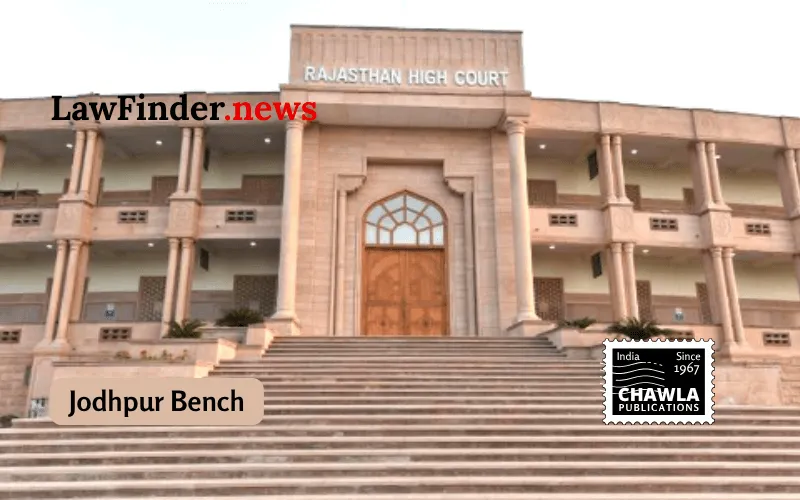
The Rajasthan High Court has set aside the termination of a deceased constable who had been dismissed from service for alleged unauthorized absence, holding that the department failed to prove that his absence was willful or deliberate. The Court also found a violation of natural justice because the enquiry report was not supplied to him before the final punishment order was passed.
A Division Bench comprising Chief Justice Sanjay K. Agrawal and Justice Vinit Kumar Mathur allowed the special appeal filed by the widow of the deceased government servant, who had challenged the dismissal order as well as the earlier judgment of the Single Judge.
The appellant’s husband had joined service as a constable in 1979. According to the record, he suffered from tuberculosis and remained absent from duty on several occasions in 1994 due to prolonged illness and deteriorating health. A departmental enquiry was initiated against him under Rule 16 of the Rajasthan Civil Services (Classification, Control and Appeal) Rules, 1958, and six charges of absence from duty were framed.
During the enquiry, defence witnesses supported the constable’s version and stated that he was unwell and undergoing treatment for tuberculosis. Despite this, the enquiry officer held him guilty, and the disciplinary authority imposed the penalty of termination on 26 October 1996.
Before the High Court, the widow argued that the absence was not intentional but caused by compelling medical circumstances. She also contended that the enquiry report was never supplied to her husband, depriving him of the opportunity to make a representation before the punishment was finalized.
The Court accepted both submissions. Relying on Supreme Court precedents including Krushnakant B. Parmar v. Union of India, Chhel Singh v. M.G.B. Gramin Bank, Union of India v. Mohd. Ramzan Khan, and H.P. State Electricity Board Ltd. v. Mahesh Dahiya, the Bench reiterated that mere unauthorized absence does not automatically amount to misconduct. The department must prove that the absence was willful. Where absence is caused by illness or other compelling circumstances, it cannot be treated as deliberate misconduct.
The Court found that the department had failed to establish willful absence. On the contrary, the evidence on record showed that the constable was suffering from tuberculosis and had remained absent because of prolonged illness. The Bench further held that non-supply of the enquiry report before the imposition of a major penalty amounted to a clear violation of the principles of natural justice.
Setting aside both the termination order and the Single Judge’s judgment, the High Court allowed the appeal. Since the employee had already died, the Court directed that his widow would be entitled to all consequential service and retiral benefits within 45 days from receipt of a certified copy of the order.
Bottom Line :
Service Law - Termination on ground of unauthorized absence cannot be sustained unless department proves that absence was willful and deliberate - Absence due to prolonged illness like tuberculosis is not misconduct when compelling circumstances are established - Non-supply of enquiry report before imposition of major penalty violates principles of natural justice - Widow of deceased employee held entitled to consequential service/retiral benefits.
Statutory provision(s): Rajasthan Civil Services (Classification, Control and Appeal) Rules, 1958, Rule 16, Rule 16(10)
Heera Mani v. State of Rajasthan, (Rajasthan)(DB) : Law Finder Doc id # 2987146