Court holds that reliance on inflated CPWD rates instead of State PWD rates led to erroneous valuation; rejects mechanical dismissal of assessee’s objections; upholds constitutional writ jurisdiction in absence of valid reassessment foundation
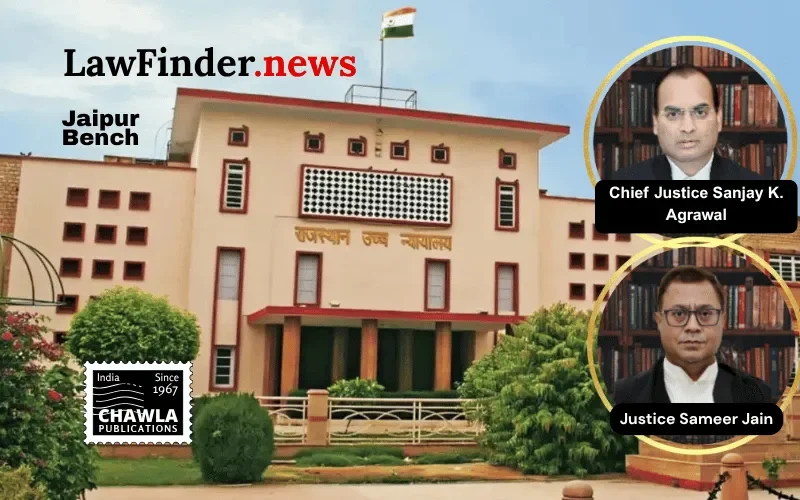
In a significant judgment delivered on November 18, 2026, the Division Bench of the Rajasthan High Court (Jaipur Bench) comprising Chief Justice Sanjay K. Agrawal and Justice Sameer Jain has quashed reassessment proceedings initiated by the Deputy Commissioner of Income Tax against Geeta Devi Jain for the Assessment Year 2014-15. The Court held that the reopening of income tax assessment cannot be based solely on the Departmental Valuation Officer’s (DVO) report without the Assessing Officer independently applying mind and forming a legally sustainable belief regarding escaped income.
The petitioner, Geeta Devi Jain, had challenged the reassessment notices and related orders issued under Sections 148A, 148, and 142(1) of the Income Tax Act, 1961. The reassessment was initiated on the basis of the DVO report that allegedly showed unexplained investment in the construction of house property. However, the petitioner contended that the DVO report alone does not constitute valid information for reopening assessments, relying on the Supreme Court’s precedent in Asstt. CIT v. Dhariya Construction Co. The initial additions made in the original assessment had already been deleted by the Commissioner of Income Tax (Appeals) due to lack of incriminating material found during search proceedings.
Further, the petitioner argued that the DVO had erred by adopting Central Public Works Department (CPWD) rates for property valuation instead of the applicable State Public Works Department (PWD) rates, which inflated the valuation and led to an incorrect computation of alleged escaped income. This incorrect valuation affected the limitation period for reassessment, as the escaped income would have fallen below the Rs. 50 lakh threshold had the correct State PWD rates been applied.
The Court examined these contentions in detail and underscored that the opinion of the DVO, by itself, is not “information” warranting reopening under Section 147 of the Income Tax Act. The Assessing Officer must independently examine all relevant material and form a valid belief about income escapement. The impugned orders failed to demonstrate that the Assessing Officer applied independent mind or addressed binding Supreme Court precedents on this issue.
The Court also highlighted that the respondent authority rejected the petitioner’s detailed objections mechanically and without passing a reasoned speaking order, violating settled principles of natural justice and judicial accountability as laid down in GKN Driveshafts (India) Ltd. v. Income Tax Officer. The necessity of a speaking order is to ensure due consideration of objections raised by the assessee, which was absent in this case.
Rejecting the respondents’ plea that the petitioner had an alternative statutory remedy and thus the writ petition was premature, the Court invoked exceptions to the rule of exhaustion of alternative remedies. It held that where reassessment proceedings are wholly without jurisdiction or fundamental legal principles are violated, writ jurisdiction under Article 226 of the Constitution is maintainable.
The Court further referred to the Supreme Court’s ruling in CIT, Ajmer v. Sunita Mansingha to stress that valuation of construction cost should be based on State PWD rates, not CPWD rates, for accurate and lawful assessment. The erroneous valuation methodology adopted by the DVO was a jurisdictional infirmity affecting the limitation period under Section 149 of the Income Tax Act.
Accordingly, the Rajasthan High Court quashed the impugned order dated April 29, 2024, issued under Section 148A(d), the consequential notice under Section 148, and all subsequent reassessment proceedings including the notice under Section 142(1). The Court directed the Income Tax authorities to adhere strictly to statutory requirements and binding judicial precedents while initiating reassessment proceedings.
No order as to costs was made, and pending applications were disposed of. The judgment applies mutatis mutandis to all connected writ petitions challenging similar reassessment proceedings.
This decision reaffirms the principle that tax authorities must exercise independent judgment rather than mechanically relying on valuation reports and must respect procedural safeguards and limitation periods, ensuring fairness and legality in reassessment proceedings.
Bottom Line:
Reassessment proceedings under the Income Tax Act, 1961, cannot solely rely on the Departmental Valuation Officer's (DVO) report as valid information for reopening an assessment. The Assessing Officer must independently examine the material and form a legally sustainable belief regarding income escapement.
Statutory provision(s):
Income Tax Act, 1961 Sections 132(1), 139(1), 142(1), 142A, 143(3), 148, 148A, 149, 153A, 260A; Constitution of India Article 226