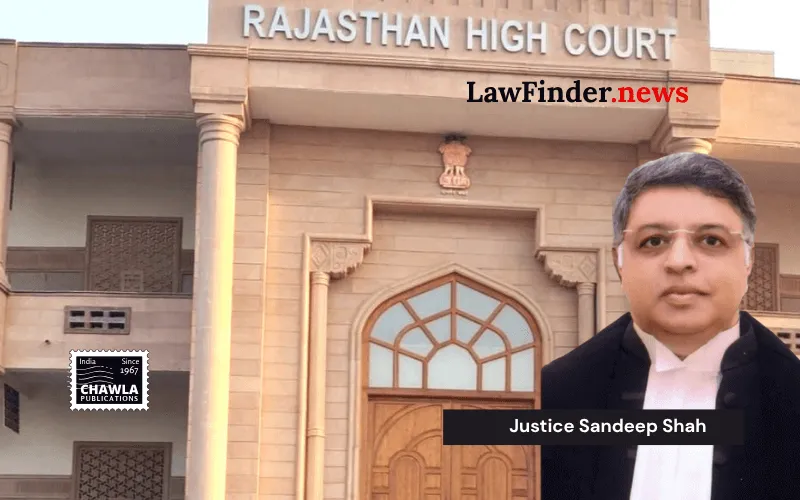
Court affirms prima facie conscious possession by accused, validates search under Section 42 NDPS Act, and stresses twin conditions of Section 37 for bail in commercial quantity narcotics cases
In a significant judgment dated October 6, 2026, the Rajasthan High Court, presided over by Mr. Justice Sandeep Shah, dismissed the bail application of Shakoor Khan, accused in a narcotic drugs case involving the recovery of 210 kilograms of poppy husk, a quantity far exceeding the commercial threshold under the Narcotic Drugs and Psychotropic Substances Act, 1985 (NDPS Act). The accused had challenged the rejection of his bail by the Additional Sessions Judge (Special Judge NDPS Cases), Phalodi.
The case arose from the seizure of 210 kg of poppy husk from a shed near the residence of the accused's father-in-law, Ilmuddin, in District Phalodi. The prosecution's case was founded on prior secret information specifically implicating the accused in the concealment of the contraband. On the day of the raid, the accused was present at the location and attempted to flee upon police arrival, leading to his apprehension. Eleven plastic bags containing the narcotics were recovered from the shed, which stood in the name of the father-in-law.
The defence contended that mere presence at the site and the ownership of the shed by the father-in-law did not establish conscious possession, an essential element under Sections 8 and 15 of the NDPS Act for proving involvement in narcotic offenses. They also argued that the search was conducted by an officer not authorized under Section 42 of the NDPS Act since the investigating Sub-Inspector was from a different police station (Bhojasar) than the site of the recovery (Lohawat), and alleged non-communication of grounds for arrest, violating Article 22(1) of the Constitution.
Rejecting these contentions, the High Court meticulously analyzed the law relating to possession under narcotic laws. Citing Supreme Court precedents such as Mohan Lal v. State of Rajasthan (2015) and Madan Lal v. State of H.P. (2003), the court emphasized that possession includes both actual and constructive possession, requiring knowledge of the narcotics and intention to exercise control, whether sole or joint. The court found that the accused's attempt to escape, prior information specifically naming him, the recovery of contraband from the shed near his father-in-law's house, and corroborative evidence such as phone call and location data prima facie established conscious possession.
On the legality of the search, the Court noted that the Sub-Inspector, Mr. Dalpat Singh, was posted as Station House Officer (SHO) of Bhojasar police station but had been officially given charge of the Lohawat police station by the Superintendent of Police due to the regular SHO's medical leave. A state government notification empowered all Inspectors and Sub-Inspectors posted as SHOs to exercise powers under Section 42 of the NDPS Act regardless of their usual territorial posting. The Court held that the search was conducted by an empowered officer, compliant with statutory requirements, and there was no material to invalidate the proceedings.
Regarding the alleged non-communication of the grounds for arrest, the Court examined the contemporaneous seizure and arrest records which explicitly stated that the accused was informed of the grounds for arrest after the recovery was made. Highlighting that this objection was raised belatedly at the hearing stage without prior mention in remand or earlier bail proceedings, the Court declined to accept this ground.
Addressing the plea of prolonged incarceration, the Court observed that the accused had been in custody since March 14, 2024, for about one year and seven months. However, it found that mere duration of custody is insufficient to grant bail in cases involving commercial quantities under Section 37 of the NDPS Act. The Court reiterated the twin conditions under Section 37(1)(b) - satisfaction that the accused is not guilty and is not likely to commit an offense while on bail - must be fulfilled before bail can be granted. Since the accused had not undergone half the maximum sentence prescribed (10-20 years), and no such satisfaction was recorded, bail was rightly refused.
The judgment also referenced the Bharatiya Nagarik Suraksha Sanhita, 2023, particularly Section 483 concerning bail, and Section 479 relating to maximum undertrial detention, emphasizing their application in harmonizing constitutional rights with the special law's rigour.
In conclusion, the Rajasthan High Court dismissed the bail application, underscoring that the trial court must proceed independently on merits and evidence. The judgment reinforces the strict approach towards bail in narcotics cases involving commercial quantities, confirming that possession, authorization of officers, and procedural compliance are critical factors in upholding prosecution cases under the NDPS Act.
Bottom Line:
NDPS Act - Bail in case involving commercial quantity of poppy husk - Mere presence at place of recovery, coupled with prior information, conduct of accused, recovery from shed near house of father-in-law, and supporting call/chat and location details, can prima facie indicate conscious/constructive possession - Search by Sub-Inspector posted as SHO held prima facie by empowered officer under State notification and Section 42 compliance found - Plea of non-communication of grounds of arrest rejected on basis of contemporaneous record - Long incarceration of about 1 year and 7 months not by itself sufficient to overcome embargo of Section 37 NDPS Act.
Statutory provision(s):
Narcotic Drugs and Psychotropic Substances Act, 1985 Sections 8, 15, 37, 42, 52; Constitution of India Article 22(1); Bharatiya Nagarik Suraksha Sanhita, 2023 Sections 479, 483
Shakoor Khan v. State of Rajasthan, (Rajasthan) : Law Finder Doc Id # 2992874