Court holds suspension valid despite delay in charge-sheet service, emphasizing protection of complainant and fair inquiry in sexual harassment cases
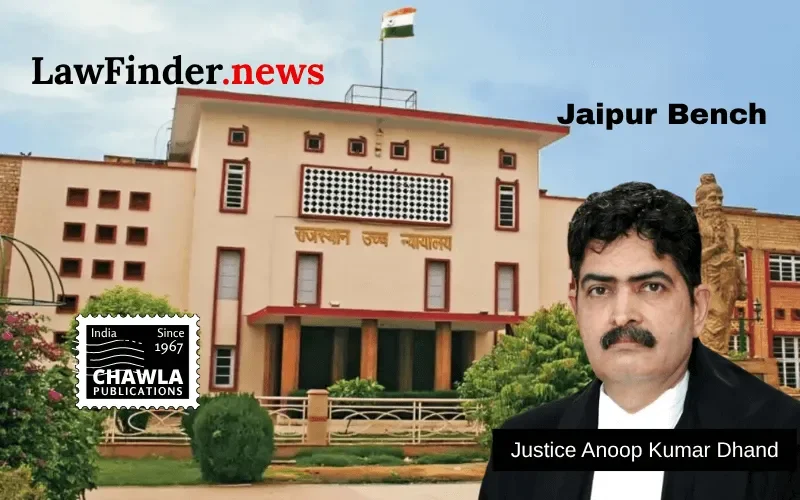
Jaipur, October 8, 2026 - In a significant ruling impacting service law and workplace harassment cases, the Rajasthan High Court has set aside the order of the Rajasthan Civil Services Appellate Tribunal that quashed the suspension of Dr. Rupendra Kumar Sharma, a government medical officer accused of sexual harassment at his workplace. The Court upheld the suspension order issued by the State of Rajasthan in January 2026 under Rule 13 of the Rajasthan Civil Services (Classification, Control & Appeal) Rules, 1958.
Background and Issue:
Dr. Rupendra Kumar Sharma, then serving as Block Chief Medical Officer (BCMO), was suspended on January 16, 2026, following allegations of sexual harassment by a female health worker. The suspension was ordered as an interim administrative measure "in contemplation of disciplinary proceedings" to ensure a fair inquiry and prevent interference with witnesses, particularly the complainant. However, the respondent challenged the suspension before the Rajasthan Civil Services Appellate Tribunal on the ground that no charge-sheet had been served within three months of suspension, as per departmental circulars.
The Tribunal allowed the appeal on March 19, 2026, quashing the suspension order solely because the charge-sheet was not served within the stipulated three-month period. The State challenged this decision before the Rajasthan High Court.
High Court's Analysis:
The Court examined whether the suspension was valid despite the delay in serving the charge-sheet. It clarified that under Rule 13 of the 1958 Rules, suspension can be imposed where disciplinary proceedings are "contemplated or pending." The Court found that although the suspension order did not explicitly use the phrase "contemplation of inquiry," the appended note directing the preparation of a memorandum of charges clearly demonstrated the competent authority's application of mind and intent to initiate disciplinary proceedings.
The Court emphasized that suspension is not a punishment but a temporary administrative measure to ensure the integrity of the inquiry process and protect complainants and witnesses from intimidation or influence. It referred to the Supreme Court's judgment in Union of India v. Ashok Kumar Aggarwal (2013) holding that courts have limited scope to interfere with suspension orders unless mala fide or procedurally improper.
Regarding the three-month charge-sheet service rule, the Court relied on the Supreme Court's decision in Ajay Kumar Choudhary v. Union of India (2015), which mandates review and recording of reasons for extending suspension beyond three months but does not automatically render suspension illegal if the charge-sheet is delayed.
The Court also highlighted the sensitive nature of sexual harassment allegations and the need for courts to exercise caution before interfering with suspension orders in such cases to protect the complainant and maintain inquiry fairness.
Outcome and Directions:
The Rajasthan High Court quashed the Tribunal's order and revived the suspension order dated January 16, 2026. The State was directed to complete the disciplinary inquiry within six months of serving the charge-sheet, ensuring due process and opportunity to the respondent. The Court clarified that it made no comment on the merits of the allegations and that the inquiry officer must conduct proceedings independently.
The Court's ruling sends a clear message that technical delays in charge-sheet service will not automatically invalidate suspension orders, especially in cases involving serious misconduct like sexual harassment, where safeguarding the inquiry process and complainant's interests is paramount.
Legal Significance:
This judgment reinforces the principle that suspension under service rules is an administrative tool to protect the integrity of disciplinary proceedings, not a punishment. It clarifies that courts should not interfere on mere technical grounds such as delay in charge-sheet service, provided there is a bona fide intention to initiate inquiry. The ruling aligns with Supreme Court precedents and emphasizes special care in handling sexual harassment allegations at the workplace.
Bottom Line:
Rajasthan Civil Services (Classification, Control & Appeal) Rules, 1958, Rule 13 - Suspension in contemplation of disciplinary proceedings - Non-service of charge-sheet within three months does not automatically render suspension illegal or liable to be quashed - If intention to initiate inquiry is clear from the suspension order and appended note, omission of the specific phrase "contemplation of inquiry" is a mere irregularity - In matters involving allegation of sexual harassment at workplace, suspension can be continued to ensure fair inquiry and to protect complainant and witnesses.
Statutory provision(s):
Rajasthan Civil Services (Classification, Control & Appeal) Rules, 1958, Rule 13; Sexual Harassment of Women at Workplace (Prevention, Prohibition and Redressal) Act, 2013