Degrees awarded through distance education in engineering by deemed universities declared invalid unless expressly permitted by AICTE; UGC ordered to conduct fresh exams and safeguard affected students amid ongoing recruitment counseling.
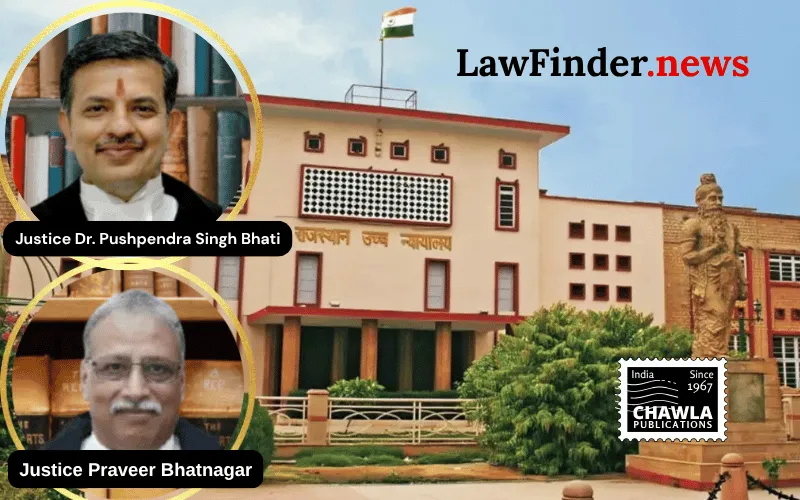
In a landmark judgment delivered on August 11, 2026, the Rajasthan High Court (Division Bench comprising Dr. Pushpendra Singh Bhati and Praveer Bhatnagar, JJ.) ruled that engineering degrees awarded through distance education by deemed universities are invalid unless explicitly permitted by the All India Council for Technical Education (AICTE). The Court held that since AICTE has consistently maintained that engineering courses cannot be offered via distance education mode, deemed universities lacked the authority to introduce such programs without AICTE's clear and unequivocal approval.
The case originated from petitions challenging the validity of engineering degrees granted through distance education by deemed universities. The Court, relying extensively on the Supreme Court's recent decision in University Grants Commission (UGC) v. Annamalai University (2026), reinforced the principle that practical, hands-on training is integral to technical education and cannot be substituted merely by distance learning methods.
To address the fallout from this decision, the Court directed the UGC to take immediate steps to protect the interests of affected students. This includes conducting fresh examinations within a reasonable timeframe, not exceeding one year, for students whose degrees have been suspended. The universities concerned are mandated to provide the UGC with detailed particulars of the affected students within fifteen days to facilitate this process.
The Court also emphasized the necessity of verifying the eligibility and validity of the degrees of such students. The UGC is empowered to affirm valid degrees after due verification. Failure to comply with these directions could expose the UGC to contempt proceedings.
Additionally, the Court addressed the concerns of an appellant undergoing recruitment counseling for the post of Assistant Professor in the Physical Training Instructor cadre under the Rajasthan Public Service Commission (RPSC). It was ordered that the appellant should not be disqualified or removed from the merit list based on the disputed degree status. In case the appellant is found eligible in the counseling, one seat shall be reserved and kept vacant pending the final outcome of the case. However, no final appointment shall be made without the Court's permission.
This ruling underscores the exclusive jurisdiction of AICTE in regulating technical education standards and reaffirms the importance of maintaining rigorous educational norms in engineering courses. It also demonstrates the judiciary's commitment to balancing regulatory compliance with safeguarding student rights and opportunities.
The case has significant implications for distance education providers and students pursuing technical education remotely, reinforcing that without proper statutory and regulatory sanction, such degrees may not be legally recognized.
Bottom Line:
Distance education in technical education - Degrees awarded through distance education mode in engineering by deemed universities stand canceled unless guidelines permitting such courses are expressly issued by AICTE - UGC directed to take steps for protecting students' interests by conducting fresh examinations for affected students.
Statutory provision(s):
University Grants Commission Act, 1956, All India Council for Technical Education Act.