Court Holds Interim Relief Proceedings Under Arbitration and Conciliation Act, 1996 Are Distinct from Civil Suits; Composite Applications Based on Separate Agreements to Be Decided on Merits
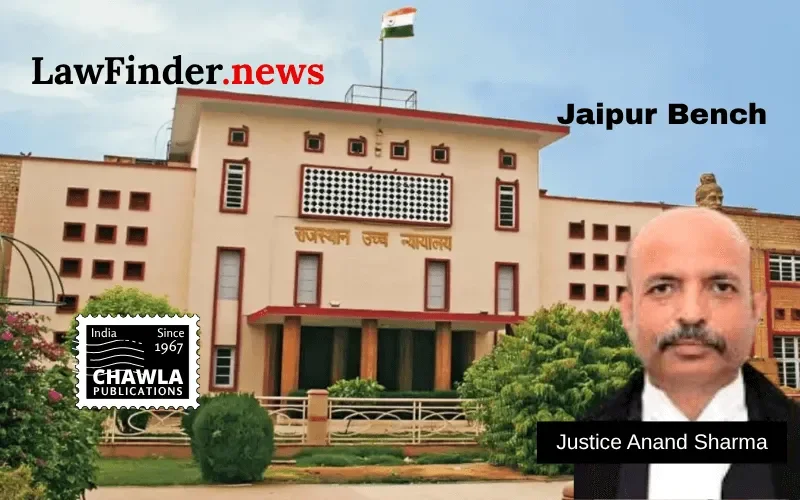
In a significant judgment dated September 29, 2026, the Rajasthan High Court, Jaipur Bench, presided over by Justice Anand Sharma, clarified the procedural approach towards applications filed under Section 9 of the Arbitration and Conciliation Act, 1996. The Court held that such applications seeking interim relief in aid of arbitration proceedings cannot be summarily rejected at the threshold by invoking Order VII Rule 11 of the Code of Civil Procedure (CPC), which pertains to rejection of plaints in civil suits.
The case arose from a dispute between M/s Marudhara Primeinfra Pvt. Ltd. and M/s Lahoty Buildcon Limited, involving two separate agreements executed on November 9, 2024, and June 20, 2025, each containing independent arbitration clauses. Respondent No.1 had filed a composite application under Section 9 of the Arbitration Act for interim measures based on both agreements, which the petitioner challenged on maintainability grounds, contending that separate applications were required due to the independence of the agreements.
The petitioner sought rejection of the composite Section 9 application at the preliminary stage by filing an application under Order VII Rule 11 CPC, arguing that the two agreements related to distinct projects and obligations, and could not be clubbed together. The Commercial Court, however, dismissed the petitioner's application as not maintainable, observing that Section 9 proceedings are interlocutory and distinct from suits, and left the substantive objection regarding maintainability open for final adjudication.
On appeal under Article 227 of the Constitution, the Rajasthan High Court upheld the Commercial Court's approach, emphasizing the nature of Section 9 proceedings as interlocutory applications intended to provide interim protection to preserve the efficacy of arbitration. The Court noted that such applications are not instituted by plaint and do not constitute regular civil suits; hence, the procedural provisions for rejection of plaints under Order VII Rule 11 CPC are not applicable.
The Court referred to precedents from the Supreme Court and various High Courts, including the landmark decision in Firm Ashok Traders & Another v. Gurumukh Das Saluja & Others (2004), which recognized that proceedings under Section 9 are distinct and designed to secure interim relief expeditiously. The Court further noted that objections related to the maintainability of composite applications based on multiple agreements require detailed examination of the agreements, their interrelation, the nature of disputes, and interim relief claimed - matters to be decided on merits by the Commercial Court.
The High Court also clarified that the Commercial Court's decision to keep the substantive objection alive for final hearing did not amount to denial of any right or jurisdictional error warranting interference under supervisory jurisdiction. It reiterated that interlocutory procedural orders are not ordinarily subject to appellate review unless there is patent illegality or grave injustice.
In light of the urgency inherent in Section 9 applications, the Court directed the Commercial Court to dispose of the pending arbitration application expeditiously, preferably within four months from receipt of the judgment copy.
This ruling reinforces the principle that interim relief applications under the Arbitration and Conciliation Act, 1996 require a pragmatic and summary approach, distinct from civil suits, and that procedural technicalities like Order VII Rule 11 CPC rejection are inapplicable at the preliminary stage. It also underscores that disputes over the maintainability of composite applications based on multiple agreements must be determined after a detailed consideration on merits.
Bottom Line:
Arbitration and Conciliation Act, 1996 Section 9 proceedings are for interim measures in aid of arbitration and are not suits - Application under Order VII Rule 11 CPC for rejection of a Section 9 application is not maintainable - Objection that one composite Section 9 application is founded on two separate agreements may be examined by Commercial Court at final hearing - No interference under Article 227 when such objection is kept open.
Statutory provision(s):
Arbitration and Conciliation Act, 1996 Section 9, Code of Civil Procedure, 1908 Order VII Rule 11, Section 151, Constitution of India Article 227