Court emphasizes that confiscation proceedings commence with demand notices under Rajasthan Minor Mineral Concession Rules, 2017; rejects release on personal security without deposit of penalty and cost of minerals.
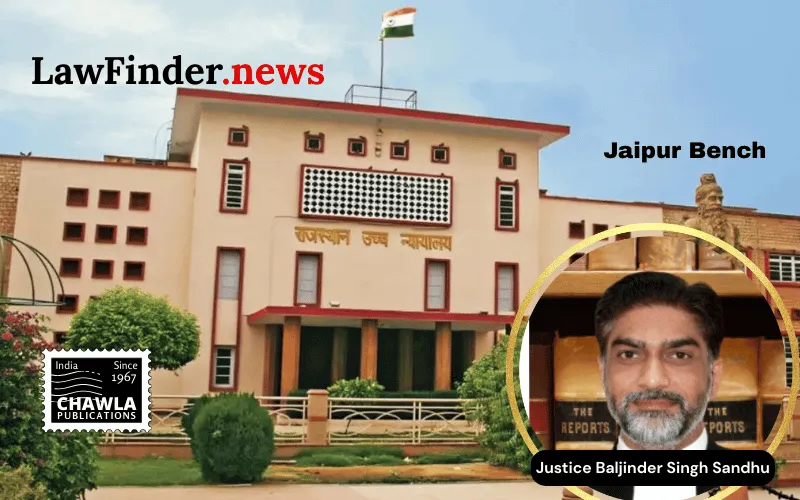
In a significant judgment delivered on August 21, 2026, the Rajasthan High Court, presided by Justice Baljinder Singh Sandhu, upheld the statutory scheme governing the seizure, confiscation, and release of vehicles involved in illegal mining activities. The Court dismissed a batch of petitions filed by vehicle owners challenging the rejection of their applications seeking release of seized vehicles without payment of statutory dues including compounding fees, cost of minerals, and compensation imposed by the National Green Tribunal (NGT).
The seized vehicles, mostly used for illegal mining or transportation of minerals such as bajri/sand, were confiscated under the Mines and Minerals (Development and Regulation) Act, 1957 (MMDR Act), and Rajasthan Minor Mineral Concession Rules, 2017 (MMCR Rules). The vehicles were seized either by police authorities under criminal laws or by mining authorities under MMCR Rules, and many were also seized under the Motor Vehicles Act.
The Court clarified that confiscation proceedings are initiated once the Mining Department determines the liability and issues notices demanding payment of the applicable statutory dues under Rules 54 and 60 of the MMCR Rules. The statutory three-month period provided under Rule 54(6) is an opportunity for the vehicle owners to pay the dues before a final confiscation order is passed by the Magistrate, but does not preclude initiation of confiscation proceedings. Therefore, the confiscation process is deemed to have commenced upon issuance of the demand notices, not merely after the expiry of three months or upon filing of an application in court.
Importantly, the Court observed that criminal prosecution and confiscation proceedings are independent and can proceed simultaneously. The pendency of criminal trials does not bar the Mining Department from pursuing confiscation proceedings. Consequently, the vehicles cannot be released simply on personal security or surety without deposit of the statutory amounts once confiscation proceedings have been set in motion.
The Court underscored the principle of parity, ruling that vehicles seized by police, mining authorities, or under the Motor Vehicles Act must be treated alike. It referred to several precedents including the Supreme Court's judgment in State of Rajasthan v. Jagdish Prasad (2023), and the Division Bench ruling in Khem Singh v. State of Rajasthan (2019), which mandated that release orders must include conditions for payment of compounding fees, cost of minerals, and environmental compensation as fixed by the NGT.
For cases where confiscation proceedings have not yet been initiated, the Court allowed release of vehicles upon furnishing an active bank guarantee equivalent to the penalty amount to secure the state's dues.
The judgment also referred to the Supreme Court's directions in cases concerning illegal sand mining in the National Chambal Sanctuary, emphasizing the need for stringent enforcement through seizure and confiscation of vehicles to ensure effective deterrence of organized illegal mining activities.
The High Court's comprehensive order maintains the integrity of the statutory regime under the MMCR Rules and strengthens enforcement against illegal mining by ensuring that violators cannot circumvent penalties by seeking release of vehicles without compliance with prescribed statutory payments.
Detailed Analysis and Guide:
1. Background:
Vehicles used in illegal mining or illegal transportation of minerals are routinely seized by police or mining authorities under various statutes including the MMDR Act, MMCR Rules, Motor Vehicles Act, and the BNSS. These vehicles are subject not only to criminal prosecution but also to confiscation proceedings aimed at penalizing and deterring illegal mining.
2. Legal Framework:
- Rules 54 and 60 of MMCR Rules, 2017:
- These rules provide a detailed procedure for seizure, demand notices, payment of compounding fees, cost of mineral, environmental compensation, and subsequent confiscation of vehicles or machinery involved in illegal mining.
- Rule 54 deals with illegal mining, transportation, and storage.
- Rule 60 deals with inspection of minerals in transit and empowers officers to seize vehicles without valid transit passes or documents.
- The rules require issuance of notices to vehicle owners demanding payment of dues. Payment within three months avoids confiscation. If dues are not paid, the vehicle can be confiscated by Magistrate order (Rule 54) or by the competent officer (Rule 60).
3. Key Issues Addressed by the Court:
- When do confiscation proceedings commence?
- Can vehicles be released on personal security or surety without payment of statutory dues once confiscation proceedings start?
- Are criminal prosecution and confiscation proceedings independent?
- What is the effect of pendency of criminal trials on confiscation proceedings?
- - Is there parity in treatment of vehicles seized by police and mining departments?
4. Court's Findings:
- Commencement of Confiscation Proceedings:
Confiscation proceedings commence once liability is determined and notices under Rules 54(5) or 60(5) are issued demanding payment. The statutory three-month window is a grace period to pay dues before the final confiscation order; it is not a barrier to the start of confiscation proceedings.
- Release Conditions:
No release on personal security or surety without payment of statutory dues is permissible once confiscation proceedings have been initiated. This is to prevent abuse of the system by violators.
- Criminal Prosecution and Confiscation:
These proceedings are independent and proceed simultaneously. Pendency of criminal cases does not affect confiscation actions.
- Parity of Treatment:
Vehicles seized by police or mining authorities must be treated alike with respect to release conditions.
- Bank Guarantee:
In cases where confiscation proceedings are not initiated, release may be allowed on furnishing an active bank guarantee equivalent to the penalty amount.
- Environmental Compensation:
Compensation as determined by the NGT must be included in statutory dues for release.
5. Implications for Stakeholders:
- Vehicle owners involved in illegal mining must comply with payment demands to secure vehicle release.
- Courts should follow the statutory scheme and not allow release without statutory payments once confiscation proceedings commence.
- Authorities must diligently initiate confiscation proceedings and ensure recovery of dues to deter illegal mining.
- The judgment reinforces environmental protection by ensuring polluters pay fines and compensation.
6. Precedents Cited:
- State of Rajasthan v. Jagdish Prasad (Supreme Court, 2023)
- Sunderbhai Ambalal Desai v. State of Gujarat (2002)
- Khem Singh v. State of Rajasthan (2019)
- Jitendra Meena v. State of Rajasthan (2021)
- Kishore Singh v. State of Rajasthan (2021)
- National Green Tribunal Bar Association v. Virender Singh (NGT Order 2020)
- In Re: Illegal Sand Mining in the National Chambal Sanctuary (Supreme Court, 2026)
7. Conclusion:
The Rajasthan High Court's ruling strengthens the enforcement mechanism against illegal mining by upholding that vehicles seized in such cases can only be released upon payment of all statutory dues after initiation of confiscation proceedings. This ensures effective deterrence against illegal mining and protects public and environmental interests.
Bottom Line:
Vehicles seized in illegal mining cases can be released only upon deposit of statutory dues including compounding fee, cost of mineral, and compensation determined by NGT - Confiscation proceedings are independent of criminal prosecution and once initiated, vehicles cannot be released merely on personal security or surety.
Statutory provision(s):
Section 303(2) of Bharatiya Nagarik Suraksha Sanhita, 2023 (BNSS), Sections 4 and 21 of the Mines and Minerals (Development and Regulation) Act, 1957 (MMDR Act), Sections 207 of the Motor Vehicles Act, 1988, Rules 54 and 60 of Rajasthan Minor Mineral Concession Rules, 2017 (MMCR Rules), Section 503 BNSS (formerly Sections 451/457 CrPC), Section 22 MMDR Act.
Phusaram v. State of Rajasthan, (Rajasthan) : Law Finder Doc Id # 2972624