Court rules that awarding cash compensation and compounded IRR contrary to concession agreement terms is illegal; Corrigendum award exceeding Section 33 scope also quashed.
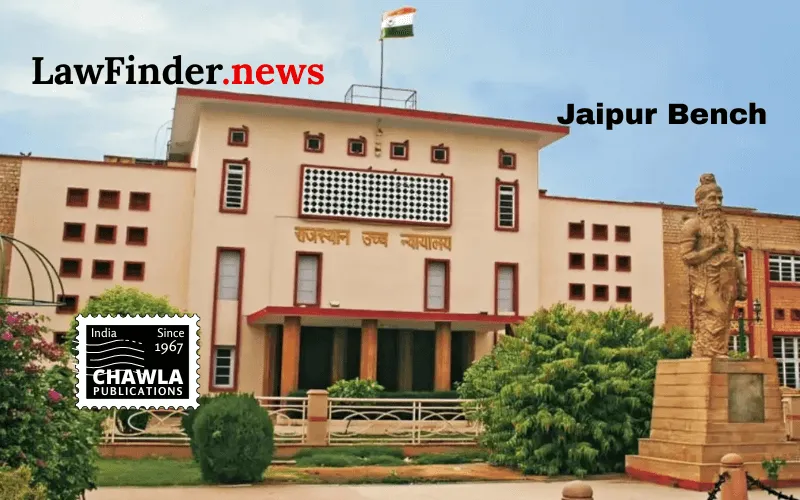
In a significant decision dated August 17, 2026, the Rajasthan High Court (Jaipur Bench) allowed the appeal filed by Jaipur Development Authority (JDA) and another against an arbitral award favoring Rohan Rajdeep Rajasthan Infra Project Limited in a Build-Operate-Transfer (BOT) infrastructure project dispute. The court set aside the arbitral award dated June 25, 2023, and the subsequent corrigendum award dated July 31, 2023, holding that the award suffered from patent illegality, violated public policy, and exceeded the scope of judicial and arbitral jurisdiction.
Background:
The dispute arose from a Tripartite Concession Agreement signed on November 27, 2009, between the Government of Rajasthan, JDA, and the respondent-concessionaire for construction, operation, and maintenance of an alternate tunnel route to "Ghat Ki Guni," Jaipur, on a DBFOT (Design-Build-Finance-Operate-Transfer) basis. The project’s original bid cost was Rs. 150 crores with a concession period of 13 years, 5 months, and 20 days.
Claims and Award:
The concessionaire claimed an increase in project cost (Rs. 175.67 crores), loss of toll revenue (Rs. 188.02 crores), compensation for toll loss due to delay (Rs. 40.71 crores), and loss of advertising revenue (Rs. 8.49 crores). The Arbitral Tribunal allowed the increase in project cost and certain toll loss claims, rejected the delay compensation claim, and allowed advertising loss claims. It awarded the claims along with an Internal Rate of Return (IRR) of 20.33% compounded annually, plus post-award interest at 12% per annum. The corrigendum award deleted the original ceiling of Rs. 198.04 crores, effectively increasing the award to over Rs. 457 crores.
Key Legal Findings:
1. Limitation Plea Rejected: The Court rejected the appellants’ plea that claims were barred by limitation, holding that the cause of action arose only after the Empowered Committee’s rejection of monetary claims in 2015, well within the three-year limitation period.
2. Award of Cash Compensation Contravenes Contract: The court emphasized that the Concession Agreement exclusively provided for compensation through extension of the concession period for delays or changes, with no provision for cash compensation except termination payments. The award granting cash compensation and compounded IRR was held to be a fundamental re-writing of the contract, constituting patent illegality.
3. Design Risk Allocation and DPR Status: The Detailed Project Report (DPR) was only a reference document, not a binding design standard. The concessionaire bore the risk for investigation, survey, and design. The arbitrator's treatment of the DPR as binding and holding the authority liable for its defects was not a possible contractual interpretation and thus illegal.
4. No Identified Breach by Authority: The arbitrator failed to pinpoint any contractual breach by the authority. Compensation without breach is impermissible under Indian Contract Act Sections 54, 55, and 73, rendering the award illegal.
5. IRR Mischaracterized as Interest: The IRR at 20.33% is a financial appraisal metric, not a contractual rate of interest or guaranteed return. Awarding IRR as compound interest without statutory or contractual basis inflated the award unreasonably, shocking the court’s conscience.
6. Corrigendum Award Exceeds Section 33 Scope: The deletion of the ceiling amount, resulting in an exponential increase in the award, was a substantive modification beyond correction of clerical errors allowed under Section 33 of the Arbitration and Conciliation Act, 1996.
7. Claims Beyond Contractual Obligations: The court found the imposition of damages for residual traffic leakage on the old road and allowance of demonetization claims without mandatory certification as beyond contract terms and perverse.
8. Commercial Court’s Failure to Exercise Jurisdiction: The lower Commercial Court was faulted for merely reiterating limited interference principles under Section 34 without applying them to the specific objections, amounting to failure to exercise jurisdiction.
Conclusion and Order:
The Rajasthan High Court held that the arbitral award and corrigendum suffered from patent illegality, were internally contradictory, and violated fundamental contractual principles and public policy. The appeal was allowed, the arbitral awards and the Commercial Court's order were set aside, and parties were directed to bear their own costs. Any amounts deposited or recovered pursuant to the award were ordered to abide by law.
This ruling reiterates the strict judicial approach to arbitral awards that contravene clear contractual terms, especially in DBFOT infrastructure projects where risk allocation and remedies are contractually defined.
Bottom Line :
Jurisdiction of Court to interfere with Arbitral Award - Arbitral award awarding cash compensation and compounded IRR in a DBFOT concession contract, contrary to contract terms providing only for extension of concession period as remedy, constitutes patent illegality and is liable to be set aside.
Statutory provision(s):
Arbitration and Conciliation Act, 1996 Sections 11, 16, 21, 28(3), 31, 33, 34, 37; Indian Contract Act, 1872 Sections 54, 55, 73; Interest Act; Rajasthan Road Development Act, 2002