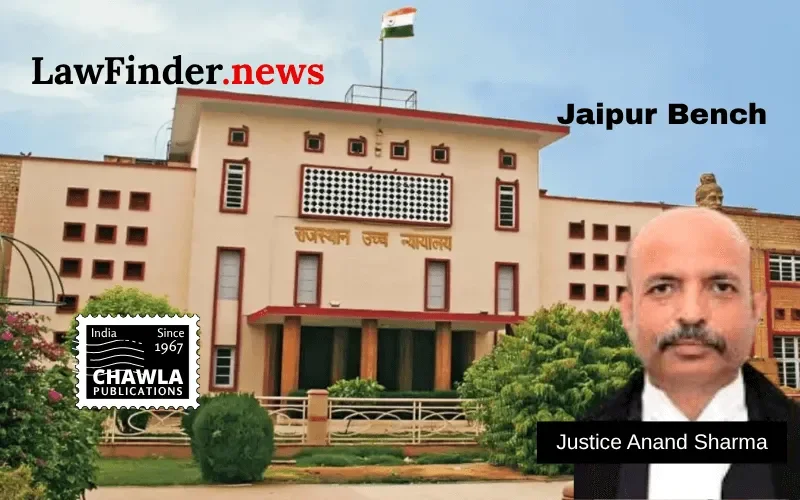
Court Emphasizes Summary Nature of Section 9 Proceedings Under Arbitration Act, Warns Against Routine Cross-Examination to Avoid Delays
In a significant judgment delivered on November 4, 2026, the Rajasthan High Court (Jaipur Bench) quashed an order of the Commercial Court No. 1, Jaipur Metropolitan-II, which had directed the cross-examination of a General Power of Attorney (GPA) holder in arbitration interim relief proceedings under Section 9 of the Arbitration and Conciliation Act, 1996. The writ petition was filed by Sita Devi challenging the Commercial Court’s order dated September 10, 2026, that allowed the respondents’ application under Order XIX Rule 2 read with Section 151 of the Civil Procedure Code (CPC) for cross-examination of the petitioner’s attorney holder.
The petitioner had instituted Section 9 proceedings seeking interim protective measures concerning the affairs and assets of the respondent LLP. The application was filed through her GPA holder, who also filed an affidavit in support. The respondents opposed the application and sought to cross-examine the attorney holder on grounds that he lacked personal knowledge of certain facts stated in the affidavit and questioned the circumstances under which he was authorized.
The Rajasthan High Court, presided over by Justice Anand Sharma, reiterated that proceedings under Section 9 of the Arbitration and Conciliation Act, 1996 are summary and intended solely to provide interim relief pending arbitration. The Court observed that such proceedings do not require a full-fledged trial or adjudication of rights and liabilities. It emphasized that the discretion under Order XIX Rule 2 CPC to direct cross-examination should be exercised judicially and not routinely or as a matter of course, to avoid unnecessary delays.
Drawing upon precedents including the Supreme Court’s recent ruling in Shruti Manav Sharma & Another v. Sunaina Singh & Ors. (2026), the Court underscored that affidavits filed in support of interlocutory applications are not evidence in the strict sense and that objections regarding the personal knowledge of the affidavit deponent or attorney holder do not automatically justify cross-examination. Instead, such objections can be considered by the Court while assessing the evidentiary value of the affidavit.
The judgment also referred to the Rajasthan Arbitration Rules, 2003, highlighting that compliance with Rule 4(1), which prescribes conditions for affidavits sworn by authorized persons, is a matter for the Court’s examination but does not mandate cross-examination as the exclusive remedy for addressing any deficiencies.
Rejecting the Commercial Court’s order as an improper exercise of discretion, the Rajasthan High Court set aside the direction for cross-examination and dismissed the respondents’ application under Order XIX Rule 2 CPC. The Court further directed the Commercial Court to decide the Section 9 application expeditiously, preferably within four weeks, without being influenced by the observations regarding cross-examination, which were confined to procedural aspects and not the merits of the dispute.
This judgment reinforces the principle that interim relief proceedings under the Arbitration Act are intended to be swift and protective, avoiding protracted procedures and mini-trials at the interlocutory stage. It serves as a caution against the routine use of cross-examination in such proceedings, thereby safeguarding the efficacy of interim protection mechanisms in arbitration.
Bottom Line:
Arbitration and Conciliation Act, 1996 - Section 9 proceedings are summary in nature and are intended to provide interim protection; cross-examination of the attorney holder should not be ordered routinely and only when absolutely necessary to decide the controversy.
Statutory provision(s):
Arbitration and Conciliation Act, 1996 Section 9, Civil Procedure Code 1908 Order XIX Rule 2, Section 151, Rajasthan Arbitration Rules 2003 Rule 4(1)
Sita Devi v. ACV Explosives LLP, (Raj)(Jaipur Bench) : Law Finder Doc Id # 3016467