Tribunal's Decision Facilitates Justice in Rent Control Case, Emphasizes Liberal Approach in Procedural Corrections
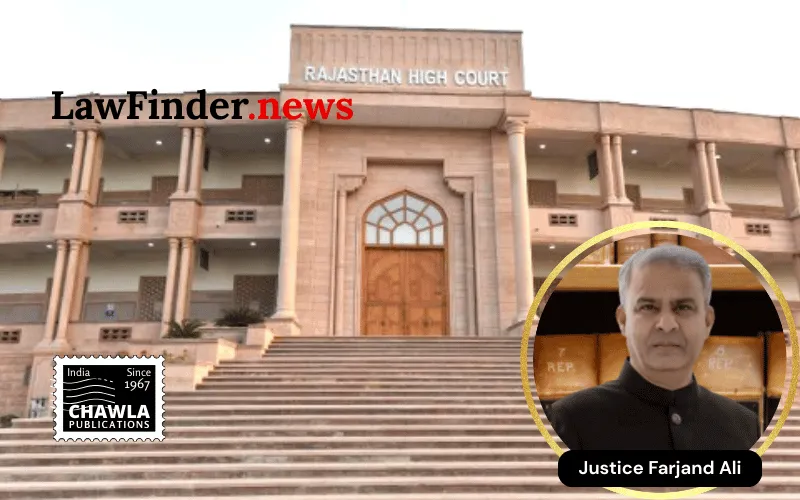
In a significant judgment passed by the Rajasthan High Court, Justice Farjand Ali upheld the decision of the Rent Tribunal, Jodhpur Metropolitan, allowing procedural amendments in an eviction petition. The case, Bharat Lakhani v. Vikas Garg, revolved around procedural corrections sought by the respondent-landlord under the Rajasthan Rent Control Act, 2001, and the Code of Civil Procedure, 1908.
The respondent-landlord, Vikas Garg, had filed eviction proceedings against the legal heirs of Bharat Lakhani under the provisions of the Rajasthan Rent Control Act. During the proceedings, Garg sought to amend the eviction petition and assign exhibit marks to certain documents initially filed but inadvertently left unmarked due to a clerical error. The petitioners, represented by Mr. Praveen Mohan Vyas, opposed these amendments citing prejudice to their case as the proceedings had reached the final argument stage.
Justice Farjand Ali, while dismissing the writ petition challenging the Tribunal's order, emphasized that procedural laws are intended to aid substantive justice rather than obstruct it. He noted that the proposed amendment did not introduce any new pleading or alter the foundation of the eviction proceedings. The correction merely aimed to rectify an inadvertent omission by incorporating references to documents already part of the record.
The court reiterated the principles governing amendments in pleadings, advocating for a liberal approach when such amendments are necessary to determine the real controversy without causing irretrievable prejudice to the parties involved. It underscored that procedural law should not thwart the cause of substantive justice, supporting adjudication on merits rather than technicalities.
Furthermore, the judgment clarified the scope of the High Court's supervisory jurisdiction under Article 227 of the Constitution of India. Justice Ali stated that this jurisdiction is meant to ensure that subordinate courts act within their jurisdiction and is not appellate in nature. Interference is warranted only in cases of manifest illegality, jurisdictional error, or gross failure of justice, none of which were evident in the present case.
This ruling not only facilitated justice in the specific eviction proceedings but also reinforced the judiciary's commitment to ensuring that procedural technicalities do not hinder substantive justice. The judgment serves as a reminder of the importance of a pragmatic approach in procedural matters, supporting the effective resolution of disputes.
Bottom line:-
Amendment of pleadings under Order VI Rule 17 CPC and procedural rectifications - A liberal approach must be adopted if the proposed amendment is necessary for determining the real controversy, does not introduce a fundamentally new or inconsistent case, and does not cause irretrievable prejudice. Procedural laws are meant to aid substantive justice and not to thwart it.
Statutory provision(s):
- Rajasthan Rent Control Act, 2001, Section 21
- Code of Civil Procedure, 1908, Order VI Rule 17
- Code of Civil Procedure, 1908, Order IX Rule 7
- Constitution of India, Article 227
Bharat Lakhani v. Vikas Garg, (Rajasthan) : Law Finder Doc id # 2937608