Court Quashes Election Committee’s Withdrawal of Voter Eligibility Conditions, Restores Requirement of Proof of Active Practice for Voting Rights
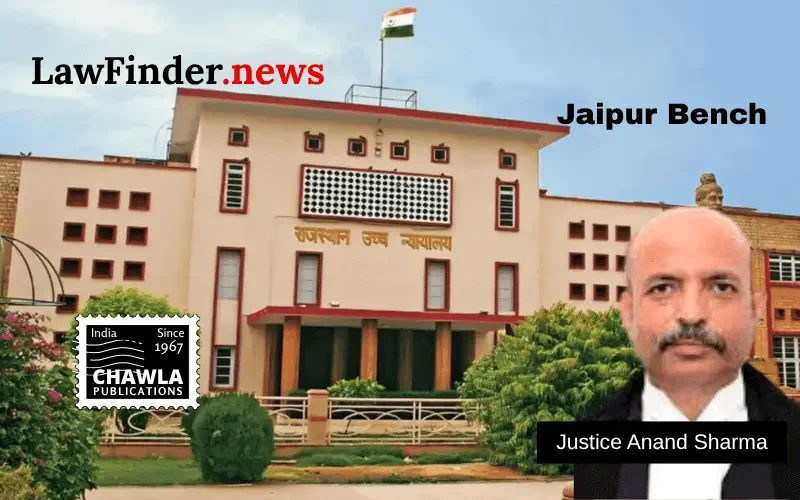
In a significant judgment dated 20 November 2026, the Rajasthan High Court, Jaipur Bench, delivered by Mr. Anand Sharma, J., has upheld the Election Committee’s authority to prescribe reasonable eligibility criteria for voters in the elections of the Rajasthan High Court Bar Association (RHCBA). The Court emphasized the necessity of active professional engagement by advocates for participation in Bar elections and rejected attempts to dilute these standards.
The matter arose when the Election Committee of the RHCBA had initially issued notices on 3rd and 4th November 2026 requiring members to submit proof of active practice — either through two Vakalatnamas or two court appearance order sheets — to be eligible to vote in the forthcoming elections. Senior Advocates were exempted from this requirement. This was intended to ensure that only genuinely practicing advocates could influence the election of the Bar Association’s office bearers, thereby maintaining the professional integrity and representative character of the Association.
Subsequently, an anonymous resolution claimed to annul these eligibility conditions. Persuaded by this resolution, the Election Committee withdrew the earlier criteria via a notice dated 17th November 2026, allowing all members, irrespective of actual practice, to participate in the elections. The petitioner, Virendra Agrawal, a senior member of the RHCBA, challenged this withdrawal before the High Court, contending that the anonymous resolution was invalid, contrary to the Association’s bye-laws, and that the Election Committee had misinterpreted the Election Tribunal’s order.
The Election Tribunal, constituted to adjudicate election disputes, had earlier set aside the anonymous resolution and reinstated the eligibility criteria, holding that the Election Committee was competent to impose reasonable conditions to ensure meaningful participation by active practitioners. However, it also noted that the specific Clause 4(a) cited in the initial notices was not formally adopted by the General House, making the notices partially untenable on technical grounds.
Rejecting the Election Committee’s subsequent withdrawal of the eligibility conditions, the High Court restored the notices dated 3rd and 4th November 2026. The Court highlighted that membership in a Bar Association does not automatically confer the right to vote in its elections without reasonable conditions that reflect actual professional engagement. It referred to the landmark Supreme Court judgment in Supreme Court Bar Association & Ors. v. B.D. Kaushik (2011) 13 SCC 774, which recognized the distinction between mere membership and electoral participation and allowed reasonable restrictions linked to active practice.
The Court noted that the eligibility condition requiring proof of two Vakalatnamas or two court appearances was a modest, objective, and non-onerous standard designed solely to verify continuing professional connection with the Court. It stressed that such a requirement does not amend the bye-laws but is a reasonable regulatory measure incidental to the Election Committee’s duty to conduct free and fair elections.
The judgment also underscored the Bar Council of Rajasthan’s Rules of 2006, which require advocates to declare regular practice for renewal of their enrollment, reinforcing the principle that only practicing advocates should influence Bar governance.
Consequently, the Court ordered the Election Committee to reopen the filing of affidavits with the requisite proofs up to 23 November 2026, including acceptance on Sunday, and directed the publication of a revised voters’ list by 24 November 2026. The rest of the election schedule remains unchanged. The petition was allowed, and the Election Committee was directed to comply immediately.
This ruling is expected to enhance the standards of the Rajasthan High Court Bar Association elections by ensuring that only active practitioners exercise voting rights, thereby strengthening the democratic and professional fabric of the legal fraternity.
Bottom Line:
Electoral participation in a Court-attached Bar Association can be reasonably regulated by prescribing eligibility criteria linked to active professional engagement without conflicting with the Bye-laws.
Statutory provision(s):
Advocates Act, 1961, Societies Registration Act, State Bar Council of Rajasthan Renewal of Certificate of Practice Rules, 2006