Court Emphasizes Need for Continuous and Uniform Practice of Customary Divorce to Acquire Legal Validity; Parties Advised to Pursue Divorce by Mutual Consent under Hindu Marriage Act
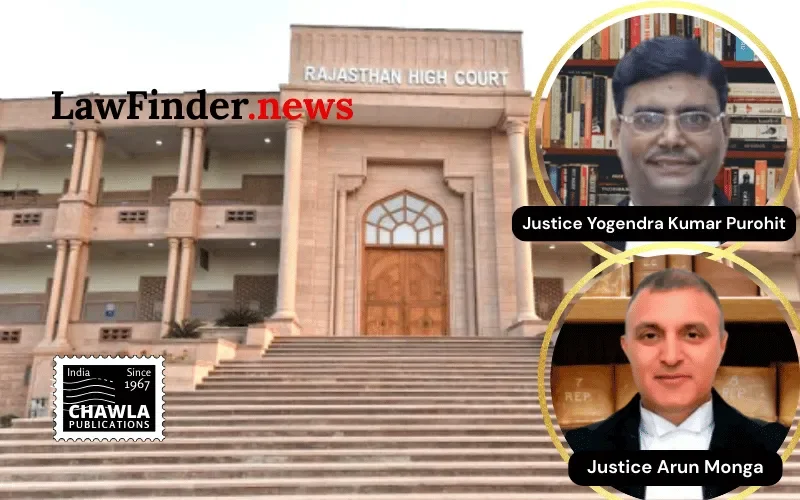
In a significant judgment dated October 13, 2026, the Rajasthan High Court dismissed an appeal filed by Smt. Deepa challenging the Family Court’s decision to reject her suit for dissolution of marriage based on a customary practice called “Samajik Chhutpalla.” The bench, comprising Justices Arun Monga and Yogendra Kumar Purohit, held that mere execution of a social separation deed does not suffice to establish a legally recognized custom of divorce unless supported by cogent evidence showing continuous and uniform observance over a long period within the community.
The appellant, Smt. Deepa, had filed a suit under Section 13 of the Hindu Marriage Act, 1955 seeking a declaration that her marriage with respondent Ashok Sungat, solemnized in 1999, stood dissolved based on a “Samajik Chhutpalla” deed executed in 2000. The appellant contended that this customary practice of social separation was prevalent in their community and should be recognized as a valid ground for divorce. She also highlighted that the parties had been living separately since the execution of the deed and no child was born from the marriage.
The respondent admitted the marriage and the execution of the “Samajik Chhutpalla” deed but denied the existence of a legally recognized custom of divorce through this practice. He stated that the deed was executed with community elders’ involvement and that the parties had been living separately even before its execution. However, he disputed the claim that the deed itself dissolved the marriage.
The Family Court, after thoroughly analyzing the evidence, held that the appellant failed to prove the existence of a customary practice of divorce by “Samajik Chhutpalla” that was continuously and uniformly followed in their community. The court noted that the deed did not contain any indication that the custom was legally recognized and that no other oral or documentary evidence was produced to establish its validity as a mode of divorce. The court accordingly dismissed the suit.
On appeal, the High Court upheld the Family Court’s findings, emphasizing the definition of “custom” under Section 3(a) of the Hindu Marriage Act, which requires a custom to be observed continuously and uniformly for a long time to acquire the force of law. The court referred to a prior judgment from the Gujarat High Court, reinforcing the principle that customary divorce must be firmly established as prevalent and legally valid in the concerned community.
The Court also observed that since both parties expressed willingness to dissolve the marriage, they were at liberty to seek divorce by mutual consent under Section 13B of the Hindu Marriage Act. The appeal was disposed of with liberty granted to the parties to file an appropriate petition for mutual consent divorce.
This judgment reaffirms the judiciary’s cautious approach toward recognizing customary practices as grounds for dissolution of marriage. It underscores that such customs must be substantiated by convincing evidence of long-standing and uniform observance within the community to be enforceable in law. The ruling directs parties to adhere to statutory provisions of the Hindu Marriage Act while seeking divorce, promoting legal clarity and uniformity in matrimonial matters.
Bottom Line:
Hindu Marriage Act, 1955 - Customary divorce through "Samajik Chhutpalla" - Held, for a customary practice to acquire the force of law, it must be continuously and uniformly observed over a long period and recognized as legally valid. Absence of cogent evidence to establish such custom or usage renders the claim unsustainable.
Statutory provision(s):
Hindu Marriage Act, 1955 Section 3(a), Section 13, Section 13B
Smt. Deepa v. Ashok Sungat, (Rajasthan)(DB) : Law Finder Doc Id # 3163299