Court says later production of sealed and signed return memo was only a correction of an inadvertent error, not an attempt to fill a lacuna; accused to get full opportunity to cross-examine.
The Rajasthan High Court has dismissed a criminal miscellaneous petition challenging the trial court’s decision to permit a bank return memo to be marked as an additional exhibit in a cheque dishonour case under Section 138 of the Negotiable Instruments Act, 1881.
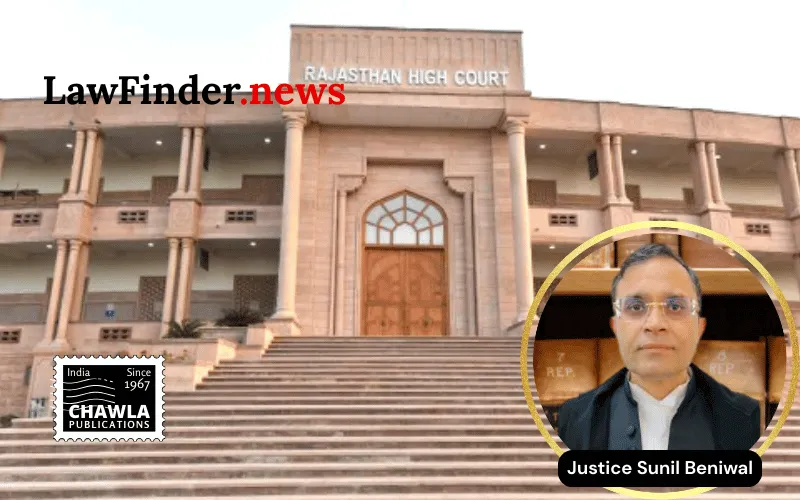
Justice Sunil Beniwal held that the later-produced return memo, which bore the bank’s seal and the signature of an authorised officer, was not an impermissible attempt to fill a gap in the complainant’s case. Instead, the Court said, it was merely a correction of an inadvertent error in the proof of an already existing document.
The case arose from a complaint alleging that the petitioner had borrowed Rs. 3,90,000 and issued a cheque in repayment, which was dishonoured for “Insufficient Funds.” During trial, the complainant first produced an online-generated return memo, which was marked as Exhibit-2 but did not bear the bank’s seal or signature. Later, after the issue was raised in cross-examination, the complainant produced another return memo relating to the same dishonour transaction, this time with the bank’s seal and authorised signature. The trial court allowed it to be marked as Exhibit-9, and the revision court upheld that order.
Before the High Court, the petitioner argued that permitting the second memo amounted to filling a lacuna in the prosecution case, especially since no formal application was filed for taking the document on record or recalling the witness. The petitioner also contended that once a return memo for the same transaction had already been exhibited, a second memo could not be introduced.
Rejecting these submissions, the High Court observed that criminal courts are meant to discover the truth and secure a just decision, not to penalise parties for procedural mistakes. Relying on Supreme Court precedents including Rajendra Prasad v. Narcotic Cell, P. Chhaganlal Daga v. M. Sanjay Shaw, and U.T. of Dadra & Nagar Haveli v. Fatehsinh Mohansinh Chauhan, the Court reiterated that an oversight or inadvertent omission cannot be equated with a “lacuna” in the case. Where a document already exists and is later produced in a properly authenticated form, its exhibition cannot automatically be treated as an attempt to unfairly improve the case.
The Court also clarified an important evidentiary principle: merely marking a document as an exhibit does not amount to proving it. Citing LIC of India v. Ram Pal Singh Bisen and other decisions, the Court said that exhibition is only a tentative step; the document’s admissibility, execution, and contents must still be proved in accordance with law. Therefore, the authenticated return memo marked as Exhibit-9 would still be open to challenge during trial.
On the procedural objection, the Court held that the absence of a formal application under the relevant provision for recalling or examining a witness again would not by itself vitiate the trial. Procedural law, the Court said, is intended to advance justice and not defeat it through technicalities. What matters is whether the accused suffers substantial prejudice. Since the petitioner would have a full opportunity to cross-examine the complainant on the newly produced memo, no such prejudice was shown.
Accordingly, the High Court dismissed the petition and upheld the orders of the trial court and revisional court. It also directed that the petitioner be allowed to cross-examine the complainant on the document, if not already done, and to raise all objections regarding its admissibility in accordance with law.
Bottom Line :
Negotiable Instruments Act, 1881 - Dishonour of cheque - Bank return memo earlier exhibited without seal/signature and later produced with bank seal and authorised signature - Subsequent exhibition of authenticated return memo is not filling up lacuna but rectification of inadvertent error - Mere marking of a document as exhibit does not amount to its proof or automatic admissibility - Absence of formal application under Section 311 CrPC/Section 348 BNSS equivalent would not vitiate trial in absence of prejudice - Accused must be given opportunity to cross-examine on such document.
Statutory provision(s): Section 528, Bharatiya Nagarik Suraksha Sanhita, 2023, Section 138, Negotiable Instruments Act, 1881, Section 311, CrPC, Section 348, BNSS, 2023
Gulam Mohd. v. Gopal Traders, (Rajasthan) : Law Finder Doc id # 2987149