Court affirms that voluntary resignation to contest elections cannot be withdrawn absent compelling reasons or material change in circumstances; political neutrality and conduct rules also emphasized
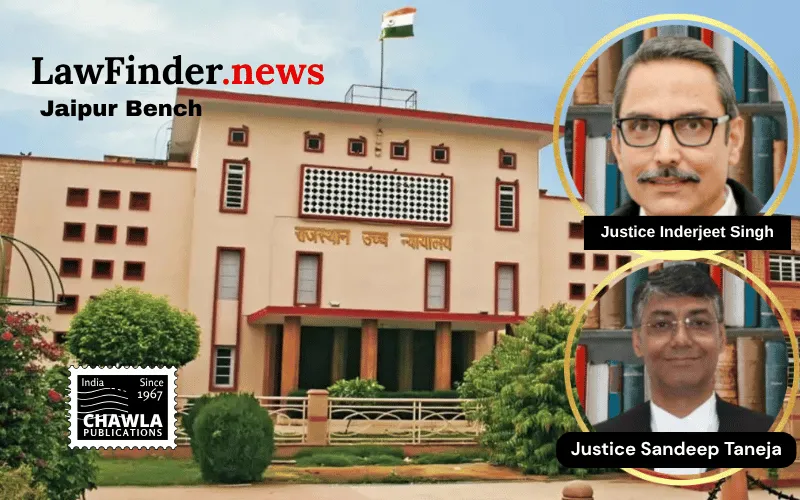
In a significant judgment dated September 1, 2026, the Rajasthan High Court (Division Bench, Jaipur Bench) dismissed the writ petition filed by Neeraj Bishnoi, a former Senior Auditor with the Northern Western Railway, seeking withdrawal of his resignation which he had tendered to contest the Rajasthan Legislative Assembly elections in 2023.
The petitioner resigned on October 10, 2023, to participate as an official candidate of the Bahujan Samaj Party (BSP) in the November 2023 elections. His resignation was accepted effective November 1, 2023. After losing the election, he sought to withdraw his resignation and sought reinstatement, citing unawareness of the loss of pensionary benefits upon resignation. His application for withdrawal was rejected by the respondents relying on Rule 26(5) of the Central Civil Services (Pension) Rules, 2021, and Rules 3(1)(vii) and 5 of the Central Civil Services (Conduct) Rules, 1964.
The petitioner challenged this rejection before the Central Administrative Tribunal (CAT), Jaipur Bench, which upheld the denial, leading to the present writ petition before the Rajasthan High Court.
The Court reiterated the stringent conditions under Rule 26(5) of the CCS (Pension) Rules, 2021, which permits withdrawal of resignation only if (i) the resignation was tendered due to compelling reasons not involving any reflection on integrity, efficiency, or conduct, and (ii) there is a material change in circumstances from those which compelled the resignation. The Court found that the petitioner's resignation was a voluntary act motivated solely by his desire to contest elections, a deliberate choice between government service and political career. No compelling reasons or material changes were demonstrated to justify withdrawal.
Furthermore, the Court emphasized the importance of political neutrality mandated under Rule 3(1)(vii) and the prohibition of political activity under Rule 5 of the CCS (Conduct) Rules, 1964. It held that the petitioner, having actively contested elections on a party ticket, breached these provisions. The Court noted that even during the period between resignation and the request for withdrawal, the petitioner's conduct was to be judged as if he was in continuous government service, thereby making his political activity improper and disqualifying him from reinstatement.
The Court distinguished the petitioner's reliance on precedents such as Balram Gupta v. Union of India (1987) and Govt. of NCT of Delhi v. Kamlesh Rani Bhatla (2023), clarifying that those cases were decided on peculiar facts and do not apply to the present circumstances where resignation had become effective prior to the election and where the petitioner's political conduct violated the conduct rules.
In conclusion, the Rajasthan High Court affirmed the CAT's order dismissing the petitioner's application, underscoring that resignation withdrawal is a discretionary and exceptional remedy requiring compelling reasons and a material change in circumstances, neither of which existed. The Court also reinforced that government servants must maintain political neutrality at all times, and resignation to join politics entails forfeiture of government service benefits and rights.
Bottom Line:
Withdrawal of resignation under Rule 26(5) of CCS (Pension) Rules, 2021 - Resignation tendered voluntarily for contesting elections - Request for withdrawal not permissible in absence of compelling reasons or material change in circumstances.
Statutory provision(s):
Central Civil Services (Pension) Rules, 2021, Rule 26(5); Central Civil Services (Conduct) Rules, 1964, Rule 3(1)(vii), Rule 5(1), Rule 5(4)