New Delhi, Aug 21 Supreme Court judge Justice B V Nagarathna has termed as "misconceived" and "uncalled for" the reference made to a nine-judge bench seeking reconsideration of the path-breaking 1978 verdict that gave a worker-friendly and expansive interpretation to the term "industry".
She strongly batted for allowing the 1978 verdict and its worker-friendly interpretation of the term "industry" to continue to govern the pending cases before the labour courts, industrial tribunals, high courts and the top court keeping in mind the “liberalisation, privatisation and globalisation” of the economy post-1991.
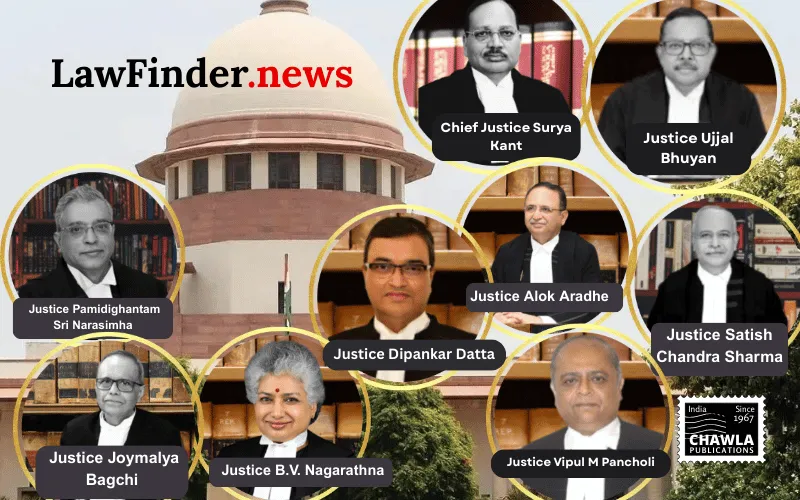
The dissent was voiced by Justice Nagarathna in her separate 157-page verdict, uploaded on Friday, on the reference made to the nine-judge bench headed by the Chief Justice of India Surya Kant.
The top court on Thursday held that its 48-year-old expansive worker-friendly interpretation of the term "industry" under the now-repealed Industrial Disputes Act of 1947 would continue to govern thousands of pending cases involving hospitals, educational institutions, and government departments.
“I have perused the erudite opinions of CJI and learned Brothers Narasimha, Dipankar Datta and Joymalya Bagchi, JJ. However, I have authored a separate opinion indicating as to why reconsideration of the judgment of this Court in Bangalore Water Supply & Sewerage Board vs. A. Rajappa, 1978 is not warranted.
“I have also stated that the reference made by a five-Judge Bench of this Court …was unnecessary. Nevertheless, I have analysed the judgment of this Court in Bangalore Water Supply and have concluded that the same does not call for any interference or modification. Accordingly, I have answered the questions referred to this nine-Judge Bench,” she wrote.
She said the reference made by the five-Judge bench to a nine-judge bench on a perception that there was a conflict in the decisions of the court, for the purpose of reconsideration of the seven-judge bench judgment in the Bangalore Water Supply judgement of 1978, was misconceived, and hence, the reference itself was uncalled for.
Summarising the reasons as to why the reference need not be answered, she said the ID Act (Industrial Disputes Act) of 1947 was repealed with effect from November 21, 2025.
A new enactment by way of the Industrial Relations (IR) Code of 2020 was enforced on November 21, 2025, containing a new definition of “industry”, she said.
She added that the judgment of the seven-judge bench in the Bangalore Water Supply case has held the field for nearly half a century, that is 48 years.
“When the judgment of the seven-Judge Bench of this Court in Bangalore Water Supply was rendered in the year 1978, there were innumerable activities which were embarked upon by the State itself.
“However, the ushering in of the reforms of 1991 in the form of liberalisation, privatisation and globalisation has resulted in a total change in the policy of the Union and the State Governments, whereby several activities of the Union and State Governments have now been privatised, liberalised or globalised,” she said.
It is in the interest of the employers, workmen and industrial activity, as well as the Indian economy itself, that the definition of “industry” of the 1947 ID Act as interpreted in 1978 shall keep applying on pending cases, she said.
“I hold that the majority judgments of the seven-Judge Bench is good law and therefore, binding. Consequently, I am of the view that the questions referred for the consideration of this Bench would have to be answered in the following manner,” she said.
Delivered by a seven-judge SC bench and authored primarily by Justice VR Krishna Iyer, the 1978 judgment dramatically expanded the definition of the term "industry" under Section 2(j) of the Industrial Disputes Act, 1947.
The ruling brought millions of workers under labour law protection, including those employed in hospitals, educational institutions, clubs, and government departments.
State of Uttar Pradesh v. Jai Bir Singh, (SC)(Constitution Bench) : Law Finder Doc Id # 2964651