Supreme Court Upholds RTI Access for Co-operative Society Member to Bank Records, Registrar can obtain documents from a co-operative society under Kerala law; construction agreement and general body minutes not exempt from disclosure, rules apex court
The Supreme Court has ruled that a member of a co-operative society is entitled to obtain key documents of the society under the Right to Information Act, 2005, even if the society itself is not a “public authority” under the RTI law.
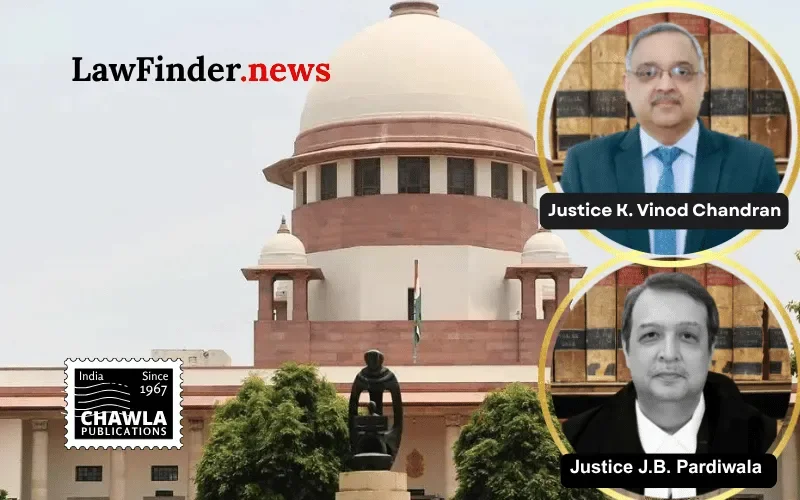
A Bench of Justices J.B. Pardiwala and K. Vinod Chandran, in The Muppathadam Service Co-Operative Bank Ltd. v. The State Chief Information Commissioner and Ors., dismissed appeals filed by the co-operative bank and upheld the Kerala High Court’s direction to provide a member with a copy of the construction agreement executed by the bank with a Labour Co-operative Society and the minutes of its last General Body Meeting.
The case arose from an RTI application filed by a member of the appellant-bank before the Joint Registrar (General) of Co-operative Societies. His request for the two documents had initially been rejected, leading to prolonged litigation before the State Information Commission and the Kerala High Court. In the second round of proceedings, the Information Commission, a Single Judge, and later a Division Bench of the High Court all affirmed the member’s right to access the records. The bank then approached the Supreme Court.
Before the apex court, the bank argued that it was not a “public authority” under the RTI Act and relied on the 2013 decision in Thalappalam Service Cooperative Bank Ltd. v. State of Kerala. It further contended that the Registrar could access the society’s records under Sections 65 and 66 of the Kerala Co-operative Societies Act, 1969 only after forming satisfaction to initiate an inquiry, and since no such inquiry had begun, the information could not be disclosed.
Rejecting this argument, the Supreme Court held that Section 2(f) of the RTI Act is broad enough to include information relating to a private body if such information “can be accessed” by a public authority under any other law. The court said the Registrar’s powers under Sections 65 and 66 of the Kerala Co-operative Societies Act provide exactly such statutory access.
The Bench clarified that actual physical custody of the documents by the public authority is not necessary. What matters is whether the law gives the authority the right to call for and inspect those records. In this case, the Registrar had statutory supervisory and inspection powers over co-operative societies, including the power to inspect books and documents as frequently as necessary.
The court also rejected the bank’s claim that the Registrar could inspect records only after first recording satisfaction to start an inquiry under Section 65. It observed that such satisfaction cannot be formed “in a vacuum.” Access to books, accounts and documents is necessary to decide whether an inquiry should be initiated at all. Therefore, access to records cannot be made dependent on prior satisfaction.
On the issue of exemptions, the Supreme Court held that the construction agreement and the minutes of the General Body Meeting were not protected under Section 8(1)(d) or Section 8(1)(j) of the RTI Act. The judges noted that the documents did not involve trade secrets, intellectual property, or commercial confidence affecting any competitive position. Since the contract had already been awarded, its terms were matters that any member of the society could legitimately be concerned with.
The court further held that the requested records could not be treated as “personal information” when sought by a member of the society itself. It drew a distinction between a member and an unrelated third party, observing that a stranger may not automatically have a right to pry into the affairs of a private entity. However, a member of the society could not be denied access to documents such as a building contract and general body minutes on the ground that they were personal to the society or unrelated to public activity.
Referring to earlier rulings including CBSE v. Aditya Bandopadhyay and the Constitution Bench judgment in Central Public Information Officer, Supreme Court of India v. Subhash Chandra Agarwal, the court reiterated that information accessible to a public authority under law falls within the scope of the RTI Act.
Concluding that the Kerala High Court’s judgment was “perfectly in order,” the Supreme Court directed the Joint Registrar to call for the two documents immediately, and in any event within two weeks, and furnish them to the applicant-member. The appeals were dismissed.
The ruling is significant for co-operative societies and their members, as it reinforces that while such societies may not themselves be public authorities under the RTI Act, information about them can still be obtained through statutory regulators where the law grants access. The judgment strengthens transparency rights of members in the functioning and administration of co-operative institutions.
Bottom Line:
Right to Information Act, 2005 - Information relating to a private body is disclosable if it can be accessed by a public authority under any other law - Registrar of Co-operative Societies can call for documents of a co-operative society under Sections 65 and 66 of the Kerala Co-operative Societies Act, 1969 - Member of society entitled to copy of construction agreement and minutes of General Body Meeting - Such documents not exempt under Section 8(1)(d) or 8(1)(j) of RTI Act.
Statutory provision(s): Section 2(f), Section 3, Section 8(1)(d), Section 8(1)(j) of the Right to Information Act, 2005, Sections 65 and 66 of the Kerala Co-operative Societies Act, 1969