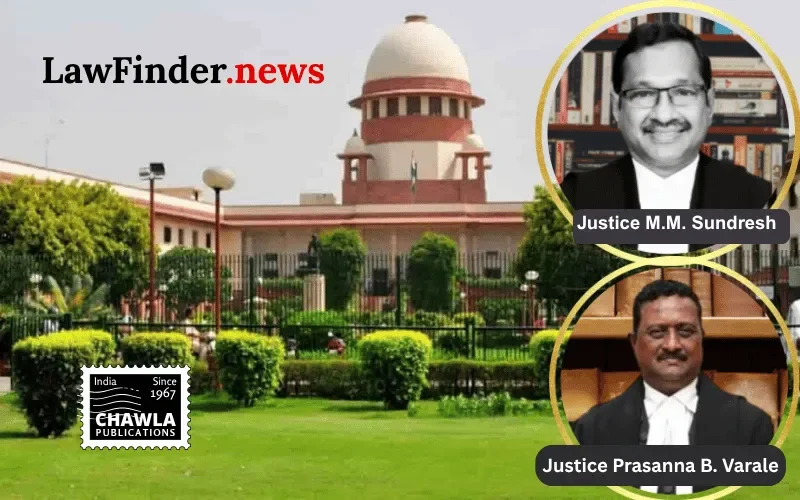
New Delhi, Nov 2 The celebration of Diwali has a religious, social and emotional connotation but degrading the environment defeats the purpose of the festivities, the Supreme Court said as it allowed the bursting of green firecrackers in Delhi-National Capital Region (NCR) from 6 am to 7 am and 8 pm to 10 pm on November 7 and 8.
A bench of Justices M M Sundresh and Prasanna B Varale observed that bursting firecrackers would cause air pollution as it noted that the right to practise, profess and propagate religion conferred under Article 25(1) is certainly subject to public order, morality, health and other provisions of Part III of the Constitution.
Diwali falls on November 8 this year. The top court made it clear that a complete ban on firecrackers, as imposed earlier, would be restored with effect from November 9.
"This court has repeatedly held that the 'right to life' envisaged under Article 21 of the Constitution includes the right to a healthy, safe and a pollution-free environment, and the said position has been crystallised and, hence, requires no repetition," the bench said in its October 29 order.
It said therefore, the right of an individual to engage in a particular practice, which may have a religious colour, is only a qualified one and cannot go beyond the Constitutional restrictions.
The bench, which passed the order on a matter concerning a ban on firecrackers, said the parties before it were in agreement on the fact that the bursting of firecrackers contributed enormously to pollution in Delhi-NCR.
It said measures undertaken by authorities based on orders passed by the top court or on their own had not yielded the desired results.
"Therefore, it can be seen that the problem lies in the implementation. Certainly, there has to be better coordination amongst all relevant stakeholders," it said.
The bench said the process of regulating, implementing and monitoring by authorities should continue not only during the time of the festival but, more importantly, even thereafter.
It said there has to be a periodic review of environmental pollution and its consequential effects, after the festive season.
The bench said AQI data ought to be collected from different monitoring stations managed by the Central Pollution Control Board and Delhi Pollution Control Committee.
"We are also of the view that statistics pertaining to increase in the number of patients, as well as the reported deaths, if any, due to the pollution, have to be collected from hospitals and health care centres across Delhi-NCR," it said.
It observed that further discussion and deliberation should take place between the stakeholders, including public health officials, towards alleviation of environmental pollution.
"We are also conscious of the fact that the celebration of Deepawali has a religious, social, psychological and emotional connotation amongst people, creating a positive atmosphere of hope, welfare and prosperity," the bench said.
"That being said, allowing the environment to degrade, which results in a health hazard to all the living beings, defeats the very purpose of the festivities, and the celebrations would be rendered nugatory," it said.
In its order, the bench noted that philosophers and thinkers of ancient India always treated the environment as an integral part of religion and for them, all living beings are one and the same.
"Life truly exists in every being and form, apart from human beings. In their profound wisdom, any religious practice, including the celebration of a festival, should facilitate this heightened thinking in every possible way," it said.
"This is evident in the way that the natural elements such as air, water, fire, earth and the sky are treated as gods and worshipped with great reverence," the bench said.
It said Diwali is the festival of lights and over the centuries, it has assumed the character of a national festival, so much so that at present, one can even consider it an international festival.
It noted that the festival is celebrated by people regardless of their caste, community and religion.
The bench said ancient Hindu scriptures such as the Skandapurana and the Padmapurana refer to the use of lamps as a ritual, while observing the festival of Diwali.
It said with the introduction of gunpowder in India a few centuries ago, the celebration underwent a change and this led to the introduction of firecrackers.
"Bursting of firecrackers, though constitutes a religious practice meant to celebrate the occasion, shall result in severe environmental pollution, especially air and noise, apart from the creation of solid wastes," the bench said.
It said the unregulated practice affects everyone including the end user and amongst human beings, children, disabled and the elderly people constitute the most vulnerable groups.
"Every year, the statistics also reflect a huge spike in the Air Quality Index (AQI) as well as the pollution levels, including the release of Particulate Matter (PM) in the atmosphere, after the festival is celebrated across the country, and more significantly, in the Delhi-NCR region," the bench said.
It said the region has a peculiar geographical setting, as there is no free passage of air, due to the low wind speed which makes the pollution persist.
It said the temperature inversion during the winter months aggravates the aforesaid phenomena.