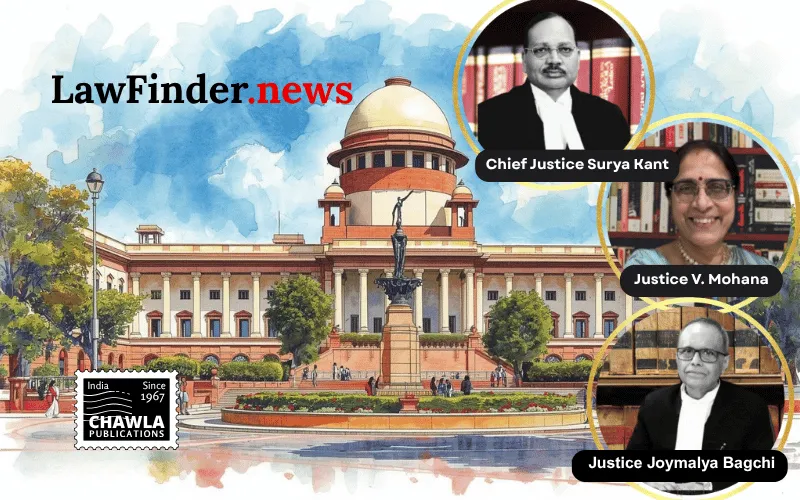
New Delhi, Aug 18 Supreme Court judge Justice V Mohana on Tuesday recused herself from hearing a 2016 PIL seeking directions to ensure speedy disposal of criminal cases involving lawmakers across the country.
As soon as the bench comprising Chief Justice Surya Kant and Justices Joymalya Bagchi and V Mohana commenced the hearing on the PIL filed by lawyer Ashwini Upadhyay, the CJI said that Justice Mohana had appeared in the case earlier as a lawyer.
"My sister will recuse… We will list it before another bench,” the CJI said.
Senior advocate and amicus curiae Vijay Hansaria urged the CJI to set up a bench as early as possible as the matter needed an urgent hearing.
Hansaria, in his latest report on criminalisation of politics, said that 251 members out of 543 in the Lok Sabha and 75 lawmakers out of 233 in the Rajya Sabha have criminal cases against them.
The affidavit filed in the apex court by Hansaria, who has been appointed amicus curiae in a PIL seeking expeditious disposal of criminal cases against MPs and MLAs, said that there are over 4,000 criminal cases against Members of Parliament (MPs) and Members of Legislative Assemblies (MLAs). The affidavit stated that the chief ministers of 14 states, out of 28, have declared criminal cases, including serious ones.
According to the data, Telangana Chief Minister Anumula Revanth Reddy has 89 cases against him, followed by West Bengal Chief Minister Suvendu Adhikari, who has 29 cases, and Karnataka Chief Minister D K Shivakumar, who has 19 cases.
Hansaria submitted that despite monitoring of cases by the top court and high courts to ensure expeditious trials, the number of pending criminal cases against MPs and MLAs since 2018 has remained almost at the same level. On November 9, 2023, in a significant verdict aimed at fast-tracking trials in more than 5,000 criminal cases against lawmakers, the top court had directed high courts to set up a special bench to monitor cases for their speedy disposal.
It had also asked special courts not to adjourn proceedings in such matters except "for rare and compelling reasons".
Issuing a slew of directions to high courts, district judges and special courts designated to hear matters related to lawmakers, the top court had directed that criminal cases against MPs, MLAs and members of legislative councils (MLCs) be given priority.