New Delhi, Aug 11 The Supreme Court on Tuesday quashed an FIR against a BSF staff member, who was an accused in a dowry-death case, saying the continuation of criminal proceedings would amount to an abuse of the process of the court.
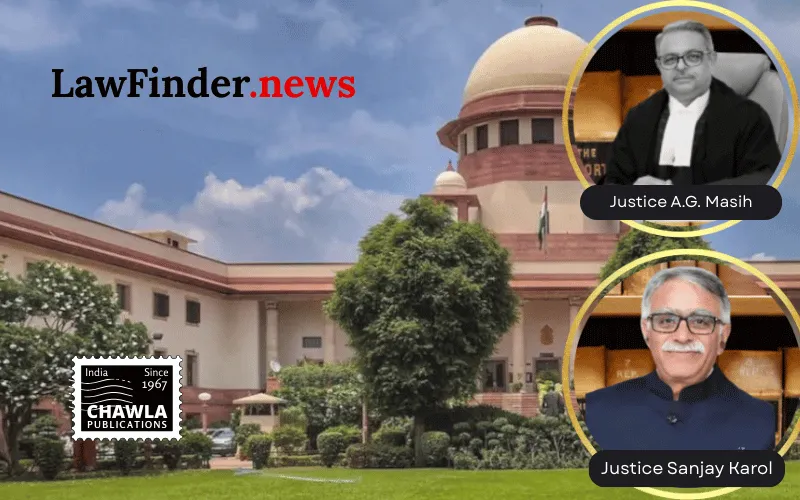
A bench of Justices Sanjay Karol and Augustine George Masih allowed his appeal challenging a December last year order of the Allahabad High Court that had refused to quash the criminal proceedings against him in a case registered in Uttar Pradesh's Meerut in 2016.
The bench noted that the appellant had relied upon a certificate issued by the commandant of a Border Security Force (BSF) battalion, certifying that he was detailed for official duty during the relevant period and was stationed in connection with official assignments outside Meerut.
It said the appellant's parents were acquitted by a trial court after a full-fledged trial in the case arising out of the same FIR.
"For the foregoing reasons, this court is satisfied that the continuation of the criminal proceedings against the appellant amounts to an abuse of the process of the court and requires to be quashed qua the appellant alone," the bench said in its judgment.
It noted that the appellant's marriage was solemnised in April 2014 and in June 2016, an FIR was lodged alleging that he and his family members had subjected his wife to cruelty and harassment for dowry and on account of the non-fulfilment of their demand, the victim was done to death by hanging.
The FIR was registered for alleged offences, including under section 304B (dowry death) of the Indian Penal Code and provisions of the Dowry Prohibition Act, 1961.
Dealing with the appeal, the top court said the contours of the power to quash an FIR or criminal proceedings are well settled.
"The power is undoubtedly to be exercised sparingly, with circumspection, and never to throttle a legitimate prosecution or to conduct a mini trial at the threshold," it said.
"These self-imposed restraints, however, do not require the court to shut its eyes to a proceeding that is a manifest abuse," the bench observed.
It noted that the prosecution has offered no satisfactory explanation as to how, if the deceased was killed by the accused persons and thereafter hanged, the room and the main gate were found to be bolted from inside.
The bench said the appellant's absence from the place of occurrence on the day of the incident does not, by itself, exonerate him of the charge.
"However, no call-detail records were ever obtained to independently verify, establish or assert, even this solitary telephonic thread that said to connect the appellant to the alleged demand," it said.
Allowing the appeal, the bench set aside the high court's order.
It quashed the FIR, the chargesheet and all consequent proceedings against the appellant in the case pending before a Meerut court.
Rahul v. State of Uttar Pradesh, (SC) : Law Finder Doc Id # 2958951