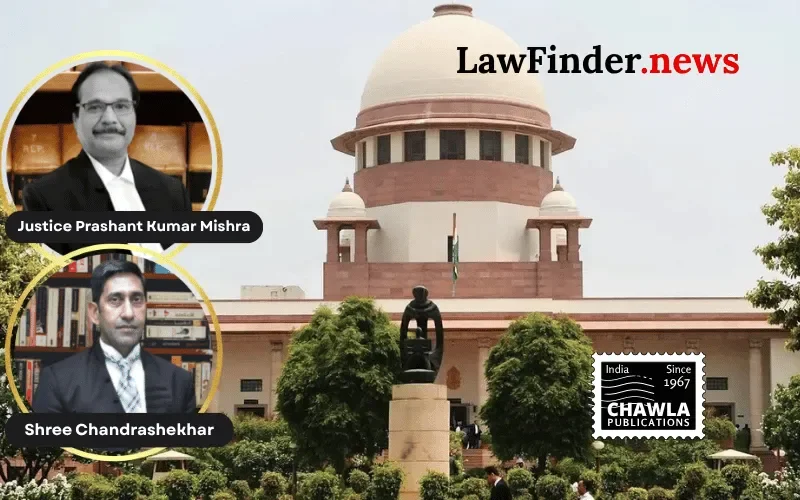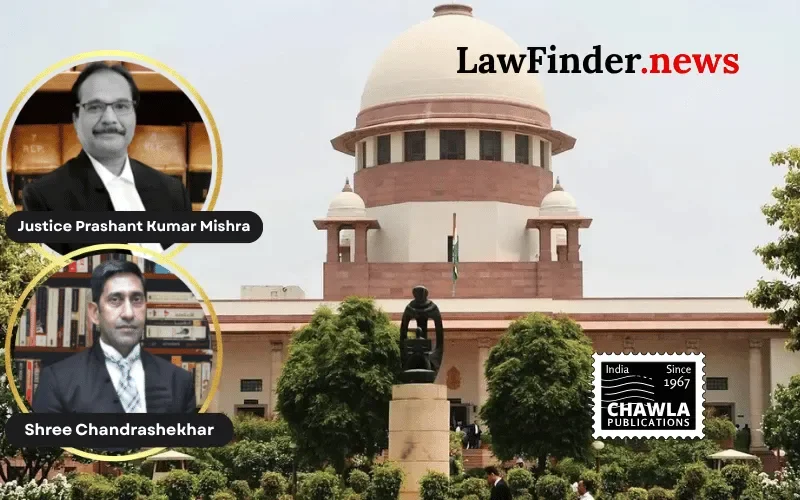
New Delhi, Nov 25 The Supreme Court on Wednesday cancelled the bail of former Karnataka minister Vinay Kulkarni, held guilty of murdering a BJP leader in 2016, and asked him to surrender in two weeks to serve his life sentence after it set aside the high court order that stayed his conviction.
A bench of Justices Prashant Kumar Mishra and Shree Chandrashekar said the decision of the high court is clearly perverse.
It set aside the Karnataka High Court's July 31 order which granted bail to eight convicts, including Kulkarni, and suspended their sentence in the case.
Dharwad BJP leader Yogesh Goudar was hacked to death by an armed group at a gymnasium in the city in June 2016. Kulkarni and 15 others were convicted by the Special Court for MPs and MLAs in Bengaluru on April 16 this year. The court sentenced them to life imprisonment a day later.
On Wednesday, the top court said the benefit of suspension of sentence cannot be granted to persons convicted for heinous crimes without any compelling reason demonstrable from the judgment of conviction.
The apex court said the order under challenge in the criminal appeals arising from the Special Leave Petitions are set aside. "The bail bonds, if any, furnished by the convict-respondents shall stand cancelled and they shall surrender before the court concerned within two weeks," it ordered.
The bench criticised the high court and said it is well settled that the judgment of conviction can be stayed only in rare and exceptional cases where the court after examining all aspects, including the ramifications of such an order, is satisfied that the convict would suffer irreversible adverse consequences.
Dealing with Kulkarni's case, who was disqualified from Karnataka assembly on May 2, the bench said, "This is a misconception that the judgment of conviction should be stayed because the convict would be disqualified to be a member of the legislative assembly."
According to the apex court, if that is how the power of the court to stay the judgment of conviction is to be interpreted then every convicted legislator would automatically become entitled to an order staying the conviction.
"Such legislators then continue to be a member of the legislative assembly, would complete their term and shall be eligible to contest further elections, notwithstanding the mandatory statutory consequences," it said.
The top court said the disqualification of a legislator upon his conviction and sentence for the crime committed by him can be one of the considerations for exercising the powers by the appellate court but the possible disqualification of Kulkarni cannot be the primary ground to stay his conviction.
"The consequence that falls on the convict upon his conviction for committing a crime, such as, his disqualification under section 8(3) of the Representation of People Act, 1951 is a statutory consequence and that cannot be avoided by him on mere showing of an arguable case," it said.
The bench also rejected the arguments advanced on behalf of Kulkarni and other accused that the prosecution case would fail if motive for the crime was not proved.
It said the motive for committing a serious crime like murder is a very weak circumstance that may be taken note of by the court in totality of the circumstances. Sometimes the court may expect the prosecution to disclose motive for the crime but it is not necessary that the prosecution for establishing the charge of murder must prove the motive, the bench said.
On suspension of the convict's sentences, the apex court said it is a wrong notion that pendency of the criminal appeal and its remote possibility of hearing in near future can be a ground to suspend the sentence in grave offences such as murder, dacoity, rape and ransom.
"The long pendency of criminal appeals in the high courts is a reality but this does not mean that a life convict is automatically entitled for suspension of sentence awarded to him," it said, emphasising that the hearing of the criminal appeals across high courts is primarily an issue which needs to be resolved on administrative side.
The bench said it is also a matter of equality and liberty of hundreds of other convicts, who are sentenced to life imprisonment and have served a substantial part of their sentence.
"The order of suspension of sentence cannot be passed as a matter of course without a careful consideration of the relevant aspects. The judgment of conviction substantially dilutes the presumption of innocence and an order of suspension of sentence can be passed where the appellate court forms an opinion that the convict has a fair chance of acquittal, that is to say, that he has a good prima facie case for acquittal," it said.
The probe into the case was handed over to the CBI in 2019.
Kulkarni, who was a minister when the murder took place, was arrested by the CBI in 2020 and was later granted bail before being convicted by the special court earlier this year.