New Delhi, Nov 27 The Supreme Court on Friday agreed to consider submissions seeking to extend priority hearing by appellate tribunals of voter appeals arising from West Bengal's Special Intensive Revision (SIR) of electoral rolls to six more poll-bound municipal corporations, besides the Kolkata Municipal Corporation (KMC).
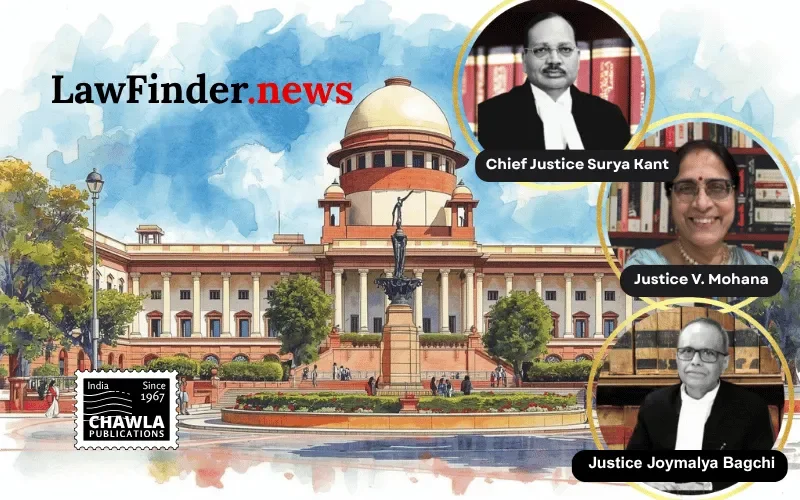
On November 23, a bench comprising Chief Justice Surya Kant and Justices Joymalya Bagchi and V Mohana had directed the Election Commission to increase the number of appellate tribunals hearing appeals arising from the SIR of electoral rolls in West Bengal.
The bench's direction had come after consultation with the chief justice of the Calcutta High Court.
The court ordered tribunals to prioritise appeals against deletions of voters, especially from assembly constituencies where civic body polls are scheduled.
In the Friday hearing, lawyer Prashant Bhushan and senior lawyer Gopal Sankaranarayanan represented some petitioners.
Bhushan said that the November 23 order named only the Kolkata Municipal Corporation (KMC), although a similar situation exists in six other municipal corporations.
He sought a minor modification so that the order covers the "Kolkata Municipal Corporation and such other municipal corporations where elections are due," seven in all.
Justice Bagchi agreed to consider the submissions, but said piling on urgent matters could make the exercise unrealistic.
"It is a difficult task for the tribunals," he said, adding that the bench would take a pragmatic approach.
"We understand the concern. You have made the application, we'll consider it," he said.
Asked about pendency, Bhushan said about 1.30 lakh appeals are pending in Kolkata and about 75,000 in the other six corporations combined, roughly two lakh in all.
Bhushan also suggested that if appeals remain pending when the civic polls are held, the deleted voters should be allowed to vote.
Sankaranarayanan told the bench that state police have been tasked with visiting the homes of appellants whose cases are pending and asking them to produce documents.
The senior lawyer said they have been told to finish the exercise by November 29 and handed a police checklist to the bench.
Justice Bagchi asked whether the documents were being formally collected and placed before the tribunals. Sankaranarayanan said the EC has told the petitioners it has nothing to do with the exercise and attributed it to the state.
Justice Bagchi noted that many people, at least in the KMC area, hold valid passports, and that tribunals need not take long to decide such cases.
He said the petitioners could approach the high court on the police action. Sankaranarayanan said they would.
The CJI added that the first concern is to ensure the appeals are decided.
Justice Bagchi said the court has already said that appeals seeking inclusion must be decided quickly.
In March, the EC set up 19 appellate tribunals at the apex court's direction.
About 700 judicial officers from West Bengal, Odisha, and Jharkhand were deployed to handle roughly 60 lakh claims and objections arising from the exercise.
On August 25, the apex court had directed the EC to furnish details of pending and disposed-of appeals, including a segregation of cases filed by voters challenging their exclusion or inclusion in the electoral rolls.
It also asked the poll panel to indicate how many additional tribunals would be required to ensure time-bound adjudication.