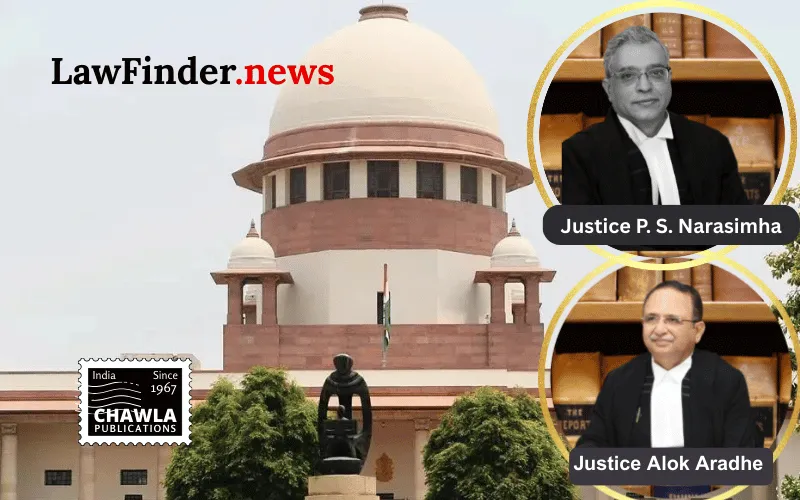
New Delhi, Jul 29 Observing that safety is a fundamental assurance that every elevator must provide, the Supreme Court on Wednesday upheld a compensation of over Rs 3.01 crore to the next of kin of a RAW officer who died in a lift mishap in 2003.
A bench of Justices P S Narasimha and Alok Aradhe dismissed the appeal filed by Otis Elevator Company (India) Limited while upholding the order passed by the National Consumer Disputes Redressal Commission (NCDRC).
The top court refused to interfere with the finding of the NCDRC that OTIS was the party principally deficient in service.
"A party that undertakes the comprehensive maintenance of a machine, which is in the nature of a vehicle, owes a heightened duty of care towards its users. OTIS was not a stranger to the defect that culminated in the accident.
"It was cognisant of the problem, and it had itself proposed the remedy. Having done so, its failure to ensure that the remedy was implemented, or, alternatively, to render the lift safe by other means pending its installation constitutes deficiency of service," the bench said.
The NCDRC had directed OTIS, RAW and Military Engineering Services (MES) to pay the compensation to the family of Vipin Handa (46), director with the Research & Analysis Wing (RAW).
On March 20, 2003, Handa was in the lift with 12 other officers after finishing a meeting at the RAW office on Lodhi Road, Delhi, when it stalled between the seventh and sixth floors. While one person was rescued just before Handa, the others got out of the lift when it opened on the sixth floor.
In 2005, his wife Rashmi Handa and two children Shristi and Kshitij filed the complaint before the National Consumer Disputes Redressal Commission.
A technical committee had concluded that the lift had stalled due to voltage fluctuation. Further, it said that when Handa was being rescued, somebody entered the machine room on the 11th floor and released the lift brakes through the brake release key.
This prompted the lift to move downwards.
"Releasing the brakes through the brake release key is the only cause of accident and is due to the human error or factor beyond any element of doubt," the commission concluded.
While OTIS was held responsible for installing the lift without a voltage stabiliser, RAW was held guilty for not insisting on the stabiliser, failing to ensure that the contract for maintaining the lift was being followed through and turning a blind eye to the complaints received against the manufacturer.
The top court, in its judgment, said elevators have become an essential part of modern urban life as, due to the limited availability of urban space, cities are growing vertically rather than horizontally.
"Strangers step into a small steel chamber, the doors close, and for a few moments they place their safety entirely in the hands of a mechanical system over which they have no control. In a crowded elevator, particularly in public spaces, the sense of confinement is real.
"The air feels heavy, personal space disappears and the awareness of being suspended between floors naturally creates unease. The slightest jerk, an unexpected stop or an unusual mechanical sound can quickly turn discomfort into fear, reminding every passenger that safety is not merely expected but is a fundamental assurance that every elevator must provide," the bench said.
The apex court said given the ever-increasing usage of passenger elevators in the modern-day urbanising societies, recognising them as a mode of vertical transportation is imperative.
In this transportation, passengers have no control over the conveyance and they have to entirely rely on automation or the operator, it said.
"It is not merely reasonable, but a legal necessity to impose a heightened duty to care, akin to that of common carriers in view of the intrinsic passenger vulnerability. An elevator must be construed and deemed to be a common carrier and the operator, in the wider sense, must undertake greater responsibility to transport passengers from floor to floor and exit safely," the bench said.
Commenting on the case, the top court agreed with NCDRC's finding that the liability of RAW and MES is less than that of OTIS.
"RAW, as the ultimate occupier of the premises and consumer of both OTIS's and MES's services, bore a residual duty to ensure that the contracts it had sanctioned were properly performed and that reports of persistent defects were acted upon. RAW did not, however, possess the technical competence that OTIS possessed.
"Its deficiency accordingly relates more to a failure of oversight than to any direct role in causing the accident... The apportionment of 70 per cent of the liability to OTIS, 25 per cent to MES and 5 per cent to RAW, in our view, properly reflects the differential degree of knowledge, control and responsibility that each party bore for the accident, and calls for no interference by this Court," the bench said.
M/s Otis Elevator Co. (India) Ltd v. Rashmi Handa, (SC) : Law Finder Doc Id # 2949942