New Delhi, Sep 16 The Supreme Court on Wednesday questioned whether a legislative majority could be considered a "safe test" to determine the ownership of a political party, particularly when disqualification proceedings were pending against the very MLAs who constituted that majority.
The top court posed the question to the Eknath Shinde-led faction, highlighting the legal complexities of relying on the numerical strength of legislators whose status itself was under scrutiny.
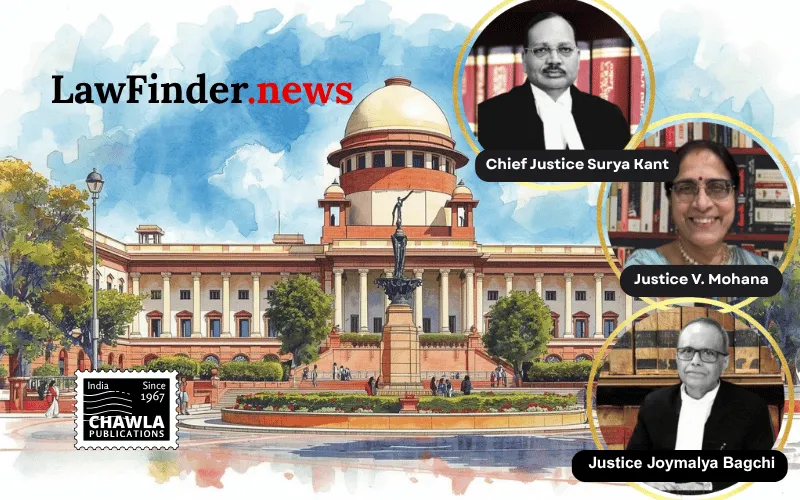
"Although legislative majority is a relevant test, can it always be the determinative or safe test where disqualification proceedings concerning those very legislators are pending?" a bench comprising Chief Justice Surya Kant and Justices Joymalya Bagchi and V Mohana asked senior advocate Neeraj Kishan Kaul advancing final arguments on behalf of the Eknath Shinde-led faction.
Kaul, at the outset, referred to the test evolved by the apex court to ascertain the majority in a political party and how the Election Commission has been applying it from case to case.
"Everyone says that they adhere to the (party) constitution. But what do we find when we examine the organisational structure?
"It is a party run in an autocratic manner and marked by ad-hocism. More than two-thirds of its members are appointed by the party president," he said.
He questioned whether such an organisation represents the will of the grassroots workers.
"The Election Commission ultimately held that given the peculiar facts of this case, legislative majority was the only workable test," he said.
Kaul said it was misleading on the part of the Uddhav Thackeray group to suggest that the Subhash Desai judgment prohibits consideration of the legislative-majority test.
"The Subhash Desai judgment repeatedly recognises that the Election Commission, exercising its plenary and expansive powers, may devise a test suited to the peculiar facts and circumstances of a case," the senior lawyer said.
"If, after examining all the available tests, the poll panel concludes that none of the other tests can be applied in the peculiar circumstances, it may adopt the workable test," he said.
The organisational structure in Shiv Sena was overwhelmingly composed of nominated members and did not reflect the aspirations of the party or its cadre, he said.
"The cadre was too numerous for its individual members to be brought before the Commission. The elected representatives were divided, and some of them faced disqualification proceedings. All three tests, therefore, had limitations," he said.
Justice Bagchi observed that if all three tests have limitations, there is another available option.
"Neither group needed to be given the advantage of the reserved symbol. Both groups could have been directed to select different symbols and contest on their own strength, not on Balasaheb's strength," he observed.
In appropriate cases, this court has repeatedly recognised legislative majority as a valid test because it may represent the democratic will in the particular circumstances, Kaul responded.
The Election Commission has wide powers and expertise in the field of representative party democracy and it must determine how a reserved symbol should be allotted, the senior lawyer said.
"We are exercising judicial review. We do not sit in the chair of the Election Commission.
"We must examine whether the available options were considered on correct legal premises. But if all the tests stood vitiated, the Commission also had the option of denying the reserved symbol to both groups and requiring them to contest on separate symbols and on their own strength," Justice Bagchi said.
The hearing remained inconclusive and will continue on Thursday.
The proceedings concern pleas filed by the Uddhav Thackeray-led faction challenging the Election Commission's recognition of the Shinde faction as the original Shiv Sena.
The dispute also involves challenges to the Maharashtra speaker's decision not to disqualify MLAs belonging to the Shinde-led camp.
The Thackeray faction has maintained that the Shinde group's use of the Shiv Sena name and election symbol is illegitimate and has urged the Supreme Court to restore the symbol or restrain the Shinde faction from using it.