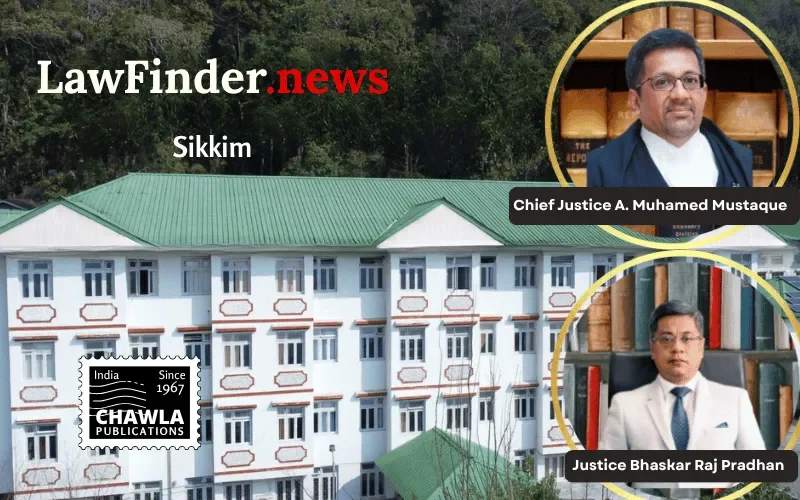
Court highlights urgent need for comprehensive climate resilience measures in Sikkim, addressing Glacial Lake Outburst Floods and climate impact on agriculture, including black cardamom plantations.
In a landmark judgment delivered on November 5, 2026, the Sikkim High Court in the public interest litigation titled "In Re- Climatic Justice in the State of Sikkim" has issued crucial directions concerning disaster preparedness and climate resilience in the Himalayan state. The Division Bench, comprising Chief Justice Mr. A. Muhamed Mustaque and Justice Bhaskar Raj Pradhan, responded to the pressing issue of Glacial Lake Outburst Floods (GLOFs) and their potentially devastating impact on Sikkim's ecology and population.
The Court acknowledged the report submitted by the Sikkim State Disaster Management Authority (SSDMA), which identified 40 glacial lakes in Sikkim as high risk for causing GLOFs. The learned Amicus Curiae, Mr. Sudhir Mishra, advocated for the appointment of a senior Nodal Officer within SSDMA, preferably an experienced officer from the Indian Administrative Service (IAS), Indian Forest Service (IFS), or Indian Police Service (IPS), to oversee disaster preparedness for these lakes. The Court endorsed this suggestion and urged the State Government to consider appointing not only one senior Nodal Officer but also four additional officers, each responsible for overseeing ten of the 40 critical glacial lakes. This hierarchical structure is intended to ensure close monitoring of glacier movements, early warning dissemination, and coordination with various departments and agencies.
Further, the Court noted that other regions like Himachal Pradesh, Uttarakhand, and Bhutan have already implemented early warning systems to mitigate GLOF risks. It strongly persuaded both the State and Central Governments to expedite procurement and installation of similar early warning technologies in Sikkim to prevent disasters akin to the October 2023 calamity.
In addition to glacial disaster management, the Court also addressed the adverse effects of climate change on agriculture, particularly the sharp decline in black cardamom production in Sikkim. An article from The Economic Times was placed on record, highlighting that unpredictable weather patterns, warmer winters, and reduced rainfall have rendered cardamom plantations vulnerable to diseases. The Court directed the State Government to respond with details on initiatives like "Mero Alaichi, Mero Dhan" (My Cardamom, My Wealth), aimed at combating these agricultural challenges.
The judgment also mandated the State Government to apprise the Court about the functioning and activities of various bodies constituted for climate resilience, including the High-Level Steering Committee, Multi-Disciplinary Task Force, and the Sikkim Commission on Glacial Hazards. Furthermore, the Court impleaded the Secretary of the Ministry of Earth Sciences and the National Disaster Management Authority (NDMA) as respondents, underlining the need for coordinated efforts between State and Central agencies.
The Court's proactive approach underscores the critical importance of anticipatory disaster management and climate adaptation in the fragile Himalayan ecosystem. The matter has been listed for further hearing on November 18, 2026, for the State Government to file its responses and update on the progress of the Court's directions.
Bottom Line:
Appointment of Nodal Officers for disaster preparedness and climate resilience in the context of high-risk glacial lakes in Sikkim; implementation of early warning systems for mitigating Glacial Lake Outburst Floods (GLOFs); addressing climate change impact on agriculture, specifically black cardamom plantations.
Statutory provision(s):
National Disaster Management Act, 2005.
In Re- Climatic Justice in the State of Sikkim, (Sikkim)(DB) : Law Finder Doc Id # 3018742