Court holds petitioners lacked locus standi and failed to approach timely; leaves constitutional validity of Certificate of Identification requirement open for future consideration
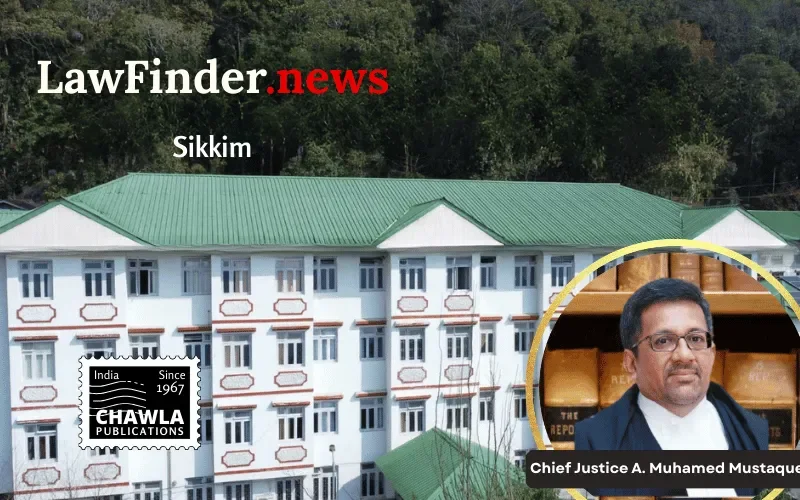
In a recent judgment dated November 4, 2026, the Sikkim High Court, presided over by Chief Justice A. Muhamed Mustaque, dismissed a writ petition challenging the eligibility conditions prescribed in an Employment Notification for recruitment to the Sikkim Judicial Service. The petitioners, practicing advocates in the High Court and district courts of Sikkim, had sought to quash the notification issued on September 17, 2026, which invited applications for five entry-level posts.
The notification prescribed several eligibility criteria, including the possession of a Certificate of Identification (COI) and a valid Local Employment Card, an age limit of 35 years, a law degree from a recognized Indian university, proficiency in Nepali or other state languages, and adequate knowledge of computer applications to be tested during the viva-voce.
The petitioners contended that the requirement of COI and local employment card was unconstitutional and that the notification failed to comply with a Supreme Court mandate in Bhumika Trust v. Union of India (2026 SCC Online SC 956), which required a minimum one-year experience for judicial service applicants. However, none of the petitioners had applied for the posts, nor had their applications been rejected. The writ petition was filed just two days before the last date for submission of applications (October 30, 2026), and the interim application seeking stay was filed after the deadline.
The Court emphasized the importance of prompt action in service-related litigation, particularly recruitment disputes affecting a large pool of candidates. It cited the Supreme Court's ruling in Kerala Public Service Commission v. K.N. Radhamani (2021) 15 SCC 501, which underscored that delayed challenges post-deadline could lead to chaotic consequences and are therefore not entertained. The Court held that since the petitioners had not applied before the last date and sought relief after the deadline had passed, they lacked locus standi to maintain the petition.
Further, the Court refused to entertain the writ petition as a Public Interest Litigation (PIL), reiterating the Supreme Court's position that service matters are generally not amenable to PILs. While dismissing the petition in limine, the Court clarified that the larger constitutional question regarding the validity of the COI and local employment card requirement was left open for adjudication at an appropriate stage when raised by an aggrieved candidate who has applied within the stipulated time.
The Court also observed that the absence of the one-year experience criterion in the notification did not prevent the petitioners from applying, and since they had not applied, the question of non-compliance with the Apex Court's directions did not arise.
Consequently, the writ petition was dismissed outright, reinforcing the principle that challenges to recruitment processes must be raised promptly and by parties with direct interest.
Bottom Line:
Recruitment to Sikkim Judicial Service - Challenge to eligibility conditions in employment notification filed after expiry of last date for application and without petitioners having applied for posts - Held, such petition is not entertainable for want of promptitude and locus standi - Service matter cannot be converted into PIL - Larger question regarding validity of COI requirement left open.
Statutory provision(s):
Sikkim Judicial Service Rules, 1975
Anirudh Gupta v. State of Sikkim, (Sikkim) : Law Finder Doc Id # 3014061