Allahabad High Court Recognizes Tribunal's Authority to Evict Family Members as Incidental Relief for Elderly Protection; Senior Citizen's Rights Must Balance Against Daughter-in-Law's Domestic Violence Protections
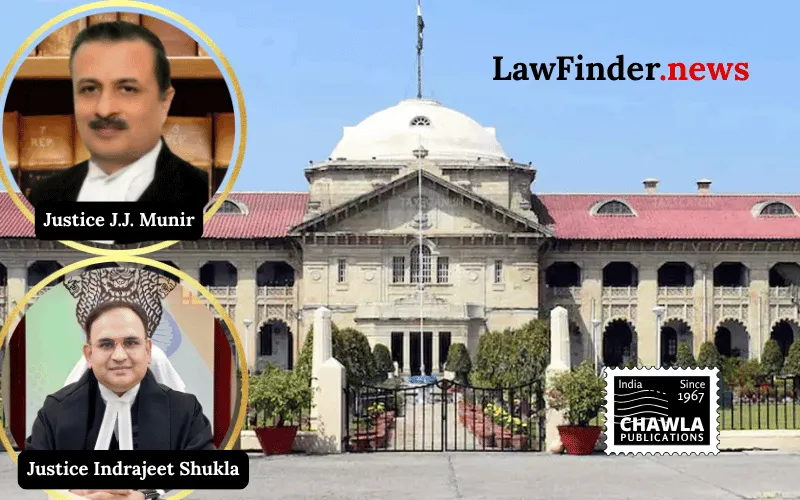
In a significant judgment that clarifies the scope of the Maintenance and Welfare of Parents and Senior Citizens Act, 2007, the Allahabad High Court has ruled that Maintenance Tribunals possess the authority to pass eviction orders as an incidental measure to protect the life, limb, and property of elderly citizens. This landmark decision, delivered by Justice Indrajeet Shukla and Justice J.J. Munir on August 25, 2026, reconciles conflicting judicial interpretations while establishing important safeguards against misuse of these powers.
The case involved Shyamji Shukla, an elderly petitioner seeking eviction of his son (Piyush Shukla) and daughter-in-law (Preeti Shukla) from his self-acquired residential property in Kanpur Nagar. Shyamji Shukla filed an application before the Maintenance Tribunal under Sections 5 and 22 of the 2007 Act, alleging that his son and daughter-in-law were causing nuisance, misbehavior, and threats that endangered his life and property. While the Tribunal provided police protection, it rejected the eviction relief on grounds of lacking jurisdiction to pass such orders.
The High Court's decision is built on several crucial principles that mark a departure from earlier restrictive interpretations. The court sided with the Supreme Court's recent judgment in Ravi Kant Gupta v. State of U.P. (2026), which explicitly held that tribunals under the Act possess power to order eviction when necessary and expedient to ensure the maintenance and protection of senior citizens. This power, the court emphasized, is not an unfettered one but functions as an incidental relief to enforcement of rights to maintenance and protection.
Justice Shukla observed that the legislature, by creating Maintenance Tribunals with powers to conduct inquiries and adjudicate maintenance claims, implicitly granted them the authority to employ means essentially necessary for execution of their jurisdiction. The court noted that restricting tribunals to maintenance awards while denying them eviction powers could render the welfare legislation ineffective, particularly in cases where elderly persons face genuine threats to their safety from family members occupying their property.
However, the court was careful to establish stringent limitations on this power. The eviction authority can be exercised only in "extraordinary circumstances" and must be supported by "cogent reasons" recorded by the Tribunal. Justice Shukla emphasized that the power should be exercised "sparingly and rarely" to reflect the Act's true spirit as beneficial legislation enacted to address modern family disintegration. The court explicitly rejected blanket eviction powers, clarifying that such orders must be directly connected to protecting an elderly person's life, health, and limb.
A critical aspect of this judgment addresses the interplay between the Maintenance and Welfare of Parents and Senior Citizens Act, 2007, and the Protection of Women from Domestic Violence Act, 2005. The daughter-in-law in this case had filed a separate proceeding under the domestic violence legislation, claiming the right to residence in the "shared household" as defined in that statute. Recognizing this conflict, the court held that the Tribunal's jurisdiction cannot be exercised to circumvent protections offered to women under the 2005 Act.
To harmonize these competing statutory regimes, the court directed that the Tribunal should await the outcome of domestic violence proceedings before deciding on eviction relief against the daughter-in-law. This measure ensures that the elderly person's right to protection does not override the daughter-in-law's statutory protections unless the Tribunal establishes compelling circumstances justifying eviction as an incidental relief. Notably, the court suggested that proceedings against the son could potentially proceed independently, as different legal principles apply.
The judgment also addressed a Full Bench decision of the Allahabad High Court in Onkar Nath Gaur v. District Magistrate (2025), which had concluded that Maintenance Tribunals possessed no eviction powers except in limited circumstances involving Section 23 of the Act (relating to void conveyances). The court held that the subsequent Supreme Court pronouncements in Ravi Kant Gupta and Kamla Kant Mishra v. Additional Collector (2025) superseded this restrictive interpretation under Article 141 of the Constitution, which mandates that Supreme Court judgments bind all lower courts.
Justice Shukla articulated the principle that High Courts cannot disregard Supreme Court rulings merely because they believe additional points were not considered or because conflicting precedents exist within the High Court itself. The law declared by the Supreme Court forms binding precedent throughout the country and supersedes even decisions of High Court Full Benches on the same subject matter.
The court emphasized important principles of statutory interpretation, acknowledging that courts cannot supply legislative omissions through creative interpretation. However, where a statute grants jurisdiction to a body, courts may infer incidental powers necessary for that body's effective functioning. The difference between reading powers into legislation and recognizing incidental necessary powers formed a crucial distinction in the court's reasoning.
Regarding the specific case, the court found the Tribunal's order "completely unsustainable" for refusing to even consider whether eviction was justified as incidental relief. The tribunal had not addressed the factual matrix or recorded reasons explaining why protection of the elderly petitioner's life and property did not necessitate eviction. This failure constituted an abdication of jurisdiction rather than a lawful exercise of discretion.
The High Court's directions require the Tribunal to reconsider the case with specific focus on whether eviction of respondents is expedient for protecting the petitioner's life and limb. The Tribunal must examine competing claims between the parties and ground its decision in factual findings regarding threats to the elderly person's security and dignity. The court set a three-month timeline for concluding these proceedings, emphasizing the need for expedition in cases affecting senior citizens.
The judgment clarifies that while Maintenance Tribunals now possess eviction authority, this power differs fundamentally from the plenary jurisdiction exercised by civil courts. It remains narrowly circumscribed, applicable only when eviction emerges as an incidental necessity for protecting elderly persons' fundamental rights to life and dignity. The court stressed that the Tribunal should evaluate factual allegations and determine whether family members' conduct genuinely threatens the senior citizen's safety or property before resorting to eviction as a remedy.
This decision has profound implications for elderly citizens facing neglect, abuse, or harassment by family members occupying their property. Previously, many seniors were left vulnerable despite possessing legal title to their homes, unable to evict problematic family members through the Tribunal process. The judgment now provides a potential avenue for relief, though carefully circumscribed to prevent abuse.
The court's insistence on awaiting domestic violence proceedings before acting against the daughter-in-law reflects awareness of how welfare legislation can be weaponized against vulnerable women. By requiring consideration of intersecting statutory protections, the judgment attempts to prevent elderly persons' legitimate needs from overriding the protections extended to abused women and daughters-in-law.
Legal experts anticipate this judgment will generate considerable litigation as elderly citizens seek eviction relief through Tribunals. The emphasis on "compelling circumstances" and "cogent reasons" suggests courts will scrutinize such applications carefully. The decision likely encourages dialogue between various stakeholders—elderly persons, family members, and legal professionals—regarding the proper scope of protective measures for seniors.
The Allahabad High Court's balanced approach represents an important development in India's framework for protecting vulnerable elderly citizens while simultaneously respecting the rights of other parties to shared households and properties. By grounding eviction authority in the incidental powers doctrine while imposing rigorous procedural safeguards, the judgment attempts to serve both protective and preventive functions within the senior citizens' welfare regime.
Bottom Line:
The Maintenance Tribunal under the Maintenance and Welfare of Parents and Senior Citizens Act, 2007, has the authority to pass eviction orders as an incidental relief if it is necessary to protect the life, limb, or property of senior citizens, subject to recording cogent reasons for such eviction.
Statutory Provisions
Maintenance and Welfare of Parents and Senior Citizens Act, 2007 - Sections 2(b), 2(s), 5, 7, 8, 9, 15, 16, 21, 23, 27; Protection of Women from Domestic Violence Act, 2005 - Sections 12, 17; Constitution of India - Articles 21, 41, 141, 226
Shyamji Shukla v. State of U.P., (Allahabad)(DB) : Law Finder Doc Id # 2971517