Court says adverse remarks against judges cannot be made on judicial side without hearing them; typographical overlap in connected trials did not justify comments on fitness for service
The Supreme Court has set aside adverse remarks made by the Rajasthan High Court against a judicial officer of the District Judge cadre, holding that such strictures could not have been passed on the judicial side without first giving the officer an opportunity to explain.
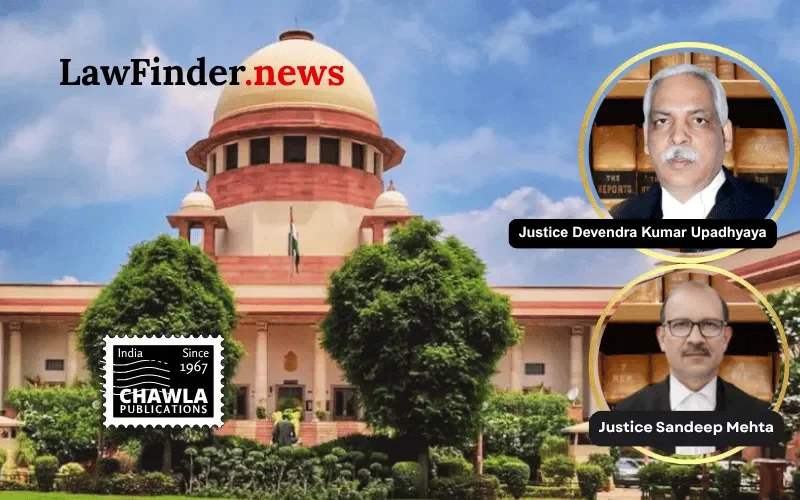
A Bench of Justice Sandeep Mehta and Justice Devendra Kumar Upadhyaya delivered the ruling on November 2, 2026, in In Re: XXX, A Judicial Officer in the District Judge Cadre of Rajasthan Judicial Services. The Court emphasized that inadvertent typographical or overlapping errors in a judgment, which do not affect the outcome of the case, cannot be treated as misconduct warranting condemnation of the presiding officer.
The controversy arose from two separate trials stemming from FIR No. 56/2019 registered at Police Station Malsisar, Jhunjhunu, Rajasthan. The FIR involved allegations under Section 376D of the Indian Penal Code and Sections 3 and 4 of the Protection of Children from Sexual Offences Act, 2012. One trial concerned an adult accused, while the other involved a child in conflict with law who, after preliminary assessment under the Juvenile Justice (Care and Protection of Children) Act, 2015, was ordered to be tried as an adult.
Because Section 23 of the Juvenile Justice Act bars joint proceedings of a child in conflict with law and an adult accused, separate trials and separate judgments had to be delivered. On January 20, 2024, the appellant judicial officer convicted both accused persons in their respective cases and sentenced each to 20 years’ rigorous imprisonment.
Later, while hearing a suspension of sentence application filed by the child in conflict with law, a Single Judge of the Rajasthan High Court noticed that parts of the judgment appeared to contain overlapping extracts from the connected trial. The High Court concluded that the trial judge had used a “cut, copy and paste” method, suggested that the judgment may have been written by a stenographer or clerk, and observed that such a judicial officer was “not entitled to remain in service of Judiciary.” It also directed that the officer be sent for training in judgment writing and that a copy of the order be placed in her Annual Confidential Report after obtaining her comments.
Challenging these remarks, the judicial officer approached the Supreme Court. Before the apex court, it was explained that the two cases arose from the same FIR, involved largely the same witnesses and evidence, and that the overlap in the judgment was inadvertent. The officer also pointed to limited staffing in the Special POCSO Court and stated that the sole stenographer had gone on leave, forcing her to dictate part of the judgment to a Lower Division Clerk on a computer. According to her, the incorrect witness numbering and overlapping portions were bona fide typographical mistakes that did not affect the substance or result of the judgment.
Accepting this explanation, the Supreme Court held that the High Court’s adverse observations were “uncalled for and avoidable.” The Bench said the remarks had been made without issuing notice to the judicial officer or giving her a chance to place her explanation on record, thereby violating the principles of natural justice, particularly the rule of audi alteram partem.
The Court underscored that High Courts, while exercising supervisory jurisdiction under Article 227 of the Constitution, must act as guardians of the district judiciary and display magnanimity. It observed that castigating a judicial officer for inadvertent typographical errors that did not alter the outcome of the case was not justified.
The Bench also warned that such harsh observations could have a “deleterious effect” on a judicial officer’s career and create a chilling effect across the district judiciary. Reiterating earlier rulings, the Court said that while an erroneous judicial order may be criticized, adverse comments on the personal conduct or calibre of a judicial officer should ordinarily not be made on the judicial side. If the conduct of an officer requires examination, the proper course is to place the matter before the Chief Justice or the administrative side of the High Court, where the officer can be heard.
Relying on precedents including In Re: ‘K’, A Judicial Officer, Kaushal Singh v. State of Rajasthan, Sonu Agnihotri v. Chandra Shekhar, and Shuvendu Saha v. State of West Bengal, the Supreme Court held that the foundational remarks of the High Court were legally unsustainable. Consequently, it expunged the strictures contained in paragraphs 9, 10 and 11 of the High Court’s order, and also set aside the consequential directions relating to training and inclusion of the order in the officer’s ACR.
Allowing the appeal, the Supreme Court directed that a copy of its order be sent to the Registrar General of the Rajasthan High Court for placing it before the Chief Justice.
The ruling is significant for reaffirming judicial discipline and procedural fairness in dealing with subordinate judges. It makes clear that mistakes in drafting, unless shown to affect the merits of the case or reflect serious misconduct, should not become the basis for public condemnation without due process.
Statutory provision(s): Article 227 of the Constitution of India, Section 376D of the Indian Penal Code, 1860, Sections 3 and 4 of the Protection of Children from Sexual Offences Act, 2012, Sections 15(1), 18(3) and 23 of the Juvenile Justice (Care and Protection of Children) Act, 2015