Court says release alone is not enough; directs 24-hour verification and release certificates, seven-day immediate aid, stronger inter-State coordination and continued monitoring
In a significant ruling aimed at strengthening the fight against bonded labour, the Supreme Court has held that the State’s duty does not end with rescuing a bonded labourer, but extends to timely financial assistance, rehabilitation and protection from falling back into exploitation.
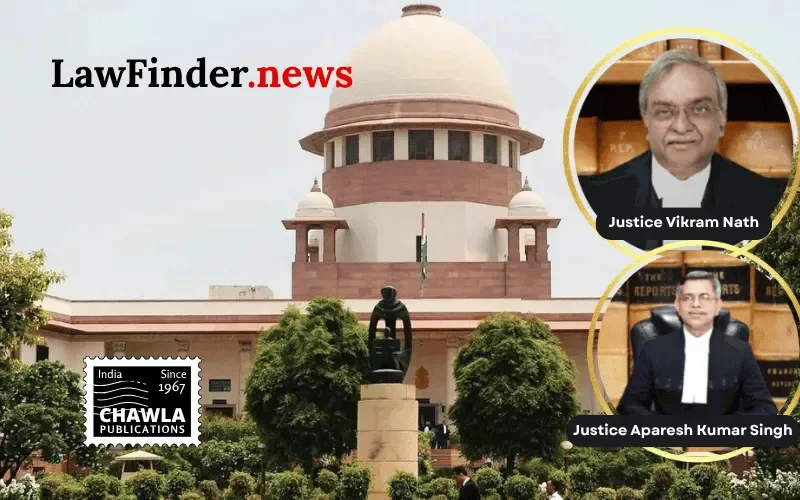
A Bench of Justice Vikram Nath and Justice Aparesh Kumar Singh passed the order on 2 November 2026 in writ petitions filed by Surendra Manjhi, a bonded labour survivor, and others, along with a connected petition raising wider concerns over the implementation of anti-bonded labour laws across the country.
The Court said identification, release and rehabilitation of bonded labourers are “interconnected stages of a continuing constitutional responsibility” flowing from Articles 21 and 23 of the Constitution. It stressed that delayed rehabilitation can effectively amount to denial of rehabilitation, especially where rescued labourers are left without livelihood support.
The case arose from the rescue of Surendra Manjhi and several others from a brick kiln in Shahjahanpur, Uttar Pradesh, in February 2019. They were allegedly taken from Bihar on the pretext of repayment of bonded debt and subjected to exploitative conditions. Although release certificates were later issued, the Court noted serious delays in payment of immediate financial assistance under the Central Sector Scheme for Rehabilitation of Bonded Labourers. Manjhi reportedly received assistance only in 2022, nearly three years after his rescue, and 17 other labourers were still awaiting payment.
Taking note of these facts, the Court ruled that immediate financial assistance cannot be withheld merely because criminal investigation or prosecution is pending, so long as the requirements of the rehabilitation scheme are otherwise met. It underscored that such aid is intended to meet urgent needs and loses its purpose if delayed for months or years.
The Bench also addressed recurring problems in inter-State rescue cases, where labourers are rescued in one State and repatriated to another. It observed that a rescued worker’s entitlement cannot depend on differing administrative practices between States. To address this, the Court directed the Union Government to ensure uniform implementation of the revised Standard Operating Procedure dated 14 May 2026 across the country.
Among the key directions, the Court ordered prompt verification of bonded labour complaints, ordinarily within 24 hours, followed by rescue where necessary. Once bonded labour is identified, release certificates are to be issued ordinarily within 24 hours. The Union Government has also been asked to prescribe a uniform format for release certificates that must be recognised by all States and Union Territories.
For rehabilitation, the Court directed that immediate financial assistance should ordinarily be disbursed within seven days of issuance of the release certificate, subject to verification. It further ordered that an individual rehabilitation plan be prepared and relevant rehabilitation measures initiated within 90 days of rescue.
The judgment also places strong emphasis on institutional accountability. All States and Union Territories have been directed to ensure that Vigilance Committees under the Bonded Labour System (Abolition) Act, 1976 are properly constituted and functional at district and sub-divisional levels. These committees are to periodically review identification, release and rehabilitation efforts.
The Court further ordered effective use of the NAVJIVAN Portal for digital monitoring of bonded labour cases, with regular updates by States and monthly review by State-level Monitoring Committees. Every district must designate an officer to receive grievances relating to non-issuance of release certificates, delayed financial assistance and rehabilitation benefits, with such complaints to be resolved ordinarily within 30 days.
In cases involving children, the Court directed strict compliance with child protection laws and called for access to education, medical care, counselling and age-sensitive rehabilitation measures without avoidable delay.
The Bench also specifically directed Uttar Pradesh and Bihar to jointly verify within one month the status of financial assistance payable to the 17 labourers rescued along with Manjhi. Any outstanding amount found due must be paid as expeditiously as possible, preferably within three months and in any event within six months.
Relying on earlier landmark rulings in Bandhua Mukti Morcha v. Union of India and Neeraja Chaudhary v. State of Madhya Pradesh, the Court reaffirmed that freedom from bonded labour must be meaningful and enduring, not merely formal. It said Article 32 jurisdiction can be used not only to remedy individual violations but also to address systemic failures that obstruct constitutional rights.
Given the seriousness of the issue, the Supreme Court kept the petitions pending for continued monitoring. The Union Government has been asked to file a compliance affidavit within four months, while all States and Union Territories must comply within six months and submit their reports thereafter. The matters will be listed again after seven months.
Bottom Line:
Supreme Court held that identification, release and rehabilitation of bonded labourers are interconnected constitutional obligations under Articles 21 and 23 - Immediate financial assistance cannot be defeated by administrative delays, inter-State coordination issues or pendency of criminal proceedings - Uniform SOP, timelines for rescue, release certificate, disbursement of assistance, inter-State coordination, vigilance committees, digital monitoring and child-sensitive rehabilitation directed.
Statutory provision(s): Article 21 of the Constitution of India, Article 23 of the Constitution of India, Article 24 of the Constitution of India, Article 32 of the Constitution of India, Sections 4, 5, 6, 10, 11, 12, 13, 14 of the Bonded Labour System (Abolition) Act, 1976
Surendra Manjhi v. Union of India, (SC) : Law Finder Doc id # 3008842