Proceedings to continue against husband, while Supreme Court quashes case against parents and second wife for lack of specific allegations
In a significant ruling on foreign divorce decrees and bigamy, the Supreme Court has held that a divorce granted by a court in England on the ground of “irretrievable breakdown of marriage” cannot automatically be recognised in India when the couple was married under Hindu law in India. The Court ruled that such a decree cannot be used by the husband to escape prosecution for bigamy under Section 494 of the Indian Penal Code.
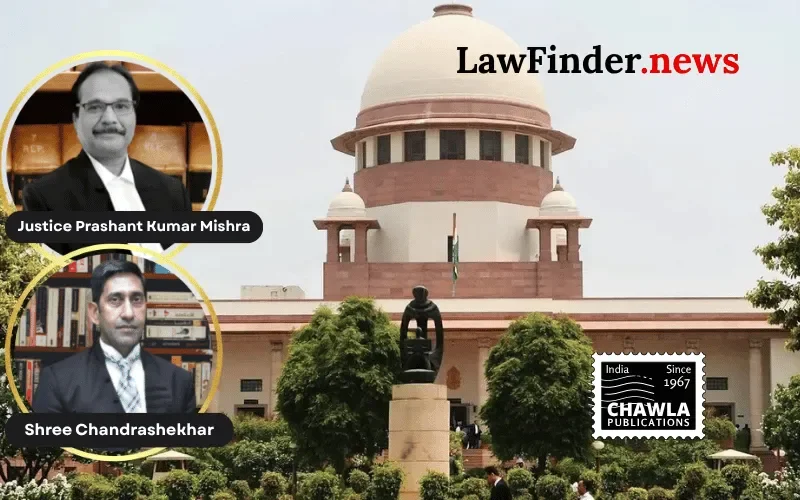
A Bench of Justices Prashant Kumar Mishra and Shree Chandrashekhar delivered the judgment in appeals arising from criminal proceedings filed by the first wife of Dr. N. Sridhar Reddy. The dispute stemmed from a marriage solemnised in Andhra Pradesh in 2003 according to Hindu rites. After matrimonial disputes arose, the husband had first sought divorce before a court in Andhra Pradesh, but his petition was dismissed. He later withdrew the appeal he had filed in the High Court.
Thereafter, after acquiring British citizenship, the husband approached the Cambridge County Court in England and obtained a divorce decree in January 2014 on the ground of irretrievable breakdown of marriage. He then married another woman in the United Kingdom in March 2014. In 2016, his first wife lodged a criminal complaint in Andhra Pradesh alleging bigamy and conspiracy.
The husband argued before the Supreme Court that since he had become a British citizen and the second marriage took place abroad, Indian penal law would not apply. He also contended that the foreign divorce decree was valid and binding, and that the first wife had participated in the UK proceedings. He further sought quashing of the criminal case on the ground of delay in filing the complaint.
Rejecting these submissions, the Supreme Court said that recognition of foreign matrimonial decrees in India must satisfy the requirements of Sections 13 and 14 of the Civil Procedure Code. The Court reiterated that the jurisdiction exercised by the foreign court and the ground on which divorce is granted must be consistent with the matrimonial law under which the parties were married.
Since the parties were married under the Hindu Marriage Act, the Court noted that “irretrievable breakdown of marriage” is not a statutory ground for divorce under that law. Therefore, the English decree could not automatically be treated as conclusive in India. The Bench relied on earlier decisions including Y. Narasimha Rao v. Y. Venkata Lakshmi and Satya v. Teja Singh, which laid down that foreign divorce decrees contrary to Indian matrimonial law or public policy are not binding.
The Court also found that the first wife had objected to the jurisdiction of the foreign court, and her participation in those proceedings could not be treated as voluntary and unconditional submission. As a result, the husband could not rely on the UK decree to claim that his first marriage had legally ended for the purposes of Indian law.
On the issue of nationality and the place of the second marriage, the Bench held that a later change in citizenship and solemnisation of a second marriage abroad do not wipe out the legal consequences of a subsisting first marriage solemnised in India. It said the inquiry into bigamy cannot be confined merely to the location of the second marriage.
The Court further rejected the plea that the complaint was delayed, observing that bigamy is a continuing offence and criminal proceedings cannot be quashed solely on that ground at the threshold.
However, the Supreme Court granted relief to the husband’s parents and the second wife. It held that mere relationship with the husband, knowledge of the second marriage, or vague allegations of encouragement were not enough to sustain charges of conspiracy or common intention. The Bench found no specific overt act, active participation, or material showing an agreement to commit the offence of bigamy.
As regards the second wife, the Court noted that the investigating agency itself had not found sufficient material against her and had deleted her name from the chargesheet. The Magistrate had later taken cognizance against her without assigning reasons. The Supreme Court held that mere cohabitation or marriage with the husband, without material showing conscious knowledge of the subsisting first marriage or knowing participation in the offence, was insufficient to continue criminal proceedings.
Accordingly, the Court dismissed the husband’s appeal and allowed the appeals filed by his parents and second wife. The criminal case for bigamy will now continue only against the husband.
Statutory provision(s): Section 13, Section 14 of the Civil Procedure Code, 1908, Section 494 of the Indian Penal Code, 1860, Section 4 of the Indian Penal Code, 1860, Section 120B of the Indian Penal Code, 1860, Section 34 of the Indian Penal Code, 1860, Section 482 of the Code of Criminal Procedure, 1973, Article 142 of the Constitution of India
Sridhar Reddy v. State of A.P., (SC) : Law Finder Doc id # 3010972