The Supreme Court of India ruled that adoption of a son-in-law by an uncle-in-law under Udaon customary law must be substantiated with evidence, setting aside lower courts' judgments.
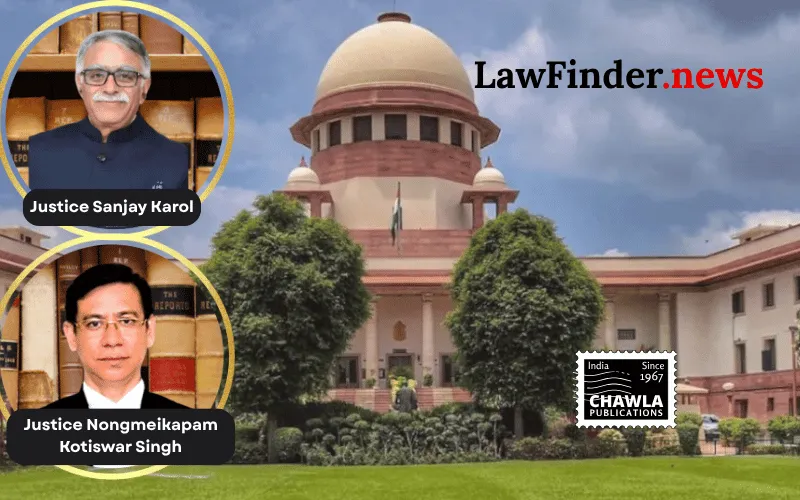
In a significant judgment delivered on July 9, 2026, the Supreme Court of India, comprising Justices Sanjay Karol and Nongmeikapam Kotiswar Singh, has underscored the necessity of substantiating claims of customary practices with concrete evidence. The case, Bejla Oraon v. Kali Das Oraon, revolved around the inheritance rights of a son-in-law, referred to as a "ghardamad," within the Udaon community.
The appellant, Bejla Oraon, challenged the property ownership claimed by the respondents, which was based on the alleged adoption of Punai, a son-in-law, by Ledura, an uncle-in-law. The courts below had upheld the respondents' claims, recognizing Punai's inheritance rights based on purported customary practices. However, the Supreme Court found these conclusions lacking evidentiary support.
The crux of the Supreme Court's decision rested on the principle that customs, particularly those deviating from general statutory principles, must be proven through long-standing and continuous usage. The Court observed that merely alleging a custom, without concrete evidence, is insufficient. The judgment clarified that the customary law of the Udaon community recognizes a ghardamad's right to inherit only when adopted by the father-in-law or the widow of the father-in-law, not an uncle-in-law.
Justice Sanjay Karol, delivering the judgment, emphasized that the onus of proving a custom lies with the party alleging it. The Court relied on established jurisprudence and scholarly works on the Udaon community's customs, indicating that such customs must be reasonable, certain, and uninterrupted since time immemorial.
The judgment also highlighted procedural lapses in the High Court's handling of the case. Although a substantial question of law regarding the validity of an uncle-in-law adopting a ghardamad was framed, the High Court had not addressed it adequately, relying instead on concurrent findings of lower courts. The Supreme Court rectified this, stating that the absence of an explicit prohibition against such adoption does not equate to its validation.
This ruling has significant implications for communities governed by customary laws, reiterating the importance of robust evidence in establishing customs that confer rights contrary to statutory norms. The Supreme Court's decision sets aside the judgments of the lower courts, decreeing in favor of the appellant, Bejla Oraon, and emphasizing that in the absence of a properly adopted ghardamad or male heir, the nearest male agnate is entitled to inherit.
The appeal was allowed, with the Supreme Court directing that each party bear their own costs.
Bottom Line:
Customary law among Udaon community - Ghardamad's eligibility to inherit property of father-in-law recognized; however, custom alleging adoption by uncle-in-law must be proven and cannot be presumed.
Statutory provision(s):
- Civil Procedure Code, 1908, Section 100
- Evidence Act, 1872, Section 48
Bejla Oraon v. Kali Das Oraon, (SC) : Law Finder Doc id # 2937239