Court rules that a widow’s limited interest under the 1937 Act enlarged into full ownership under Section 14(1) of the Hindu Succession Act, validating her Will and the subsequent sale.
The Supreme Court has dismissed a civil appeal filed by the legal representatives of Ganapati, upholding the Karnataka High Court’s decision that recognized the absolute ownership rights of his stepmother, Kashibai, over the disputed properties.
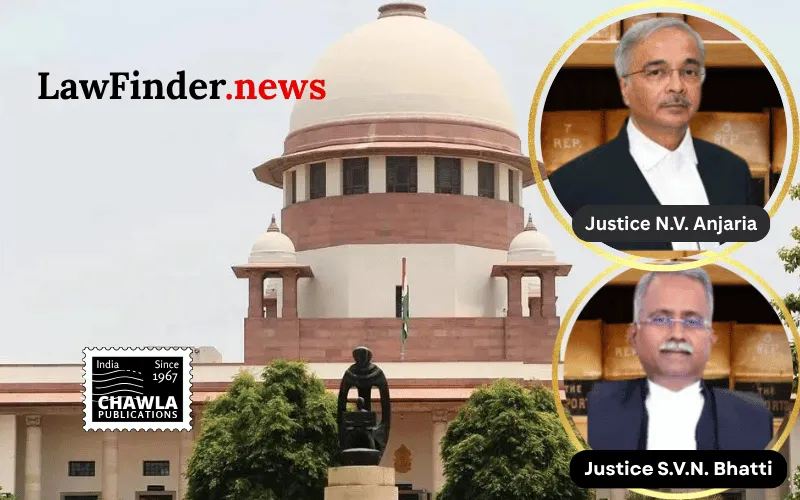
A Bench of Justices S.V.N. Bhatti and N.V. Anjaria held that Kashibai, the widow of Gangaram, had acquired rights in her husband’s property under Section 3 of the Hindu Women’s Rights to Property Act, 1937. Though the interest was limited at the time of inception, it automatically enlarged into full ownership under Section 14(1) of the Hindu Succession Act, 1956.
The dispute concerned house properties in Terdal village in Karnataka. Gangaram died intestate in 1949, leaving behind his son Ganapati from his first wife and Kashibai, his second wife, along with two daughters. Ganapati claimed exclusive ownership over the properties, arguing that Kashibai had no title and that the Will executed by her in 1984 in favour of her daughter was invalid. He also challenged the later sale deed executed by the daughter in favour of a third party.
The trial court and first appellate court had accepted Ganapati’s stand, holding that the defendants failed to prove an oral partition and that Kashibai had no transferable title. However, the High Court reversed those findings, concluding that Kashibai had inherited a share in Gangaram’s estate under the 1937 Act and that her rights had become absolute by virtue of Section 14(1) of the 1956 Act.
Affirming the High Court, the Supreme Court said the law on the issue is no longer res integra. The Court relied on earlier decisions, including V. Tulasamma, Raghubar Singh, and Potti Lakshmi Perumallu, to reiterate that a Hindu widow’s pre-existing right to maintenance and property is protected and enlarged into absolute ownership unless the case falls within the narrow exception under Section 14(2).
The Bench also rejected the argument that an actual partition between the son and widow was necessary for the widow’s right to mature into absolute ownership. It held that partition is not a sine qua non for the operation of Section 14(1). Even if the alleged oral partition was not proved, Kashibai’s statutory right remained unaffected.
The Court further ruled that once Kashibai became the absolute owner, she was competent to execute a valid Will in favour of her daughter, and the daughter in turn had the legal authority to transfer the property to a third-party purchaser. Accordingly, the challenge to the mutation, Will, and sale deed failed.
Dismissing the appeal, the Supreme Court said the High Court had correctly applied the law to the admitted facts and had rightly interfered under Section 100 of the Code of Civil Procedure.
Bottom Line:
Widow's right under Section 3 of Hindu Women's Rights to Property Act, 1937 enlarges into absolute ownership under Section 14(1) of Hindu Succession Act, 1956 - Actual partition between son and widow is not sine qua non for such enlargement - Widow competent to bequeath and transferee from legatee gets valid title.
Statutory provision(s): Hindu Women’s Rights to Property Act, 1937 Sections 3(1), 3(2), 3(3), Hindu Succession Act, 1956 Section 14(1), Section 14(2), Code of Civil Procedure, 1908 Section 100
Ganapati (Dead) by His LRs v. Prabhakar, (SC) : Law Finder Doc Id # 2983353