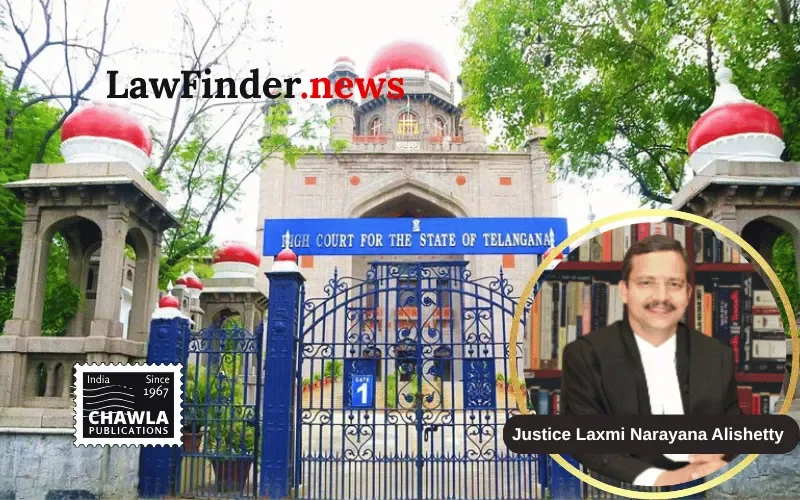
Court reiterates advocates' no-strike rule per Supreme Court directives, but refuses to proceed with contempt due to ongoing criminal cases and lack of specific evidence against all respondents
In a significant judgment delivered on September 21, 2026, the Telangana High Court, presided over by Justice Laxmi Narayana Alishetty, dismissed a contempt petition filed by advocate Vijay Gopal against the office-bearers of the Metropolitan Criminal Court Bar Association (MCCBA), Nampally, Hyderabad. The petition accused the respondents of passing a resolution calling for a one-day boycott of court work on June 16, 2025, obstructing the petitioner from entering the court premises, and physically assaulting him, thereby violating binding Supreme Court guidelines against advocates' strikes and boycotts.
The court reaffirmed the settled legal principle that advocates have no right to call for strikes or boycott court proceedings, as established in the landmark Supreme Court judgment in Ex-Capt. Harish Uppal v. Union of India (2003). The judgment reiterated that only in the "rarest of rare" cases involving the dignity, integrity, or independence of the Bar or Bench can a one-day abstention from work be tolerated-and only after consultation with the Chief Justice or District Judge concerned. The MCCBA's resolution, though confined to one day and ostensibly a show of solidarity against attacks on advocates, was not preceded by any consultation with the Metropolitan Sessions Judge, rendering it noncompliant with these guidelines.
However, the Court noted that the contempt petition suffered from procedural and substantive infirmities. The petitioner had arrayed all office-bearers of the MCCBA collectively without identifying individual roles or overt acts of contempt, except for respondent No.5, against whom specific allegations of assault were made. Contempt proceedings, being quasi-criminal, require proof beyond reasonable doubt of wilful disobedience by each accused, and vicarious liability cannot be fastened on others merely by virtue of their office positions.
Significantly, the Court declined to proceed further against respondent No.5 despite the serious allegations of assault and wrongful restraint. This was because these acts are already the subject matter of criminal investigations (FIR Nos. 159 and 160 of 2025) registered at Nampally Police Station, involving disputed questions of fact. The High Court held that it would not conduct a parallel adjudication of these factual disputes in contempt proceedings.
The Court emphasized that no Bar Association or its office-bearers can prevent any advocate from attending court or impose adverse consequences for ignoring a boycott call. It warned office-bearers to exercise restraint and ensure any future protests comply strictly with Supreme Court guidelines, without resorting to intimidation or obstruction.
In conclusion, while the Court unequivocally condemned any coercion or assault on advocates, it dismissed the contempt case for lack of sufficient material to establish contempt by all respondents and due to the pendency of criminal proceedings. The judgment serves as a strong reminder to Bar Associations about the limits of lawful protest and the paramount importance of ensuring uninterrupted access to justice.
Bottom Line:
Advocates have no right to strike or boycott court work; even a one-day abstention claimed to be in solidarity must satisfy the limited exception laid down in Ex-Capt. Harish Uppal, including prior consultation with the District Judge/Chief Justice. However, contempt against office-bearers of a Bar Association cannot be fastened collectively or vicariously without specific allegations and proof of wilful disobedience attributable to each individual; where assault and obstruction allegations involve disputed facts already subject to criminal proceedings, the High Court may decline to proceed in contempt.
Statutory provision(s): Contempt of Courts Act, 1971 Sections 2(b), 10, 11, 12, 15; Telangana High Court Rules of Practice, Rule 17; Bharatiya Nyaya Sanhita, 2023 Sections 115, 126, 351, 352, 3(5)
Vijay Gopal v. N.V. Ramana Goud, (Telangana) : Law Finder Doc Id # 2990631