Court Dismisses Petition Challenging Gender-Specific Recruitment Policy for Extension Officers
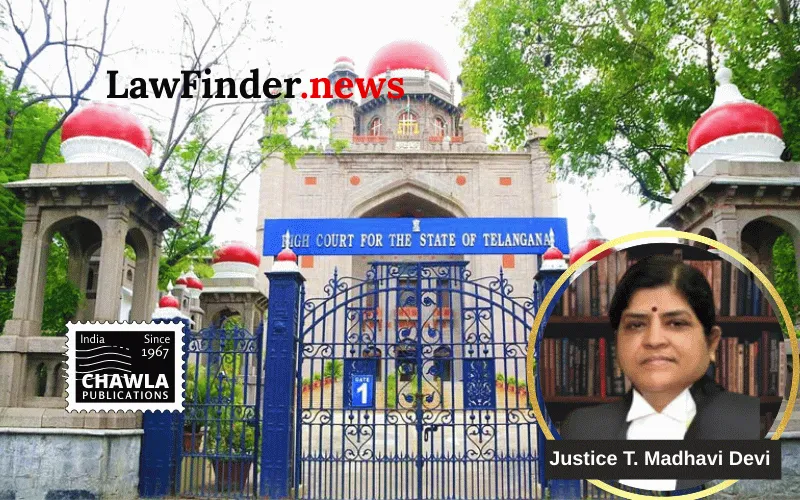
The Telangana High Court has upheld the state government's policy of reserving 100% of posts for women in the Department of Women Development and Child Welfare, dismissing petitions that challenged this reservation as discriminatory and unconstitutional. The judgment, delivered by Justice Smt. T. Madhavi Devi, supports the government's decision to exclusively recruit women for the posts of Extension Officers Grade-I and Grade-II (Supervisors), a move justified by the department's focus on women and children as primary stakeholders.
The petitioners, led by Boorla Mahesh, argued that the reservation violated Articles 14, 15(1), 16(1), 19(1)(g), and 21 of the Constitution, which guarantee equality and non-discrimination, including gender. They contended that the posts could be effectively filled by individuals of any gender, challenging the amendments made to G.O.Ms.No.14, which restrict recruitment to women only.
The court's decision reaffirmed the government's policy decision under Article 15(3) of the Constitution, which allows for special provisions for women. Justice Madhavi Devi noted that the decision was not arbitrary, given that the primary stakeholders and beneficiaries, such as children, adolescent girls, pregnant women, and lactating mothers, are predominantly women. Furthermore, Anganwadi workers, who form the core of the scheme's functionaries, are also women.
The court cited previous judgments, including Vijay Lakshmi v. Punjab University, where gender-specific recruitment was upheld to safeguard public morals and provide a protective work environment, particularly in roles involving significant interaction with women and children. The judgment emphasized that the exclusion of men from these posts was justified by the unique needs of the beneficiaries and stakeholders.
The ruling is significant for reinforcing gender-specific policies aimed at empowering women in sectors where they are more suited to perform due to the nature of the work involved. The decision underscores the court's stance on upholding government policies that aim to create a supportive and safe environment for women, especially in roles that require direct engagement with women and children.
Both petitions challenging the amendment were dismissed, with the court concluding that the government's decision did not violate the proviso to Rule 22-A(1) of the Telangana State and Subordinate Service Rules, 1996, which permits preference to women for posts where they are better suited. The court found that the government's policy was well within legal boundaries and served the intended social purpose effectively.
Bottom line:-
Reservation of 100% posts for women as Extension Officers in the Department of Women Development and Child Welfare is valid and does not violate Articles 14, 15(1), 16(1), 19(1)(g), or 21 of the Constitution of India, when the primary stakeholders and functionaries are predominantly women.
Statutory provision(s): Articles 14, 15(3), 16(1), 19(1)(g), 21 of the Constitution of India, Rule 22-A of the Telangana State and Subordinate Service Rules, 1996
Boorla Mahesh v. State of Telangana, (Telangana) : Law Finder Doc id # 2938084