Division Bench Rules State's Classification Reasonable and Within Executive Powers, Rejects Petition Challenging Exclusion of NCC `A' Cadets from Incentive Scheme
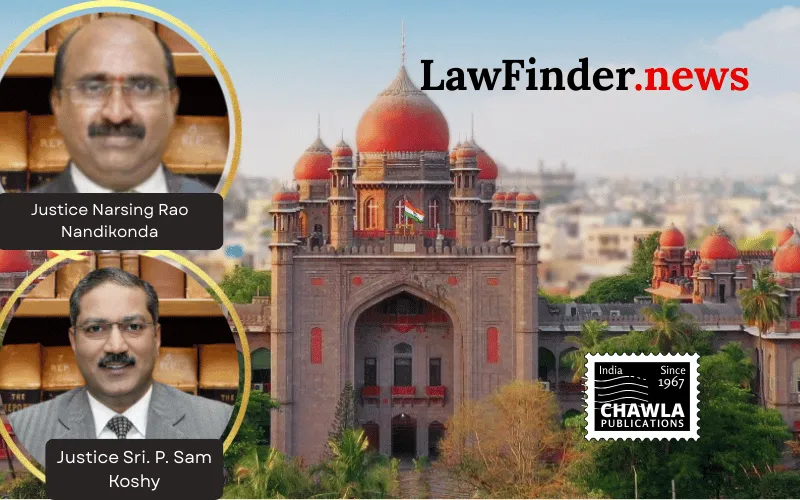
In a significant judgment dated September 1, 2026, the Telangana High Court (Division Bench) dismissed a writ petition challenging the State Government's policy of awarding grace marks to National Cadet Corps (NCC) `B' certificate holders in the NEET UG medical entrance examination, while excluding NCC `A' certificate holders from this benefit. The petitioner, Chatla Susheel Kumar, had contended that the exclusion of NCC `A' certificate holders from the grace marks scheme was arbitrary, discriminatory, and violative of Articles 14, 15(4), 21 read with Article 46 of the Constitution of India.
The policy under challenge stemmed from Government Order (G.O.Ms.No.75) dated July 4, 2023, which replaced the earlier 1% horizontal reservation quota for NCC cadets in medical and dental admissions with a system of grace marks awarded to qualifying NCC cadets. The grace marks ranged from 3% to 7% based on categories such as participation in Republic Day Camp, Thal Sainik Camp, and possession of NCC `B' certificate. Notably, the policy excluded NCC `A' certificate holders - students who had completed NCC training up to Class X - from receiving any grace marks, providing the benefit only to those holding NCC `B' certificates, typically awarded after completion of Class XII.
The Court relied heavily on a prior Division Bench ruling in Silamkoti Yanjleena v. State of Telangana (2025), which had upheld the constitutional validity of the policy change from reservation to grace marks for NCC cadets. In that ruling, the Court emphasized the limited scope of judicial review over executive and legislative policy decisions, particularly those involving incentive schemes in educational admissions. It held that the State's decision to replace a narrow reservation quota with grace marks was a valid exercise of executive power aimed at incentivizing a broader base of NCC cadets.
Addressing the specific grievance of exclusion of NCC `A' certificate holders, the Court held that this classification was based on an intelligible differentia - the stage of education and NCC training completed. Since NEET eligibility requires completion of Class XII or equivalent, and NCC `B' certificates are awarded to students who have pursued NCC till Class XII, granting grace marks only to `B' certificate holders aligns with the objective of incentivizing students pursuing NCC till the minimum qualification required for NEET. The Court found this classification to have a rational nexus with the State's objective and thus did not violate Article 14's guarantee against arbitrary discrimination.
The petitioner's reliance on the training similarity between `A' and `B' certificate holders and their expectation for equal benefit was found insufficient to overturn the policy decision. The Court underscored that the choice between reservation and grace marks, as well as the criteria for awarding such marks, falls within the domain of policy making and is subject to limited judicial interference.
The Court also noted that the doctrine of legitimate expectation could not compel the State to maintain a particular policy indefinitely, especially when the policy change aims to serve a broader public interest. Additionally, references to policies of neighboring States were held irrelevant as each State is free to formulate policies suited to its specific circumstances.
In conclusion, the Telangana High Court affirmed the State Government's policy as constitutionally valid, rational, and not arbitrary, thereby dismissing the writ petition filed by Chatla Susheel Kumar. The judgment reinforces the principle that policy decisions involving educational incentives and reservations are to be respected unless they are manifestly arbitrary or illegal.
Bottom Line:
Policy decisions taken by the State are subject to limited judicial review. A reasonable classification in policy decisions, such as awarding grace marks to NCC 'B' certificate holders while excluding NCC 'A' certificate holders for NEET admissions, does not violate Article 14 of the Constitution if the classification has a rational nexus with the objective of the policy.
Statutory provision(s):
Article 14, Article 15(4), Article 21, Article 46 of the Constitution of India; National Cadet Corps Act, 1948; Telangana Medical and Dental Colleges Admission (Admission into MBBS & BDS Courses) Rules, 2017.
Chatla Susheel Kumar v. State of Telangana, (Telangana)(DB) : Law Finder Doc Id # 2974323