New Delhi, Aug 11 The Supreme Court on Tuesday said an employee's termination order for not disclosing criminal antecedents should not be mechanical and the employer must apply its mind before arriving at a decision on the nature of suppression, type of offence and nature of employment.
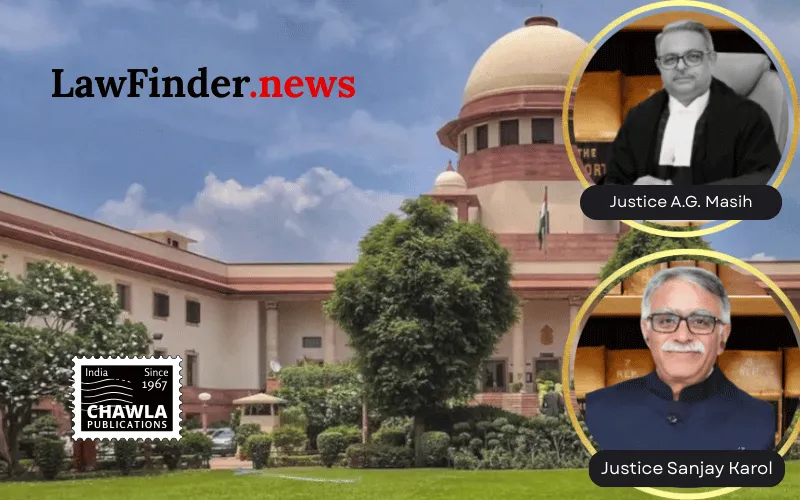
A bench of justices Sanjay Karol and AG Masih said termination is therefore not an automatic consequence of the disclosure of criminal antecedents; rather, the specific case of the employee must be considered, and the employer must apply its mind before arriving at a decision.
Restoring the job of Shatrughan Yadav, who was terminated from Fertilizers and Chemicals Travancore Ltd for not disclosing a non-cognizable offence case against him, the bench said an enquiry must be made by the employer, before proceeding to terminate someone's services on the ground of suppression of information regarding criminal antecedents.
"The order of termination must not be mechanical but must have regard to the form of suppression, the outcome of the criminal case, the nature of the employment and of the offence, and any special circumstances.
"Termination is therefore not an automatic consequence of the disclosure of criminal antecedents; rather, the specific case of the employee must be considered, and the employer must apply its mind before arriving at a decision," it said.
The bench said the inquiry to be undertaken by the employer must be two-pronged - whether there was any truth in suppression or furnishing of false information by the candidate, having regard to the extent of his knowledge at the relevant time and the circumstances in which the declaration came to be made.
It said the second prong of enquiry requires the authorities to apply their mind to the specific facts and circumstances of the case including the type of the suppression, the nature of allegations, role and gravity of the offence, the nature of the post and the duties attached to it and wherever relevant the effect thereof, and the eventual outcome of the criminal proceedings, if concluded, in order to arrive at a considered conclusion that the only option available is termination from service.
The top court said, "It is only where both these stages of enquiries are undertaken and not otherwise, that an order of termination on this ground can be said to be sustainable in law."
The bench, which found Yadav's termination order as not sustainable in law, said that he has throughout maintained that he was neither arrested in the case nor was ever summoned and therefore he did not have any knowledge of pendency of any case while making declaration for the company at the time of joining of job.
"Needless to say, knowledge of a fact is a necessary pre-requisite for its non-disclosure. The very concept of suppression presupposes an awareness of that which is suppressed; one cannot be said to have withheld or concealed something of which one had no knowledge in the first place. It would be both illogical and unjust to hold a candidate liable for suppression of information that was never within his knowledge to begin with," the bench said.
It said where the very existence of a criminal antecedent is not shown to have been within the candidate's knowledge at the relevant time, he cannot be held to have suppressed or furnished false information in that regard, there being no suppression of a fact that was, to him, non-existent.
The top court, however, said such lack of awareness of the existence of a criminal antecedent is itself a fact that must be established by the candidate, the onus being upon him to substantiate the claim before the employer.
"A bare plea of ignorance, without cogent and reliable material to assert such a claim, will not suffice to escape liability. Were it otherwise, the requirement of disclosure in verification forms would be rendered illusory, open to circumvention by simply pleading ignorance," it said.
The bench pointed out in the instant case, Yadav's consistent claim of bona fide ignorance of the non-cognisable report stands duly established by documentary evidence on record.
"In light of the above, we answer the issue framed by us in the negative, and hold that the termination of the appellant was not permissible in law, as it fails on both the prongs, the order being illegal as well as without application of mind," the bench held. It directed Yadav's reinstatement in service forthwith with all consequential benefits, except for backwages which will be restricted to 50 per cent to be paid within a period of eight weeks.