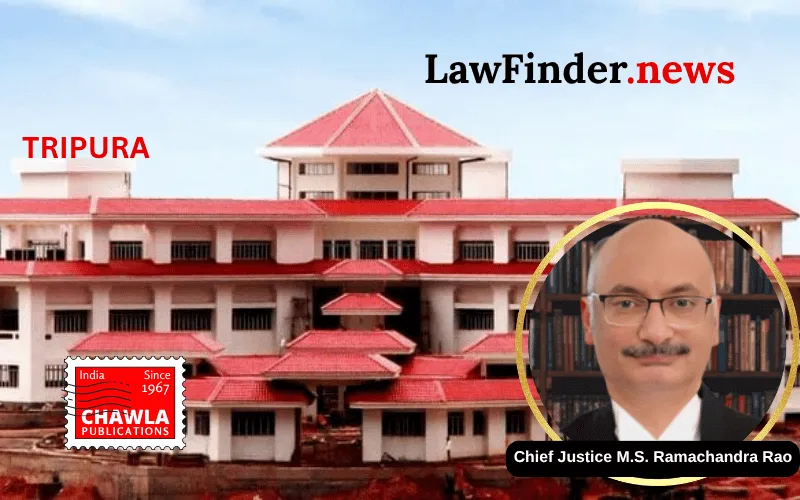
High Court Sets Aside Lower Court's Orders, Calls for Liberal Approach in Substitution and Condonation of Delay
In a significant judgment, the Tripura High Court has revived a legal battle concerning land possession, setting aside previous orders by the District Judge, Gomati District, Udaipur. The case, involving appellants Sukesh Chandra Saha and others against respondent Parimal Saha, centers around the possession of a disputed property initially claimed by the respondent. The High Court's decision underscores the necessity for a liberal interpretation of substitution applications and delay condonation under the Civil Procedure Code, 1908.
The case originated from Title Suit 02 of 2021, where the respondent sought a declaration of ownership and recovery of possession of the property. The appellants, who are legal heirs of the original defendants, faced an ex-parte decree due to procedural lapses, including the withdrawal of their counsel without notice. This led to the dismissal of their Title Appeal 19 of 2025 and associated applications by the District Court.
Presiding over the case, Chief Justice M.S. Ramachandra Rao emphasized the importance of a justice-oriented approach, particularly for senior citizens and individuals of unsound mind, in cases involving procedural delays. The High Court criticized the lower court for not considering the circumstances leading to the appellants' lack of representation and the subsequent ex-parte decree.
The High Court highlighted that the substitution of legal representatives under Order XXII Rule 4 of the CPC should be liberally construed. It stated that the filing of substitution applications within the prescribed timeframe should automatically set aside abatement, aligning with previous Supreme Court rulings. The judgment also addressed the need to condone delays under Section 5 of the Limitation Act, 1963, when justified by sufficient cause.
By invoking its powers under Article 227 of the Constitution of India, the High Court set aside the orders of the District Judge, directing the restoration of the Title Appeal 19 of 2025. The appeal will now be reconsidered on merits, with instructions for a swift decision within four months. Furthermore, the execution proceedings arising from the original suit have been stayed pending the appeal's outcome.
This ruling serves as a reminder of the judicial system's responsibility to ensure fair opportunities for litigants to present their cases, especially when procedural lapses are beyond their control. The decision reinforces the principle that substantial justice should prevail over procedural technicalities.
Bottom line:-
The High Court held that substitution of legal representatives under Order XXII Rule 4 CPC must be liberally construed, and filing of substitution applications within the prescribed period automatically sets aside abatement. It further emphasized that senior citizens and persons of unsound mind should not be penalized for procedural lapses, especially when substantial stakes are involved in the litigation.
Statutory provision(s): Order XXII Rule 4 CPC, Section 5 of the Limitation Act, 1963, Article 227 of the Constitution of India
Sukesh Chandra Saha v. Parimal Saha, (Tripura) : Law Finder Doc id # 2934561