Court Clarifies that Basic Statutory Motor Vehicle Insurance Policies Exclude Coverage for Gratuitous Pillion Riders; Insurance Company Not Obligated to Compensate in Such Cases
Agartala, 7 September 2026 - In a significant judgment concerning motor vehicle insurance claims, the Tripura High Court has upheld that pillion riders on two-wheelers are not covered under the basic statutory third-party insurance policies unless an additional premium is specifically paid to cover such risks. The ruling came in the appeal filed by the parents of a deceased pillion rider seeking compensation following a fatal accident involving their son, Deep Chakraborty.
The case arose from a tragic accident on 29 June 2019 on the Agartala-Airport road, where the motorcycle ridden by the insured vehicle owner collided with a tree, resulting in grievous injuries leading to the death of the pillion rider, Deep Chakraborty. The claimants, the deceased's parents, approached the Motor Accident Claims Tribunal (MACT) seeking compensation from the insurance company that had insured the vehicle under a statutory "Act on Policy/Liability Policy." The tribunal dismissed the claim, and the claimants appealed.
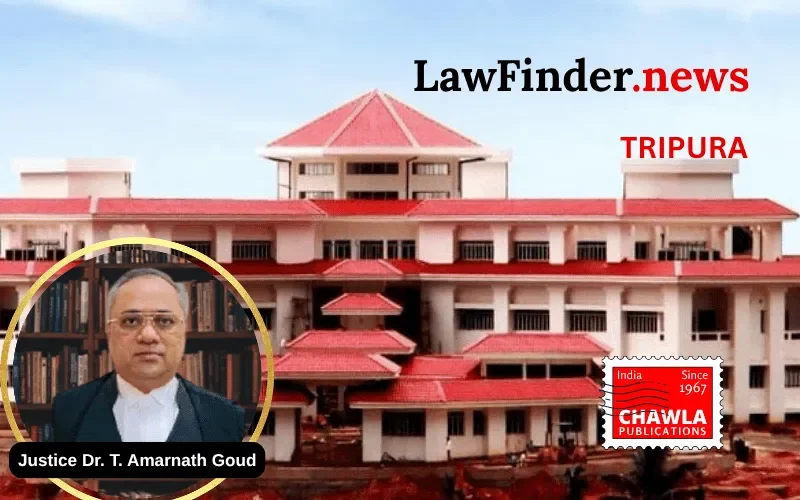
The High Court, presided over by Justice Dr. T. Amarnath Goud, extensively analyzed the Motor Vehicles Act, 1988, particularly Sections 146 and 147, which mandate compulsory third-party insurance for motor vehicles. The Court noted that while such policies cover third-party liabilities arising from death, bodily injury, or property damage, they explicitly exclude coverage for gratuitous passengers like pillion riders unless a specific additional premium is paid.
The Court observed that the insurance policy in question was a basic liability policy, with no evidence of any add-on premium having been paid to cover the risk of the pillion rider. The policy provided protection only for the owner-driver, and an avoidance clause negated liability for unauthorized use or risks outside the policy's scope. The Court relied on binding precedents from the Supreme Court of India, including Oriental Insurance Company Limited v. Sudhakaran K.V. (2008) and United India Insurance Company Limited v. Tilak Singh (2006), which have consistently held that pillion riders are not "third parties" under a statutory third-party insurance policy unless specifically covered.
Further, the Court emphasized that the doctrine of "pay and recover," which sometimes obliges insurers to pay compensation upfront and recover it later from the insured, is inapplicable here since the insurer is not liable under the policy terms for a pillion rider's death.
The judgment clarified that the statutory obligation under Section 147 of the Motor Vehicles Act is limited to third-party risks and does not extend to gratuitous pillion riders, who must be covered by a separate contractual provision supported by an additional premium. Consequently, the insurance company was held not liable to compensate the claimants for the death of their son.
Dismissal of the appeal by the Tripura High Court reaffirms the legal position that pillion riders cannot claim compensation from an insurer under a basic statutory third-party policy. This judgment serves as a crucial guideline for claimants and insurers alike regarding the scope and limits of compulsory motor vehicle insurance coverage.
Bottom Line:
Motor Vehicles Act, 1988 - A pillion rider is not covered under a basic statutory "Act" or "Liability" policy unless additional premium is paid to cover the risk. Insurer is not liable for the death or bodily injury of a gratuitous pillion rider under such a policy.
Statutory provision(s):
Motor Vehicles Act, 1988 Sections 146, 147
Sri Ranjan Chakraborty v. Sri Debabrata Saha, (Tripura) : Law Finder Doc Id # 2980558