Disciplinary Authority Directed to Communicate Tentative Reasons for Disagreement Before Ordering Fresh Inquiry; Earlier Order Quashing Fresh Inquiry Reinstated
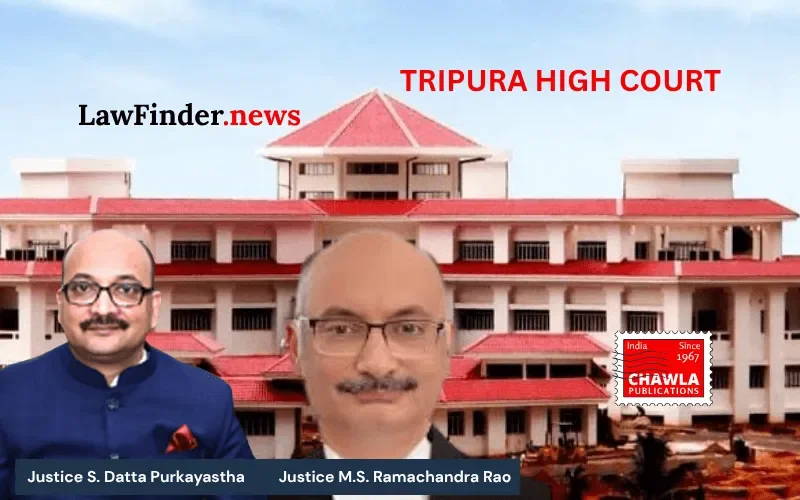
In a significant judgment delivered on 29th September 2026, the Division Bench of the Tripura High Court, comprising Chief Justice M.S. Ramachandra Rao and Justice S. Datta Purkayastha, reaffirmed the mandatory procedural safeguards under Rule 15(2) of the Central Civil Services (Classification, Control and Appeal) Rules, 1965 ("The Rules") in departmental disciplinary proceedings.
The case arose when the State of Tripura, through the Commissioner & Secretary, General Administration (Personnel & Training) Department, challenged the order of the Single Judge quashing the disciplinary authority's order directing a fresh inquiry against Sri Goutam Choudhury, an employee who had earlier been exonerated by the Inquiry Officer.
Background:
The disciplinary proceedings began with a show cause notice issued on 15th September 2018, followed by framing of charges and an inquiry which resulted in the Inquiry Officer exonerating the respondent of all allegations by report dated 10th May 2021. However, the disciplinary authority disagreed with the findings and, without communicating any tentative reasons to the respondent, ordered a fresh inquiry on 28th July 2021. This order, along with subsequent orders appointing new inquiry officers, was challenged by the respondent in WP(C) No.708/2023.
The Single Judge, on 11th December 2023, set aside the fresh inquiry order, holding that the disciplinary authority failed to comply with Rule 15(2) which mandates that if the disciplinary authority disagrees with the Inquiry Officer's report, it must communicate its tentative reasons for disagreement to the employee and provide an opportunity to submit written representations. The Court emphasized that bypassing this procedure violates the principles of natural justice and is liable to be quashed.
Despite this binding judgment, the disciplinary authority issued another order on 2nd March 2024 invoking Rule 15(1) to remit the matter back for further inquiry from the stage of inspection of records, effectively bypassing the requirement under Rule 15(2). The respondent again challenged this order in WP(C) No.372/2024, and the Single Judge quashed the fresh inquiry order reiterating the requirement of Rule 15(2).
The State preferred the present Writ Appeal against this decision.
Court's Analysis and Decision:
The Division Bench examined the scope and applicability of Rule 15(1) and 15(2) of the Rules. Rule 15(1) allows the disciplinary authority to remit the case for further inquiry only if the authority itself is not the inquiry authority and the reasons for such remittance are recorded in writing. Rule 15(2), however, specifically governs the situation where the disciplinary authority disagrees with the inquiry report. It mandates that the disciplinary authority must communicate its tentative reasons for disagreement to the delinquent employee and invite his representation before passing the final order.
The Court noted that the earlier order dated 11th December 2023 in WP(C) No.708/2023 had conclusively held that the disciplinary authority's fresh inquiry order was illegal due to non-compliance with Rule 15(2). The subsequent invocation of Rule 15(1) to order fresh inquiry amounted to an impermissible override of the High Court's binding judgment.
The Court held that the disciplinary authority cannot devise its own procedure to bypass the statutory mandate. If dissatisfied with the inquiry report, the authority must follow the procedural safeguard under Rule 15(2) to ensure compliance with the principles of natural justice. The Court further directed that the disciplinary proceedings continue strictly in accordance with law.
Final Directions:
The appeal was dismissed with the following directions:
- The disciplinary authority shall communicate the tentative reasons for disagreement with the inquiry report to the respondent within four weeks.
- The respondent shall be given four weeks thereafter to submit his written objections or representations.
- After considering the representations, the disciplinary authority shall pass a final speaking order in accordance with law and communicate a copy to the respondent.
- The disciplinary proceedings shall continue strictly following these guidelines.
This judgment reinforces the importance of adherence to procedural fairness in departmental inquiries and clarifies the proper interpretation of Rule 15 of the Central Civil Services (Classification, Control and Appeal) Rules, 1965.
Bottom Line:
Departmental disciplinary proceedings - Once earlier order directing fresh inquiry was set aside for non-compliance with Rule 15(2) of the Central Civil Services (Classification, Control and Appeal) Rules, 1965, the Disciplinary Authority could not invoke Rule 15(1) to remit the matter for further inquiry and thereby bypass the binding earlier judgment - If Disciplinary Authority disagrees with exoneration report of Inquiry Officer, it must communicate tentative reasons for disagreement to delinquent employee and invite his representation before passing final order.
Statutory provision(s): Central Civil Services (Classification, Control and Appeal) Rules, 1965, Rule 15(1), Rule 15(2)
State of Tripura v. Sri Goutam Choudhury, (Tripura)(DB) : Law Finder Doc Id # 2989359