Court overturns Tribunal's dismissal, awards Rs.8.34 lakh with interest to deceased vehicle owner's family, emphasizing insurer's liability for passenger coverage under package policy
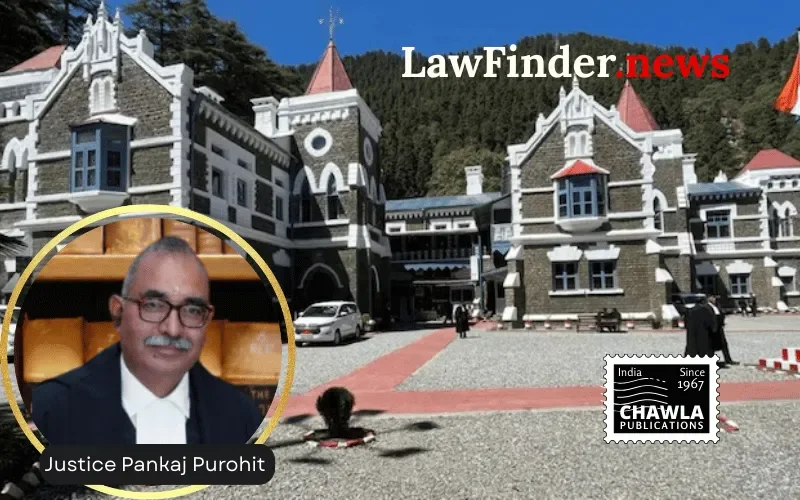
In a significant judgment delivered on September 11, 2026, the Uttarakhand High Court, presided over by Justice Pankaj Purohit, held that the owner of an insured vehicle, traveling as a passenger, is entitled to compensation under a comprehensive insurance policy which expressly covers liability towards passengers. This ruling came in the appeal filed by Smt. Poonam Devi and others, the legal representatives of the deceased owner, Laxman Singh, against the New India Assurance Company and another.
The case arose from a tragic accident on January 17, 2008, near Village Padagali, District Tehri Garhwal. Laxman Singh, the owner of a Tata Spacio vehicle bearing registration UA-7M-5553, was traveling as a passenger when the vehicle, driven by respondent Makan Singh, met with an accident resulting in his death. The deceased's family sought compensation of Rs.11.25 lakh from the insurance company.
The Motor Accident Claims Tribunal (MACT) initially dismissed the claim, holding that since Laxman Singh was the owner of the vehicle, he was not a third party under the Motor Vehicles Act, 1988, and thus not entitled to compensation under the insurance policy. The Tribunal relied on precedents like Dhanraj v. New India Assurance Co. Ltd. (2004) and Oriental Insurance Co. Ltd. v. Jhuma Saha (2007) to support its decision.
However, the High Court found this reasoning to be overly technical and not in line with the terms of the insurance policy in question. The Court observed that the vehicle was insured under a "Passengers Carrying Commercial Vehicle Policy B Package" which included a specific premium towards liability for nine passengers. The policy explicitly contemplated coverage for passengers, including the owner when traveling as a passenger.
The Court also referred to the Supreme Court's recent decision in National Insurance Co. Ltd. v. Smt. Thungala Dhana Laxmi (2026) which emphasized that under comprehensive/package policies, insurers are liable to compensate all occupants of the insured vehicle, not just third parties in the traditional sense.
Consequently, the Court held that the ownership status alone cannot bar the deceased from claiming compensation when the policy covers passengers. Since Laxman Singh was traveling as a passenger and the policy provided for passenger coverage, the insurance company was liable to compensate his legal representatives.
Regarding the quantum of compensation, the Court applied established principles from landmark Supreme Court cases including Laxmi Devi v. Mohammad Tabbar (2008), National Insurance Co. Ltd. v. Pranay Sethi (2017), and Sarla Verma v. Delhi Transport Corporation (2009). Taking the deceased's notional income as Rs.3,000 per month, and adding 40% for future prospects, the Court calculated the loss of dependency at Rs.6,04,800. Additionally, Rs.2,00,000 was awarded towards consortium to the wife, mother, and three minor children, along with Rs.15,000 each for loss of estate and funeral expenses, totaling Rs.8,34,800.
The Court directed the insurance company to deposit the awarded amount along with 7% interest per annum from the date of filing the claim petition until realization, within eight weeks. The Tribunal was instructed to release the amount to the claimants forthwith.
This ruling reinforces the principle that comprehensive vehicle insurance policies that include passenger liability cannot exclude owners traveling as passengers from claiming compensation in the event of accidents. It underscores the need for insurers and tribunals to consider the specific terms of insurance contracts rather than relying on rigid interpretations of ownership and third-party status.
Bottom Line:
Motor Vehicles Act - Owner of the insured vehicle traveling as a passenger is entitled to compensation under a comprehensive/package policy, provided the policy contemplates liability towards passengers.
Statutory provision(s):
Motor Vehicles Act, 1988
Smt. Poonam Devi v. New India Assurance Company, (Utt) : Law Finder Doc Id # 2979507