The Writer D. V. Dhindsa is an eminent lawyer at Punjab and Haryana High Court Chandigarh, Political Thinker and Farmer Activist.
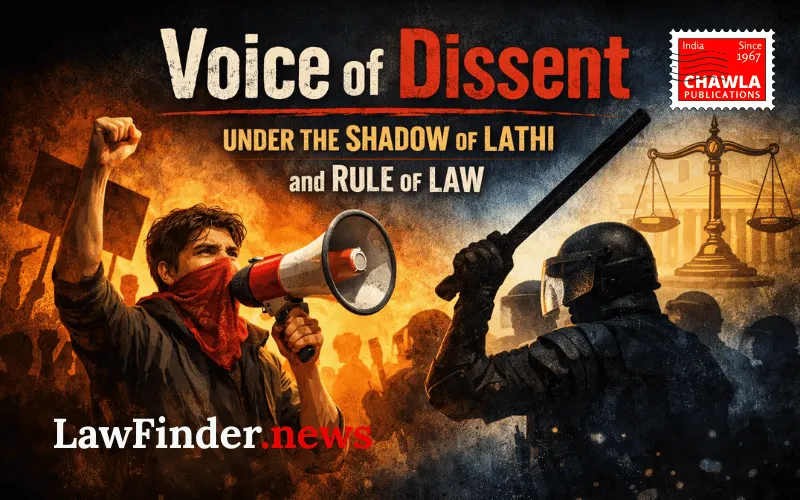
The recent incident of lathi charge on women and students at national capital Dehli-has once again intensified the debate as to how much force the police are allowed, or should be allowed, to use against citizens in a democratic system.
In democratic framework, where it is theoretically accepted that the public elects’ representatives to form a government to govern them but such incidents shake the very foundation of democratic system and compels to think, whether this democratic system is actually citizens oriented and even bothers to care for the will of masses.
The videos emerged showing police using excessive force and assaulting women and students during the protest in the national capital, Delhi, have certainly fueled a sense of public outrage against the police administration. After such incidents a basic and foundational question arises: How well-protected is the citizens' right to express dissent in a democratic system? And on what parameters and grounds do governments handle citizens who agree with state policies versus those who disagree?
Marches protests, and rallies are an integral part of democracy. While citizens who disagree with government policies have the right to protest, stage sit-ins, and hold rallies against broken promises or to demand public welfare policies, it is equally the government's duty to ensure that non-participating citizens and the nation's law and order are not harmed. Citizens constitutional right and states duty to maintain law and order is very crucial and a balance is required to be maintained between the two.
Constitution safeguard and Citizens' Rights to dissent
Constitution of India not only safeguards the freedoms of citizens through Fundamental Rights, but also binds the State within a strict framework of constitutional duties. Under these provisions, the government is obligated to treat all citizens equally-ensuring the right to life and liberty, Right to equality, Right to freedom of expression, Right to assemble peacefully including right to form association.
Article 14 of the Indian constitution states that “The State shall not deny to any person equality before the law or the equal protection of the laws within the territory of India.” Whereas the Article 19 provides that “All citizens shall have the right-to freedom of speech and expression; to assemble peacefully and without arms; to form associations or unions or co-operative societies; to move freely throughout the territory of India; to reside and settle in any part of the territory of India; and to practise any profession, or to carry on any occupation, trade or business ” and Article 21 directs the state that “No person shall be deprived of his life or personal liberty except according to procedure established by law.”
A collective reading of these provisions enshrined in the constitution to safe guard the liberties of the citizens and ensure their all-round development indicate the importance given to the citizens. Not only it was ensured that the authoritarian governments may not transgress in the realm at any point of time transgress in the realm citizens right but also the enforcement of these rights is ensured through constitutional remedies. Despite these rights and remedies the incidents of use of excessive force by Haryana police during the farmers protest at Shambhu and Khanouri border during farmers protest and recent LATHI charge in national capital of Delhi are not the exception.
Supreme Court on Citizen’s Right to Dissent
The fundamental rights granted by the Constitution of India are not left to the whims of the State. The Constitution itself empowers the citizens to enforce these rights through the Courts of Law.
Barring a few exceptions,the Apex Court has safeguarded these rights through various landmark judgments. If we look at the decision during the Emergency period in ADM Jabalpur case, which continues to be criticized in judicial circles today, the Apex Court has not only interpreted the fundamental rights with inclusive approach but expanded the scope. The apex court has built up an infallible shield by its decisions against the arbitrary state action and majority governments.
In Himat Lal K. Shah v. Commissioner of Police, Ahmedabad, (SC) : Law Finder Doc Id # 107174 the apex court held Rules 7, 13, 14 and 15the framed by Commissioner of Police Ahmedabad under the Bombay Police Act, 1951, Section 33(1)(o) as intra vires and reaffirmed that the Citizens’ have right to hold meetings subject to reasonable regulation, similarly in Mazdoor Kisan Shakti Sangathan v. Union of India (SC) : Law Finder Doc Id # 1109532 it was held that Right to hold peaceful protests and demonstrations is a fundamental right and held that certain categories of peaceful protests and demonstrations, in a guarded and regulated manner, could be allowed so as to enable the protestors to exercise their right and, at the same time, ensuring that no inconvenience of any kind is caused to the residents.
Rakesh Vaishnav v. Union of India, (SC) : Law Finder Doc Id # 1785305 it was held during Farmers protest that Protest is part of fundamental rights and that protest should be allowed to continue without impediment and without any breach of peace but also showed concern about the inconvenience to the public.
In Ramlila Maidan Incident v. Home Secretary, Union of India (2012) 5 SCC 1 is the leading judgment on police use of force against protesters.The Supreme Court held that:
Peaceful protest is a constitutional right.
Police must first attempt persuasion and negotiation.
Use of force should always be the minimum necessary.
Lathi charge and tear gas are measures of last resort.
State action must satisfy the test of proportionality.
The midnight police action at Ramlila Maidan was held to be unjustified, excessive and disproportionate, violating Articles 19 and 21.The Court observed that restrictions may be lawful, but their execution must also be lawful. Even a valid order becomes unconstitutional when enforced through disproportionate violence.
Whereas in Amit Sahni v. Commissioner of Police (Shaheen Bagh Case) (2020) the SC while affirming the right to protest, the Supreme Court clarified that public roads cannot be occupied indefinitely and Rights of protesters must be balanced with rights of commuters.Demonstrations should ordinarily be conducted at designated places.
After the unfortunate incident of lathi charge and use of pellet gun during recent protest in Delhi the apex court in Shailendra Mani Tripathi v. Union of India & Ors a bunch of petitions observed that "Right to peaceful, lawful protest absolutely guaranteed under Constitution. So long as it is peaceful agitation, merely because there is agitation, there can't be [excess]...If there is excess committed, it should be independently examined. It's not only a case of Delhi. Uniformity in protocol required. Merely because agitation there, doesn't mean lathi-charge. Discipline integral to democratic process."
Law to Regulate the Unlaw full Assembly and BNSS Safe Guard
After having glance at constitutional provisions and apex courts active involvement to safe guard these rights it’s necessary to have an overview on the law which empowers the security agencies to proceed and deal in such like matters, especially when the states obligation to maintain law and order and citizens right of dissent are vis-a-vis.
Section 148 of BNSS Dispersal of assembly by use of civil force.
- (1) Any Executive Magistrate or officer in charge of a police station or, in the absence of such officer in charge, any police officer, not below the rank of a sub-inspector, may command any unlawful assembly, or any assembly of five or more persons likely to cause a disturbance of the public peace, to disperse; and it shall thereupon be the duty of the members of such assembly to disperse accordingly.
- (2) If, upon being so commanded, any such assembly does not disperse, or if, without being so commanded, it conducts itself in such a manner as to show a determination not to disperse, any Executive Magistrate or police officer referred to in sub-section (1), may proceed to disperse such assembly by force, and may require the assistance of any person, not being an officer or member of the armed forces and acting as such, for the purpose of dispersing such assembly, and, if necessary, arresting and confining the persons who form part of it, in order to disperse such assembly or that they may be punished according to law.
Section 149 of BNSS Use of armed forces to disperse assembly.
- (1) If any assembly referred to in sub-section (1) of section 148 cannot otherwise be dispersed, and it is necessary for the public security that it should be dispersed, the District Magistrate or any other Executive Magistrate authorised by him, who is present, may cause it to be dispersed by the armed forces.
- (2) Such Magistrate may require any officer in command of any group of persons belonging to the armed forces to disperse the assembly with the help of the armed forces under his command, and to arrest and confine such persons forming part of it as the Executive Magistrate may direct, or as it may be necessary to arrest and confine in order to disperse the assembly or to have them punished according to law.
- (3) Every such officer of the armed forces shall obey such requisition in such manner as he thinks fit, but in so doing he shall use as little force, and do as little injury to person and property, as may be consistent with dispersing the assembly and arresting and detaining such persons.
Section 150 of BNSS Power of certain armed force officers to disperse assembly.
When the public security is manifestly endangered by any such assembly and no Executive Magistrate can be communicated with, any commissioned or gazetted officer of the armed forces may disperse such assembly with the help of the armed forces under his command, and may arrest and confine any persons forming part of it, in order to disperse such assembly or that they may be punished according to law; but if, while he is acting under this section, it becomes practicable for him to communicate with an Executive Magistrate, he shall do so, and shall thenceforward obey the instructions of the Magistrate, as to whether he shall or shall not continue such action.
Section 163 of BNSS Power to issue order in urgent cases of nuisance or apprehended danger.
- (1) In cases where, in the opinion of a District Magistrate, a Sub-divisional Magistrate or any other Executive Magistrate specially empowered by the State Government in this behalf, there is sufficient ground for proceeding under this section and immediate prevention or speedy remedy is desirable, such Magistrate may, by a written order stating the material facts of the case and served in the manner provided by section 153, direct any person to abstain from a certain act or to take certain order with respect to certain property in his possession or under his management, if such Magistrate considers that such direction is likely to prevent, or tends to prevent, obstruction, annoyance or injury to any person lawfully employed, or danger to human life, health or safety or a disturbance of the public tranquillity, or a riot, or an affray.
- (2) An order under this section may, in cases of emergency or in cases where the circumstances do not admit of the serving in due time of a notice upon the person against whom the order is directed, be passed ex parte.
- (3) An order under this section may be directed to a particular individual, or to persons residing in a particular place or area, or to the public generally when frequenting or visiting a particular place or area.
- (4) No order under this section shall remain in force for more than two months from the making thereof: Provided that if the State Government considers it necessary so to do for preventing danger to human life, health or safety or for preventing a riot or any affray, it may, by notification, direct that an order made by a Magistrate under this section shall remain in force for such further period not exceeding six months from the date on which the order made by the Magistrate would have, but for such order, expired, as it may specify in the said notification.
- (5) Any Magistrate may, either on his own motion or on the application of any person aggrieved, rescind or alter any order made under this section by himself or any Magistrate subordinate to him or by his predecessor-in-office.
- (6) The State Government may, either on its own motion or on the application of any person aggrieved, rescind or alter any order made by it under the proviso to sub-section (4).
- (7) Where an application under sub-section (5) or sub-section (6) is received, the Magistrate, or the State Government, as the case may be, shall afford to the applicant an early opportunity of appearing before him or it, either in person or by an advocate and showing cause against the order; and if the Magistrate or the State Government, as the case may be, rejects the application wholly or in part, he or it shall record in writing the reasons for so doing.
The collective reading of the above provisions clarifies; no doubt the law enforcement agencies have power to declare an assembly unlawful and can use force but the power is not unfettered. Under standard procedure, an Executive/Duty Magistrate must be deployed at the scene. If a gathering appears to violate the law, a clear warning must first be issued to the people present, officially declaring the assembly unlawful. If the assembly continues after being declared unlawful only then the force can be used to disperse it. But even then, there are strict rules governing the use of force. Special care must be extended to women, children, and the elderly. Force can only be used to a strictly limited and necessary extent. The Delhi incident calls these legal safeguards into question as the same was an attempt to silence the voice of dissent under the shadow of LATHI.
Conclusion
The incidents such as that of Shambhu and Khanauri, where not only excessive force was used but also extensive tear gas was fired at farmers and a farmer lost his life to a security force bullet and the recent incident of Delhi, inevitably create a sense of alienation among citizens toward the security forces.
We must not forget that security agencies exist for the protection of citizens and to maintain law and order. The weapons and power conferred upon the securities agencies can legally be used only against individuals or groups formally declared dangerous or harmful to the nation and not to curb the voice of dissent.In a constitutional democracy like India, no legal provision grants the police or any security agency, the right to use batons or bullets against citizens who gather to protest, hold sit-ins, or organize rallies to criticize government policies or demand public-interest reforms as use of excessive force by security agencies create the rift between the state and citizens and poses a threat to the rule of law.
The true test of any democracy is not how it treats those who agree with the government policies, but how it treats those who express dissent. No doubt the incidents of use of excessive force to curb the voice of dissent are unfortunate but we need to be hopeful for future reforms when the state will adopt the measures like equipping police officers with auto-mode body cameras during protests and imparting humanitarian, citizen-centric training. The voice of dissent must not be suppressed in the name of national security and law and order. The person in power must be aware the use of excessive force weakens public trusts, fuels alienation resulting in damage to the legitimacy of law enforcement agency and existence of state.