Apex Court says mere incorrect entry later corrected, without any gain or forged document, does not justify criminal prosecution under IPC Sections 420 and 465.
The Supreme Court has quashed criminal proceedings against a woman accused of furnishing the wrong date of death of her mother while applying online for a death certificate, holding that a mere mistake in the date—later corrected—does not by itself constitute cheating or forgery.
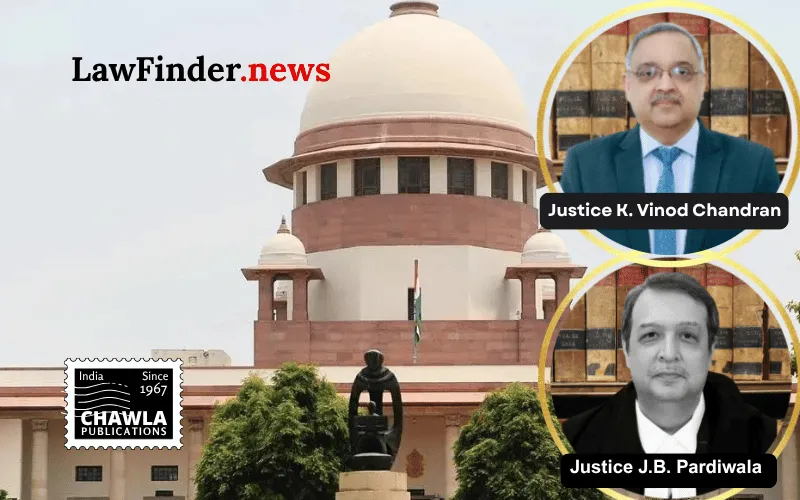
A bench of Justice J.B. Pardiwala and Justice K. Vinod Chandran allowed the appeal filed by Pooja and set aside the case pending before the Additional Chief Judicial Magistrate-I, Muzaffarnagar. The Court said that no useful purpose would be served by continuing the prosecution when the essential ingredients of the alleged offences were missing.
According to the case, the appellant had applied through an online system for issuance of a death certificate issued by the competent authority under the Panchayati Raj Vibhag, Uttar Pradesh. The certificate reflected the date of death as 21 November 2019. Later, a third party, Sanjay Kumar, complained that the actual date of death was 20 November 2019. Based on this complaint, an FIR was registered and a charge sheet was filed.
The appellant argued that there were family disputes and pending civil litigation with her sister, and that the complaint had been motivated by those disputes. She also claimed that she had relied on information given by her sister and had submitted the application through a Jan Sewa Kendra because she was not technically proficient.
The Supreme Court observed that the certificate was issued by the competent authority and there was no allegation of any forgery in the issuance of the document itself. The Court further noted that merely furnishing an incorrect date could also have been a bona fide mistake. Importantly, there was no allegation that the appellant had used the death certificate to obtain any wrongful benefit.
In these circumstances, the bench held that the allegations did not make out offences under Sections 420 or 465 of the Indian Penal Code. Since the incorrect date had already been corrected, continuing the criminal case would serve no useful purpose, the Court said.
The judgment reinforces the principle that criminal law should not be used to pursue prosecutions where the facts disclose at most a clerical or bona fide error, and where no dishonest intention or wrongful gain is shown.
Bottom Line:
Wrong furnishing of date of death in application for issuance of death certificate, when certificate was issued by competent authority and there was no allegation of use of certificate for obtaining any benefit, would not by itself constitute offences under Sections 420 or 465 IPC - Mere mistake in date, later corrected, does not justify continuation of criminal prosecution - Proceedings quashed.
Statutory provision(s): Sections 420, 465 of the Indian Penal Code, 1860