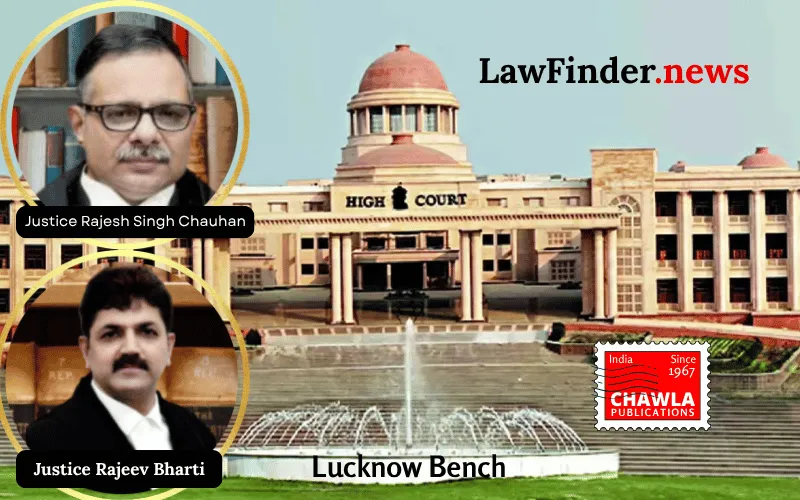
Lucknow, Oct 8 The Allahabad High Court has asked the Uttar Pradesh government to examine whether state law officers holding government posts should be permitted to contest elections to bar associations or the Uttar Pradesh Bar Council.
A Lucknow bench of Justices Rajesh Singh Chauhan and Rajiv Bharti directed the state government to consult all stakeholders, including bar associations, the UP Bar Council and state law officers, before taking an appropriate decision on the issue.
The bench also issued an eight-point set of guidelines governing the appointment and functioning of state law officers, stressing that the government should assess the actual requirement of law officers on the basis of the workload of cases before making appointments, according to the order made available on Thursday.
The directions were issued while hearing a batch of PILs, including one filed by Mahendra Singh Pawar.
Advocate General Ajay Kumar Mishra had submitted that the state government has a Legal Remembrancer (LR) Manual and engagements of law officers are made in accordance with its provisions.
Upholding the LR Manual, the court said the requirement of law officers should not be assessed merely on the basis of the number of criminal cases.
The government must take into account the entire range of litigation involving the state and the workload handled by law officers while determining their requirement, it said.
The court directed that clear eligibility and selection criteria be prescribed in advance and the selection process be made transparent and objective.
Appointments should be based on merit, experience, competence, integrity, conduct and suitability for the post, it said.
The guidelines apply to appointments including government advocates, additional government advocates, chief standing counsel, additional chief standing counsel, standing counsel and brief holders handling civil and criminal matters.
The bench said persons with a criminal background or undesirable conduct should not be appointed as state law officers.
The entire process of selection and appointment, including assessment of the requirements of law officers, should be transparent and, to the extent permitted by law, information relating to the process should also be made public, the court said.
It directed the state government to consider ensuring adequate representation of women advocates among law officers, subject to availability.
Apart from merit and suitability, the requirements of the administration of justice should also be kept in mind while making such appointments, the bench said.
The court further directed that whenever an FIR is registered, or a criminal case is instituted against a state law officer, a copy of the FIR or details of the case should be forwarded immediately to the Advocate General.
The Advocate General would then be required to take appropriate action in accordance with standards of professional integrity and the requirements of the administration of justice, it said.
The bench also made it mandatory for a state law officer representing a private party against the state to obtain a no-objection certificate (NOC) from the competent authority.
The NOC must be filed along with the vakalatnama, and violation of the requirement could invite disciplinary action against the concerned law officer. The restriction, however, would not apply to brief holders.
On the issue of bar elections, the bench directed the state government to undertake a comprehensive exercise to determine whether a state law officer should be permitted to contest elections to a bar association or the Bar Council while holding office.
The government should seek the views of all concerned stakeholders before taking an appropriate decision, the court said.
The court clarified that its observations and guidelines were not intended to affect appointments of state law officers that had already been made.
The directions have been issued to make future appointments more transparent, fair, objective and rational, the bench said.