Court directs Union Government and RBI to propose mechanisms for release of funds from savings accounts of comatose or deceased patients to their dependents, while urging State Government to consider Kerala HC guidelines.
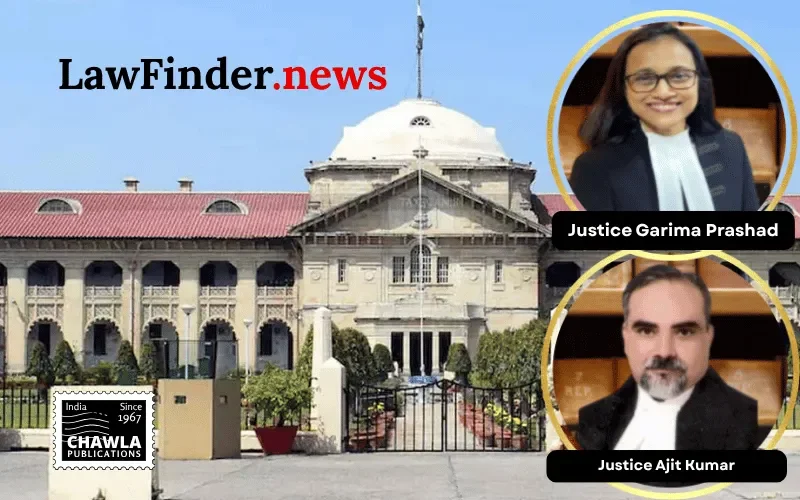
In a landmark judgment dated October 8, 2026, the Allahabad High Court (Division Bench comprising Justices Ajit Kumar and Garima Prashad) addressed the pressing issue faced by dependents of persons who are in a coma or have died, and whose savings bank accounts remain inaccessible. The Court highlighted the urgent need for clear legislative measures or regulatory guidelines to ensure that family members and dependents can access necessary funds for medical treatment, hospital expenses, and household management.
The case arose when Smt. Parveen Jahan, the petitioner, sought relief relating to funds in the savings bank account of her husband, who was in a coma and later passed away. The petitioner faced severe difficulty in withdrawing money from the account for treatment and day-to-day expenses, a predicament commonly faced by many families in similar situations.
Referring extensively to the Court's earlier ruling in Uma Mittal & Others v. Union of India & Others (2020), the bench noted that despite the passage of time, the Central Government and the Reserve Bank of India (RBI) had not implemented adequate measures to facilitate release of funds in such special circumstances. The Court observed that the absence of a mechanism renders dependents helpless, exacerbating their hardship during already distressing times.
Accordingly, the Court issued stringent directions to the Union of India and the RBI to file affidavits outlining any existing proposals or guidelines aimed at addressing this issue. The RBI was directed to respond specifically on whether it has framed or intends to frame guidelines for nationalized and subsidiary banks concerning the release of funds from accounts of comatose or deceased persons.
In addition, the Court instructed the State Government of Uttar Pradesh to consider adopting the guidelines framed by the Kerala High Court in Shobha Gopalakrishnan v. State of Kerala (2019), which had been referred to in Uma Mittal. The Chief Secretary of Uttar Pradesh was summoned to file a detailed affidavit on steps taken or proposed to implement such measures at the State level. The Court warned that failure to present a concrete plan in writing would necessitate the Chief Secretary's personal appearance in Court.
Importantly, the Court clarified that while these systemic solutions are being pursued, the petitioner remains free to apply for succession to claim the amount in the deceased account holder's savings bank account. This ensures that the petitioner can pursue relief through the succession process in the interim.
The case has been listed for further hearing on November 6, 2026, with notices to be served on the RBI and Union of India. The Court emphasized the urgency and seriousness of the matter, making it clear that non-compliance by the Central Government or RBI would compel the Court to summon responsible officials for personal explanation.
This judgment marks a significant step toward protecting the rights and welfare of vulnerable dependents who face financial and emotional crises when a breadwinner becomes comatose or dies. It calls upon legislative and regulatory authorities to urgently fill the existing legal vacuum and establish clear, standardized procedures for the release of funds from savings accounts under such critical circumstances.
Bottom Line:
Banking law - Savings bank account of a person in coma/deceased account holder - Dependents facing hardship in withdrawal of money for treatment and household expenses - High Court sought response from Union of India and Reserve Bank of India regarding legislation/guidelines for release of funds and directed State Government to consider enforcement of Kerala High Court guidelines referred to in Uma Mittal.
Statutory provision(s):
Banking law.
Smt. Parveen Jahan v. State of U.P., (All)(DB) : Law Finder Doc Id # 3000437