Court Holds One-Year Limitation Bar on Warrant Issuance Does Not Extinguish Substantive Right to Maintenance; Arrears Beyond Limitation Can Be Recovered Through Civil Remedy
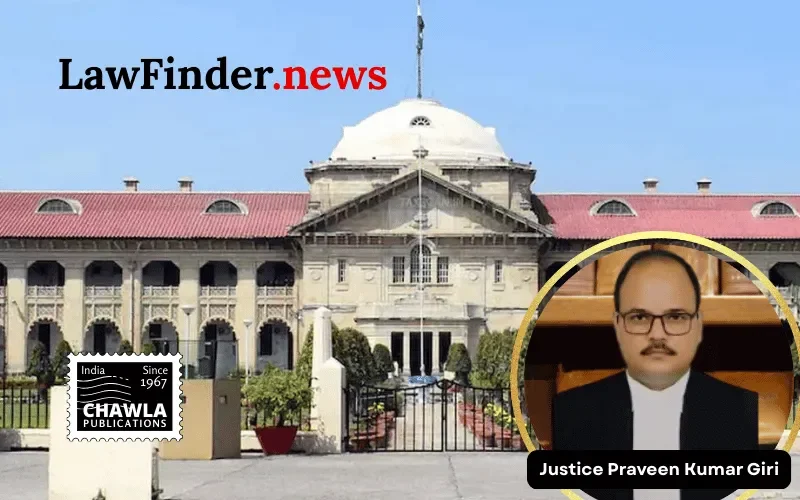
In a significant judgment dated October 16, 2026, the Allahabad High Court, presided over by Justice Praveen Kumar Giri, has elaborately interpreted the scope and limitation of the first proviso to Section 125(3) of the Code of Criminal Procedure, 1973 (CrPC) and corresponding Section 144(3) of the Bharatiya Nagarik Suraksha Sanhita, 2023 (BNSS), relating to enforcement of maintenance orders.
The revision petition filed by Smt. Sunita challenged an order of the Family Court, Hamirpur, which rejected her application for coercive recovery of maintenance arrears on the ground that it was filed beyond the prescribed limitation period of one year from the date the maintenance amount became due, as mandated by the first proviso to Section 125(3) CrPC.
The Court clarified that the one-year limitation under the proviso merely bars the issuance of a warrant and imprisonment as coercive measures if no execution or enforcement application is filed within one year from the date the maintenance amount became due. However, it does not extinguish the substantive right of the wife or claimant to receive maintenance arrears. The right to recover maintenance continues as a recurring liability under the original maintenance order.
Relying on the precedent set by the Supreme Court in Poongadi & Anr. vs. Thangavel (2013), the Court emphasized that once an enforcement application is filed within the limitation period, subsequent monthly defaults continue to accrue and remain enforceable without the necessity of filing successive applications for each month of default. If enforcement applications are not filed within the one-year window, coercive enforcement through warrants and imprisonment is not available, but arrears beyond limitation can still be pursued through ordinary civil remedies as a money decree.
The Court also elucidated the distinction between maintenance orders under different statutes and their modes of enforcement. Maintenance orders under the Hindu Marriage Act, 1955 and Hindu Adoptions and Maintenance Act, 1956 are executable as civil decrees under the Code of Civil Procedure, 1908, with a maximum civil imprisonment of three months for default in payment. In contrast, maintenance orders under CrPC Section 125/BNSS Section 144 are enforceable through special criminal procedure, allowing imprisonment up to one month for each month's default, subject to statutory conditions.
The judgment detailed the procedural mechanism for recovery of maintenance under Section 125(3) CrPC and Section 421 CrPC, which includes issuance of warrants for levy of fines by attachment and sale of movable property or recovery as arrears of land revenue. The Court underscored that the revenue authorities' power to recover arrears as land revenue does not replace or override the special procedure for imprisonment under the maintenance provisions.
Importantly, the Court upheld the Family Court's decision to reject the revisionist's application for coercive recovery filed beyond the limitation period, stating that no illegality was committed. Nevertheless, the revisionist was at liberty to recover the arrears beyond limitation through civil suit proceedings.
The judgment also highlighted the Supreme Court's directive to dispose of execution petitions expeditiously, preferably within six months, to ensure that the successful party receives timely relief.
In conclusion, the Allahabad High Court held that while the first proviso to Section 125(3) CrPC/144(3) BNSS restricts the coercive recovery of maintenance arrears beyond one year, it does not extinguish the substantive right to maintenance, which can be enforced by other civil remedies. The Court dismissed the revision petition but gave detailed guidelines for proper enforcement and recovery of maintenance arrears.
Bottom Line:
Maintenance, Section 125(3) CrPC/Section 144(3) BNSS - First proviso requiring application within one year does not extinguish substantive right to receive maintenance - It only bars coercive recovery by warrant and imprisonment for the time-barred period if no execution/enforcement application was filed within one year from the date amount became due - Where first enforcement application is filed within limitation, subsequent defaults may be pursued as continuing liability without filing successive applications for every month - Arrears beyond limitation may still be recovered by civil remedy as money decree.
Statutory provision(s):
Section 125(1), 125(2), 125(3), 128, 421 CrPC; Section 144(1), 144(2), 144(3), 147, 461 BNSS; Section 24 Hindu Marriage Act, 1955; Section 18 Hindu Adoptions and Maintenance Act, 1956; Section 18 Family Courts Act, 1984; Sections 51, 58, 169, 170, 184 U.P. Revenue Code, 2006; Order XXI CPC; Section 58 CPC; Gram Nyayalayas Act, 2008 Section 12, 25; Protection of Women from Domestic Violence Act, 2005 Rule 6.
Smt Sunita v. State of U.P., (All) : Law Finder Doc Id # 2998917