Court affirms constitutional mandate under Article 243-E; dismisses indefinite election deferral due to pending Dedicated Commission's report on OBC reservation restructuring; validates appointment of outgoing Pradhans as interim Administrators under U.P. Panchayat Raj Act
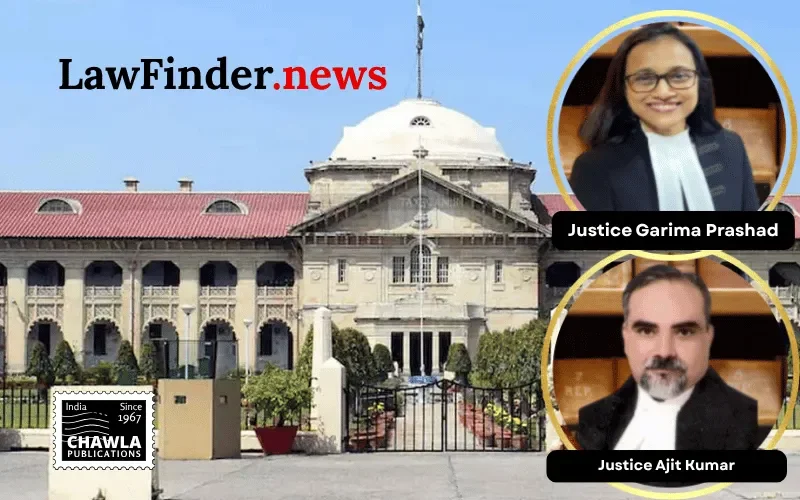
In a landmark judgment delivered on October 14, 2026, a Division Bench of the Allahabad High Court, comprising Justices Ajit Kumar and Garima Prashad, emphatically ruled that Panchayat elections in Uttar Pradesh must be conducted within a constitutionally mandated timeframe, dismissing attempts by the State Election Commission and the State Government to indefinitely defer elections pending the outcome of an empirical inquiry concerning Other Backward Classes (OBC) reservations.
The case arose from a series of writ petitions and Public Interest Litigations filed by various petitioners including Dashrath Yadav, Ayush Pandey, and others, challenging the State's postponement of Panchayat elections beyond the expiry of the existing five-year term which ended in May 2026. The State had delayed elections citing the need to await the findings of a Dedicated Commission constituted in May 2026 to conduct a rigorous empirical inquiry into socio-economic and political backwardness within OBC categories, aiming to restructure the current 27% OBC reservation in Panchayat bodies.
The Court meticulously analyzed the constitutional provisions under Article 243-E of the Indian Constitution, which mandates the completion of Panchayat elections before the expiry of their five-year term or within six months of premature dissolution. It emphasized that neither the State Election Commission nor the State Government has the authority to postpone elections indefinitely based on incomplete reports from a Dedicated Commission.
Drawing extensively from Supreme Court precedents such as Dr. K. Krishna Murthy v. Union of India (2010), Vikas Kishanrao Gawali v. State of Maharashtra (2021), and Suresh Mahajan v. State of Madhya Pradesh (2022), the Court reiterated the "triple test" for OBC reservations in local bodies:
- 1. Constitution of a Dedicated Commission to carry out a rigorous empirical inquiry into political backwardness of OBC groups;
- 2. Specification of reservation proportions local body-wise based on the Commission's recommendations; and
- 3. Ensuring the aggregate reservation for SC/ST/OBC does not exceed the 50% ceiling.
The Court critically assessed the progress and methodology of the Dedicated Commission's inquiry, noting that only about 60% of the survey work had been completed five months after its constitution, with insufficient empirical data and an unclear causal link between socio-economic indicators and political backwardness. Using the district of Agra as an example, the Court highlighted the inadequate public participation and data collection, emphasizing that mere head counts or general opinions do not suffice to justify postponement of elections.
Importantly, the Court held that the existing reservation regime, including the 27% OBC quota, must continue unabated until a lawful restructuring based on a comprehensive empirical inquiry is completed and implemented through appropriate statutory or legislative amendments. The judgment clarified that pending inquiry cannot suspend the constitutional mandate to hold timely elections, and any delay beyond the term expiry would violate Article 243-E.
Regarding the State Government's appointment of outgoing Pradhans as Administrators under Section 12(3-A) of the U.P. Panchayat Raj Act, 1947, the Court upheld the validity of such appointments as a temporary administrative arrangement where elections are delayed. It rejected challenges to the vires of Sections 12(3-A) and 12-BB(3), holding these provisions intra vires Article 243-E. However, the Court cautioned that the tenure of such Administrators cannot be extended beyond statutory limits and any misuse of power by such appointees could be addressed on a case-by-case basis.
The Court issued clear directions to the State Election Commission and the State Government to immediately proceed with the necessary preparatory steps and complete Panchayat elections within three months from the judgment date, applying the existing reservation scheme without treating OBC-reserved seats as open seats due to pending reports. The State was further directed to provide all logistical and administrative assistance to facilitate smooth conduct of elections.
Simultaneously, the Dedicated Commission was permitted to continue its inquiry and submit its final report within the prescribed timeframe, after which the State would be required to undertake statutory actions, including amendments if needed, to implement any restructured reservation scheme.
This judgment reinforces the primacy of constitutional mandates over administrative delays and clarifies the procedural framework for OBC reservations in local self-government, balancing the need for empirical data with timely democratic processes.
Bottom Line:
Panchayat Elections - Holding of Panchayat elections within constitutional time frame mandatory - State Election Commission and State Government cannot defer elections indefinitely on the ground of pending empirical data or report by Dedicated Commission concerning OBC reservations - Existing reservation regime, including 27% OBC reservation, to continue until restructuring based on empirical data is complete - Appointment of outgoing Pradhans as Administrators under Section 12(3-A) of U.P. Panchayat Raj Act, 1947 is valid, Sections 12(3-A) and 12-BB(3) of U.P. Panchayat Raj Act, 1947 not ultra vires Article 243-E of Constitution - Empirical data collection for OBC reservation restructuring is necessary but cannot delay constitutional mandate of elections - Triple test for OBC reservation involves (i) constituting dedicated Commission, (ii) empirical inquiry local body-wise, (iii) reservation ceiling of 50% including SC/ST/OBC combined.
Statutory provision(s):
Article 243-E of the Constitution of India, Sections 12(3), 12(3-A), and 12-BB(3) of the U.P. Panchayat Raj Act, 1947; U.P. Panchayat (Determination and Publication of Number of Persons belonging to the Backward Classes) Rules, 1994
Dashrath Yadav v. State of Uttar Pradesh, (Allahabad)(DB) : Law Finder Doc Id # 2997435