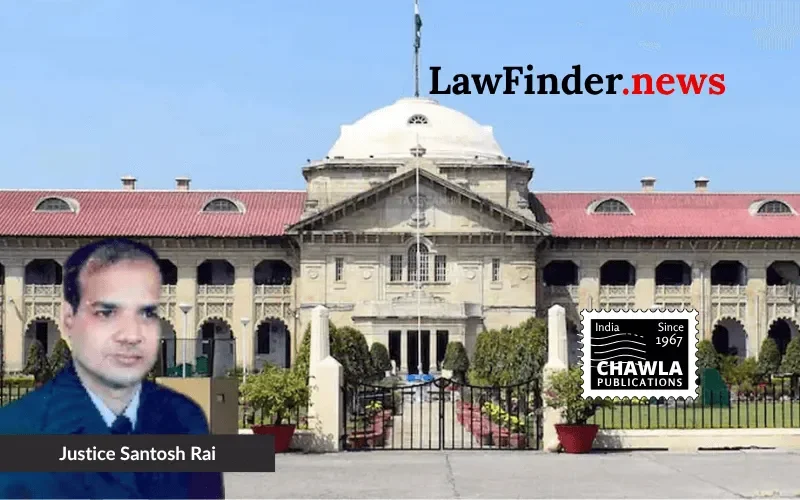
Court Emphasizes Mandatory Judicial Scrutiny Under Sections 173(4), 175(3), and 175(4) of Bharatiya Nagarik Suraksha Sanhita, 2023, in Complaints Against Public Servants
In a significant judgment delivered on October 13, 2026, the Allahabad High Court, presided over by Justice Santosh Rai, quashed an order directing the registration of an FIR against Sub-Inspector Sandhya Jaisawal and other police personnel. The case arose from allegations made by Sushila Devi, accusing the police officers of illegal detention and caste-related abuse during an incident on July 22, 2026, at Police Station Cholapur, Varanasi.
The High Court scrutinized the impugned order passed by the Special Judge (SC/ST Act), Varanasi, which had directed the Station House Officer to register an FIR and conduct an independent investigation under Section 173(4) of the Bharatiya Nagarik Suraksha Sanhita, 2023 (BNSS). The court found that the order was passed mechanically, without adhering to the mandatory statutory safeguards contained in Sections 175(3) and 175(4) BNSS, which govern investigation protocols involving complaints against public servants.
The petitioner's son, Rohit Kumar Gautam, was an accused in a contemporaneous criminal case, with the appellant herself acting as the investigating officer. The police record, including a supurdginama (custody release document), indicated that Rohit Kumar was handed over to his mother on the same day, contradicting the allegation of illegal detention exceeding 24 hours. Despite the availability of this material, the Special Judge failed to examine the police report, the official status of the accused, and the necessity of inquiry under the relevant BNSS provisions.
Justice Rai emphasized that under Section 175(3) BNSS, before ordering an investigation, the Magistrate is required to consider the application supported by an affidavit, conduct such inquiry as deemed necessary, and consider submissions from the police officer. More importantly, Section 175(4) BNSS mandates that in complaints against public servants arising in the course of official duties, the Magistrate must obtain and consider a report from the superior officer and the assertions of the public servant concerned.
Highlighting the legislative intent, the Court noted that these provisions are substantive safeguards designed to prevent frivolous or vexatious litigation and protect public servants acting in good faith from undue harassment. The judgment referred extensively to recent Supreme Court precedents, including Om Prakash Ambadkar v. State of Maharashtra (2026) and XXX v. State of Kerala (2026), which clarified the procedural rigor required under BNSS in such matters.
The Court found that the Special Judge's order was non-speaking, lacking reasoned findings on the compliance with Sections 175(3) and (4) BNSS. It did not reflect any judicial application of mind regarding the necessity of inquiry or the police officer's submissions. Consequently, the order was quashed for being legally unsustainable.
This ruling underscores the judiciary's commitment to balancing the right to seek justice with the need to prevent misuse of criminal procedure against public servants. It reinforces that applications for FIR registration under BNSS must undergo careful judicial scrutiny, especially where allegations involve acts committed in official capacity.
The Allahabad High Court's order mandates that courts must not mechanically direct FIR registration under Section 173(4) BNSS without compliance with procedural safeguards and thorough examination of contemporaneous records and police reports. This precedent will guide magistrates and special courts in handling complaints against police and other public servants, ensuring fairness and adherence to statutory mandates.
Bottom Line:
Bharatiya Nagarik Suraksha Sanhita, 2023 - Application styled under Section 173(4) BNSS for direction to register FIR against police/public servants cannot be allowed mechanically - Magistrate/Special Court must examine requirements of Section 175(3) BNSS and, where allegations arise in course of official duty of public servant, must also comply with safeguards under Section 175(4) BNSS by considering superior officer's report and assertions of public servant - Non-speaking order directing FIR without such compliance is unsustainable.
Statutory provision(s):
Bharatiya Nagarik Suraksha Sanhita, 2023 Sections 173(4), 175(3), 175(4); Bharatiya Nyaya Sanhita, 2023 Sections 115(2), 69, 351(3) (referenced in case crime); SC/ST (Scheduled Castes and Scheduled Tribes) Act provisions (implicit in context)
Sandhya Jaisawal v. State of U.P., (All) : Law Finder Doc Id # 2996193