Court Rules Contractual Fee Disputes Must Be Resolved in Civil Courts, Not Under Writ Jurisdiction
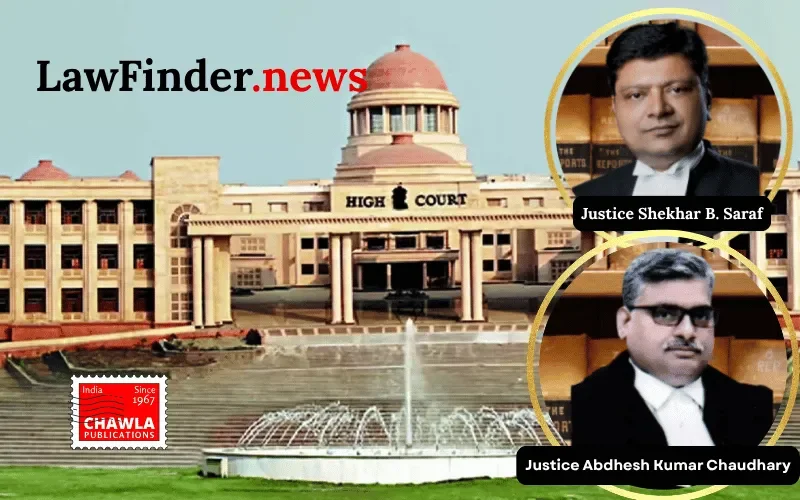
The Allahabad High Court, in a significant ruling, dismissed four writ petitions filed by Advocate Jyotinjay Verma, seeking the recovery of professional fees from the State of Uttar Pradesh. The Division Bench, comprising Justices Shekhar B. Saraf and Abdhesh Kumar Chaudhary, emphasized that such disputes arising from contractual engagements necessitate adjudication in civil courts rather than under writ jurisdiction.
Advocate Verma, who represented himself, filed writ petitions demanding the payment of overdue fees totaling approximately Rs. 4.8 crore for his services as a Special Counsel in four districts: Sitapur, Lucknow, Hardoi, and Raebareli. He claimed these payments were due for his representation in special appeals on behalf of the Basic Education Department, Uttar Pradesh, as per government orders issued in 2009 and 2011.
The court, however, expressed its disapproval of the State's failure to compensate its legal representatives, stating that such matters should ideally be resolved through mediation or conciliation. Nonetheless, it underscored that the resolution of disputed monetary claims, especially those involving complex factual disputes, falls outside the scope of writ jurisdiction under Article 226 of the Constitution.
The respondents, including the State of Uttar Pradesh, contested the maintainability of the writ petitions, arguing that the dispute over fee payment should be addressed in civil courts. They highlighted discrepancies regarding Verma's engagement period and the lack of acknowledgment of the fee amounts claimed by him.
Citing precedents, the court reiterated that Article 142 of the Constitution, which grants extraordinary powers to the Supreme Court, does not set a binding precedent applicable to High Courts. It further stated that the judgment relied upon by Verma, passed under Article 142, was distinguishable on facts and not pertinent to the present case.
Recognizing the contractual nature of the advocate-client relationship, the court noted that unresolved factual issues and the absence of admitted dues by the State rendered the writ petitions untenable. The bench advised Verma to pursue his claims through a competent civil court, where evidence can be presented, and the matter can be thoroughly adjudicated.
While dismissing the petitions, the court granted Verma the liberty to file a civil suit, ensuring the applicability of Section 14 of the Limitation Act to protect his claims from being time-barred.
Bottom Line :
Writ petitions for recovery of professional fees by an Advocate against the State are not maintainable under Article 226 of the Constitution. Disputed monetary claims arising from contractual engagements require adjudication in civil courts.
Statutory provision(s): Article 226 of the Constitution of India, Article 142 of the Constitution of India, Section 14 of the Limitation Act.
Jyotinjay Verma v. State of U.P., (Allahabad)(DB)(Lucknow) : Law Finder Doc id # 2961205